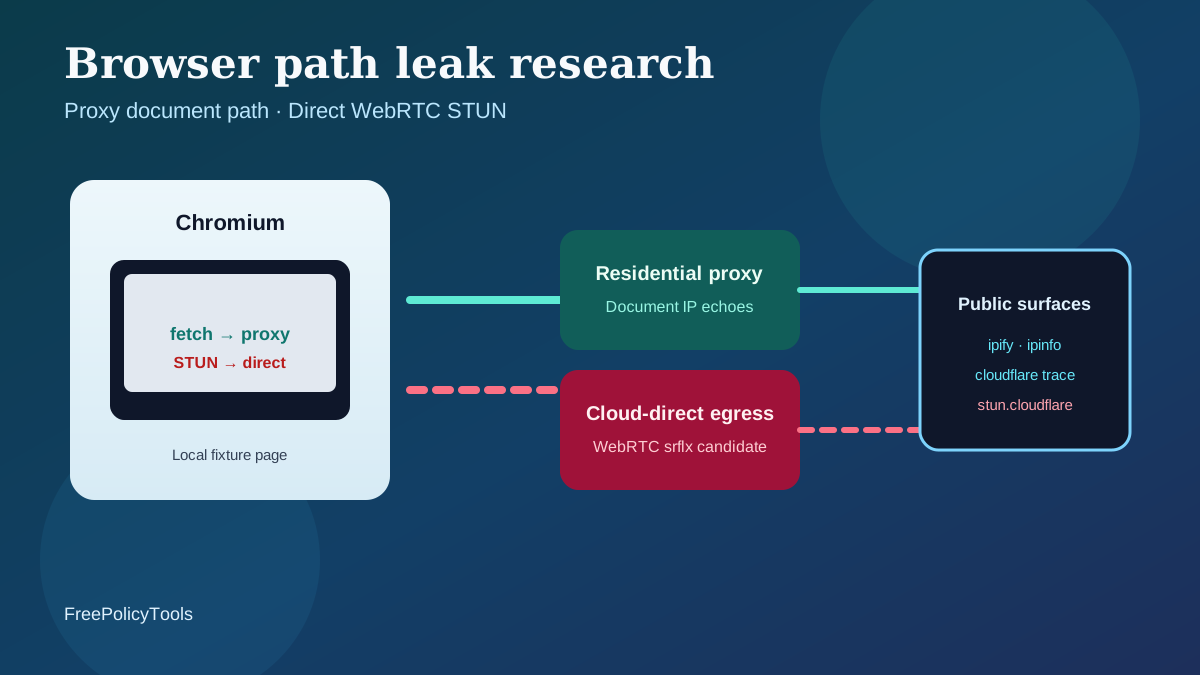
A browser can send its page fetches through a residential proxy while WebRTC STUN still advertises a different public address. On a Cursor-hosted USA cloud VM, we configured Playwright Chromium with ProxySeller residential HTTP and SOCKS paths and compared those runs with the same machine’s cloud-direct egress.
Across seven controlled visits (cloud-direct twice, HTTP proxy twice, SOCKS proxy twice, and one dead-proxy check), document IP echoes followed the proxy when it was engaged, while server-reflexive WebRTC candidates never matched the proxy document echo. In multiple proxy runs, the STUN-reflexive address instead matched the cloud-direct address set. When the HTTP proxy port was intentionally dead, all four document echoes failed with ECONNREFUSED 127.0.0.1:9, but WebRTC still produced a reflexive candidate on the cloud path. Every visit ended ICE gathering in timeout while still returning host + srflx. No IPv6 addresses appeared in this package.
These are browser-path findings on one VM, one Chromium build, and one residential package. They are not proof of provider logging, deception, or a product-wide defect. CometVPN was not measured as a tunnel on this host; affiliate mentions are product context only.
Download: article · protocol · summary · hash relations · REPRODUCE.
For background, read our HTTP versus SOCKS proxy guide, WebRTC and IPv6 leak guide, VPN versus proxy comparison, and the earlier proxy routing research on application environment variables (a different layer from this browser study).
One Cursor USA VM · Playwright Chromium Chromium 131.0.6778.33 · ProxySeller residential HTTP/SOCKS · no CometVPN tunnel claim
Why this study exists
Earlier FreePolicyTools work measured VPN-website warning pages, tracker payloads inside a working Proton CLI tunnel, HTTP-client environment-variable routing, and paid-proxy CONNECT authentication boundaries. Those studies answer whether an application honors a proxy setting, or whether a VPN product page warns about protection gaps.
This study asks a different operational question: if Chromium is told to use a residential proxy, do the surfaces a website can see—document fetches and WebRTC ICE—agree on one public identity, or does any observed path still match the machine’s direct egress?
The cloud amendment freezes that question onto Cursor-hosted USA VMs. Kenya ISP wireless, Proton Desktop/CLI, NetworkManager WireGuard profiles, and stacked VPN-plus-proxy conditions from the October draft are out of scope. CometVPN is VPN-only: it must not be used as HTTP/SOCKS, and we do not claim tunnel results without a proven VPN path on the host.
Collection chronology
Presence-only Runtime Secret probes at ~17:22 UTC confirmed all five PROXYSELLER_* names (values never logged). Cloud-direct baselines ran at ~14:59 UTC with the full fixture. Before the A1 matrix, an early collector revision forced loopback through the residential gateway (<-loopback>) and recorded a 90 s fixture timeout with 503 Target host denied (http-fixture-debug.json). A Playwright HTTP smoke then succeeded (~3.1 s, hash d916dfcb511f)—a different residential exit than the later matrix hash 8453b223a010.
Independent urllib HTTP CONNECT succeeded; Python requests/SOCKS helpers were missing on the host (exclusions, not browser findings). Env discovery at ~17:40 listed 50 keys and five matching secret names; HTTP and SOCKS upstream ports were equal (10000) on this package. Native SOCKS5+auth failed at context creation. The A1 matrix then ran 17:48:26–17:49:43 UTC: HTTP p1 → SOCKS p1 → HTTP p2 → SOCKS p2 → dead p1.
What we measured
Platform: Cursor Cloud Agent VM with USA datacenter egress (ipinfo labeled AS14618 Amazon.com, Inc. / US on cloud-direct baselines). Collector: Playwright Chromium 131.0.6778.33, locale en-US, timezone UTC, viewport 1360×900, fresh isolated context per visit.
Document IP echoes: api.ipify.org, api64.ipify.org, ipinfo.io/json, cloudflare.com/cdn-cgi/trace. WebRTC ICE used stun:stun.cloudflare.com:3478 only (no TURN; zero relay candidates observed). ICE gather window: 8 seconds. Independent Python urllib route checks ran before and after each visit.
Credentials came from Cursor Runtime Secrets (PROXYSELLER_HOST, PROXYSELLER_HTTP_PORT, PROXYSELLER_SOCKS_PORT, PROXYSELLER_USER, PROXYSELLER_PASS). Values were never committed. Chromium rejects SOCKS5 username/password natively; SOCKS visits used a local anonymizing forwarder. Document echoes under proxy used Playwright’s API request context after in-page fetch() through this residential path proved unreliable for collector timeouts. Proxy WebRTC used a local webrtc-only fixture with loopback bypass 127.0.0.1,localhost,<loopback>—not <-loopback>.
Two public comparison artifacts must not be conflated: sha-relations.json (session union of cloud-direct hashes; article “in cloud-direct set” column) and cross-compare.json (pass-oriented baseline flags). SOCKS p2 is in the session union because dff3fc69aff9 appeared as a cloud-direct p2 document echo, while narrower cross-compare baseline flags for that row stay false.
All seven visits
| Visit | UTC start | Document echoes | Country / org | ICE | srflx vs proxy echo | srflx in cloud-direct set |
|---|---|---|---|---|---|---|
| cloud-direct p1 | 14:59:26 | 4/4 | US / AS14618 Amazon | timeout · host+srflx | own-echo: no | baseline |
| cloud-direct p2 | 14:59:39 | 4/4 | US / AS14618 Amazon | timeout · host+srflx | own-echo: no | baseline |
| proxy-us-http p1 | 17:48:26 | 4/4 | BR / AS28142 | timeout · host+srflx | no match | yes · 7533c8958c39 |
| proxy-us-socks p1 | 17:48:42 | 4/4 | BR / AS28142 | timeout · host+srflx | no match | no · 81fae7bcfd17 |
| proxy-us-http p2 | 17:49:00 | 4/4 | BR / AS28142 | timeout · host+srflx | no match | no · e08b95f750df |
| proxy-us-socks p2 | 17:49:17 | 4/4 | BR / AS28142 | timeout · host+srflx | no match | yes · dff3fc69aff9 |
| proxy-dead p1 | 17:49:35 | 0/4 · ECONNREFUSED | n/a | timeout · host+srflx | n/a | yes · f53c21c2a17e |
Document-path outcomes in the selected matrix
Counts from this seven-visit package — not a population leak rate.
- 4 Proxy HTTP document path (50% of chart total)
- 4 Proxy SOCKS document path (50% of chart total)
- 0 srflx matched proxy echo (0% of chart total)
- 0 Dead-proxy document successes (0% of chart total)
WebRTC candidates gathered by condition
Host vs srflx counts across passes (dead proxy has one pass).
srflx vs cloud-direct session union
Per proxy/dead visit from sha-relations.json — not a population rate.
Document echo latency by visit (ms)
Illustrative collector timings — not ProxySeller SLAs. Dead visit shows refuse ms.
Finding 1: HTTP and SOCKS document fetches left the cloud path
Under both ProxySeller HTTP and SOCKS conditions, all four document echoes succeeded in both passes. ipinfo labeled those exits BR / AS28142 DIGITAL DESIGN SERVIÇOS DE TELECOMUNICAÇÕES EIRELI. Cloud-direct remained US / Amazon. Cloudflare trace also returned country BR under both proxy modes.
Every successful proxy echo shared hash prefix 8453b223a010, outside the cloud-direct address set. The browser’s configured proxy path was engaged for these HTTPS document fetches. A tester who only looked at ipify/ipinfo would conclude the proxy “worked.” Proxy document echoes completed in roughly 1.5–2.6 s per URL via APIRequestContext (illustrative, not SLAs).
This study used a purchased residential package for researcher-operated fixtures. It is not an uptime or speed benchmark of ProxySeller. For application-level proxy tooling context, see our ProxySeller review.
Finding 2: WebRTC reflexive candidates never followed the proxy echo
In every proxy visit with successful document echoes (four visits), the WebRTC server-reflexive candidate did not match the proxy document-echo address. Both HTTP and SOCKS produced host + srflx only. Host candidates were local/other. No relay candidates appeared.
Practical risk: a site or “am I protected?” widget that only inspects fetch-visible echoes can report the proxy exit while STUN still learns another address. That is the core split-path result.
Baseline caveat: even the two cloud-direct visits recorded matchesDocumentEcho: false for srflx. Cloud-direct p1’s srflx hash f53c21c2a17e later appeared as a cloud-direct p2 document echo; p2’s srflx 8036bb026004 matched a prior p1 document echo. Datacenter multi-homing already disagrees across surfaces; proxy findings are stronger because document echoes left the cloud path entirely while STUN did not follow them.
Finding 3: Some STUN candidates matched the cloud-direct set
Against the cloud-direct session union (size 5): proxy-us-http p1 srflx 7533c8958c39 matched; proxy-us-socks p2 srflx dff3fc69aff9 matched; proxy-dead srflx f53c21c2a17e matched. HTTP p2 (e08b95f750df) and SOCKS p1 (81fae7bcfd17) fell outside the recorded union—but still mismatched the proxy document echo 8453b223a010.
Bounded claim: on this VM, WebRTC STUN was not confined to the proxy document-echo identity. Cloud NAT rotation means the cloud-direct comparison set is a session union, not a single immortal IP. We report visits individually instead of inventing a leak percentage.
Finding 4: A dead HTTP proxy failed closed for documents, not for WebRTC
With Chromium pointed at http://127.0.0.1:9, all four document echoes failed (documentEchoOk: 0) with connect ECONNREFUSED 127.0.0.1:9 in 1–11 ms. WebRTC still gathered host + srflx under iceState: timeout, and the srflx hash matched the cloud-direct set.
That is fail-closed behavior for the HTTPS document path and fail-open behavior for STUN/UDP relative to the dead HTTP CONNECT proxy. Anyone validating kill-switch style expectations for a browser HTTP proxy must re-check ICE candidates, not only page loads.
Fixture screenshots from all seven visits
Local leak / WebRTC fixture UI only — no raw IP text retained in public shots.







Finding 5: Chromium rejected authenticated SOCKS5 at context creation
A native Playwright context with SOCKS5 plus username/password threw Browser does not support socks5 proxy authentication before any navigation. That guard is recorded in the public package. SOCKS measurements used a local anonymizer so Chromium spoke to a local HTTP proxy without credentials while upstream traffic still used the residential SOCKS endpoint.
This is a hard error at context creation—not a silent direct fallback. Automation that needs authenticated SOCKS on Chromium requires a bridge or a different browser stack.
Finding 6: ICE always timed out; IPv6 never appeared
All seven visits ended with webrtcIceState: "timeout" and webrtcError: null, yet each still returned exactly one host and one srflx candidate inside the 8-second gather window. Incomplete gathering is the normal outcome in this package, not an empty candidate set.
Every successful document echo and every WebRTC candidate used IPv4. api64.ipify.org did not yield IPv6 here. We make no IPv6 leak claim for this VM; absence of IPv6 is an observation about this egress and STUN path, not a general network property.
Methods detail worth reproducing
- Freeze conditions in
protocol.mdbefore collection. - Discover Runtime Secret names with presence-only probes; refuse proxy conditions if required names are absent.
- Build private
proxies.jsonfrom environment variables (gitignored). - Record the Chromium SOCKS auth guard before bridging.
- Avoid
<-loopback>unless you intend to force local fixture traffic through the upstream proxy. - For each visit: route-check → Playwright collect → route-check.
- Under proxy: document echoes via
APIRequestContext; WebRTC via localwebrtc-onlyfixture. - Redact public JSON to aliases / SHA-12 prefixes; keep country/org/typ/classify.
- Publish both session-union and pass-baseline comparison artifacts; cite which one you used.
- Keep probe/smoke hashes separate from matrix hashes (residential rotation).
Collector sources live under research/browser-path-leak-study/. Step-by-step notes: REPRODUCE.md.
What this means in practice
- Confirm more than one surface. A green IP-echo widget is not a WebRTC test.
- Treat STUN/UDP as a separate path from HTTP(S) proxy CONNECT.
- Fail-closed checks must include ICE. Killing the HTTP proxy stopped document echoes here; it did not stop srflx.
- SOCKS automation on Chromium may need a local forwarder when the upstream requires username/password.
- Expect ICE timeouts with partial candidates; do not require ICE “success” as the only success criterion.
- A full-tunnel VPN can cover UDP where a browser HTTP proxy cannot. We did not prove a CometVPN tunnel on this hosted VM. See our CometVPN review. Do not use CometVPN as HTTP/SOCKS credentials.
Related reading: proxy encryption research, consumer portal access research, VPN website protection warnings.
Limits and non-claims
- One Cursor USA VM, one Chromium build, one residential package/account.
- USA cloud datacenter egress is not a matched residential control for residential proxy exits.
- Kenya/Proton/NetworkManager conditions were intentionally removed.
- CometVPN tunnel behaviour was not measured.
- We do not claim provider logging, marketing deception, malware, or named-person identification.
- We do not publish a population leak rate or competitive ProxySeller uptime ranking.
- Cloud NAT rotation means the cloud-direct address set is a session union; within-visit document≠srflx already occurs on baseline.
- Document echoes under proxy used Playwright request context; in-page fetch reliability through this residential path was separated from WebRTC collection for proxy visits.
- Alternate client probes (
requests, SOCKS helpers) were unavailable on the host—exclusions, not browser leaks. - Residential exit hashes rotated between smoke/probe and A1 matrix visits.
- ICE timeout with candidates present is incomplete gathering, not proof that additional candidate types would never appear with a longer window or TURN.
- No IPv6 was observed; that is not an IPv6-protection claim.
Evidence, exclusions, and disclosure
Public package under /research/browser-path-leak-study/: per-visit redacted JSON; summary, hash-relation, and cross-compare tables; Chromium SOCKS auth guard; env discovery names; presence-only secret probes; fixture-debug / smoke / connectivity probes; protocol; REPRODUCE; fixture screenshots for all seven visits; and the markdown article. Private (gitignored): raw IPs, credentials, full route dumps.
FreePolicyTools is a ProxySeller affiliate and a CometVPN affiliate. Affiliate links are disclosed and separate from the measured matrix. ProxySeller residential capacity used here was purchased for FreePolicyTools cloud research. CometVPN is VPN-only context with no tunnel measurement in this package.
Download the evidence
Redacted per-visit JSON, protocol, comparison tables, presence-only secret probes, collector reliability artifacts, SOCKS auth guard, all seven fixture screenshots, REPRODUCE notes and the markdown article. Raw IPs and credentials remain private.
Frequently Asked Questions
Sources & Research Notes
Affiliate disclosure: This article contains ProxySeller and CometVPN affiliate links (/proxyseller/, /cometvpn/). FreePolicyTools may earn a commission if you purchase through them. These offers are separate from the research findings and do not constitute a comparative product test or change the study’s methods, results or limitations. CometVPN was not measured as a tunnel on this VM.