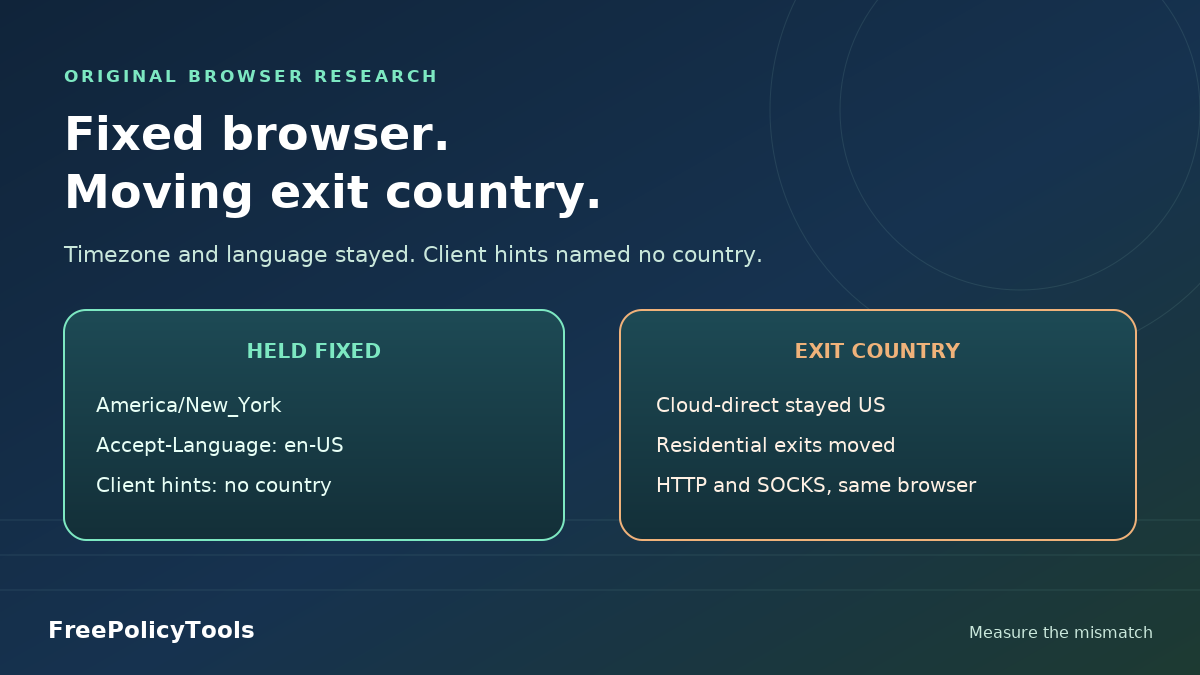
A residential proxy can move the country a website reads from the connection. It did not move the country this browser was willing to admit. We held one Playwright Chromium profile at en-US and America/New_York and asked, twice a day, how often timezone, Accept-Language, and client hints disagreed with the exit country of cloud-direct versus ProxySeller residential HTTP and SOCKS.
On the probes that entered the primary rates, timezone and language disagreed with the residential exit on 29 of 29 and with the cloud-direct exit on 0 of 18. Client hints never named a country. The hint bundle matched the first cloud-direct probe on all 47 included probes. High-entropy hints came from the JavaScript API. They were not on the wire, and we did not forge them.
Chromium 131.0.6778.33, headless, locale en-US, timezone America/New_York, viewport 1360×900. Six included residential probes were Japan, six Spain, six the United Kingdom, six Brazil, and five India. Six other residential probes were dropped because Cloudflare and ipwho.is named different countries. One SOCKS probe never connected.
What we measured
The frozen protocol is protocol.md, locked at 2026-11-19T14:44:00Z before the first probe. Each probe opened a fresh context, loaded Cloudflare’s trace and ipwho.is once each, and read timezone, language, and navigator.userAgentData in the page. Wire headers came from Playwright’s request event. We did not add client-hint headers of our own.
This is not the WebRTC path-leak study and not the canvas and WebGL fingerprint study. Those snapshots showed a proxy can move a document address while other browser surfaces stay put, and that WebRTC can ignore the proxy. We cite them so this page does not pretend to repeat them. No peer connection was opened here. No canvas was hashed.
The practical cousins of these signals are the header sniffer, the IP geolocation tool, and the essay on why changing an IP does not change a browser fingerprint. They are context. They are not this dataset.
Disagreement with exit country
Primary denominator only. Cloud-direct is 18 probes. Residential is 29 included probes. Client hints confirm the exit on none of the 47.
Included probes by agreed exit country
18
6
6
6
6
5
Where the 54 probes went
Finding 1: cloud-direct agreed with the fixed browser
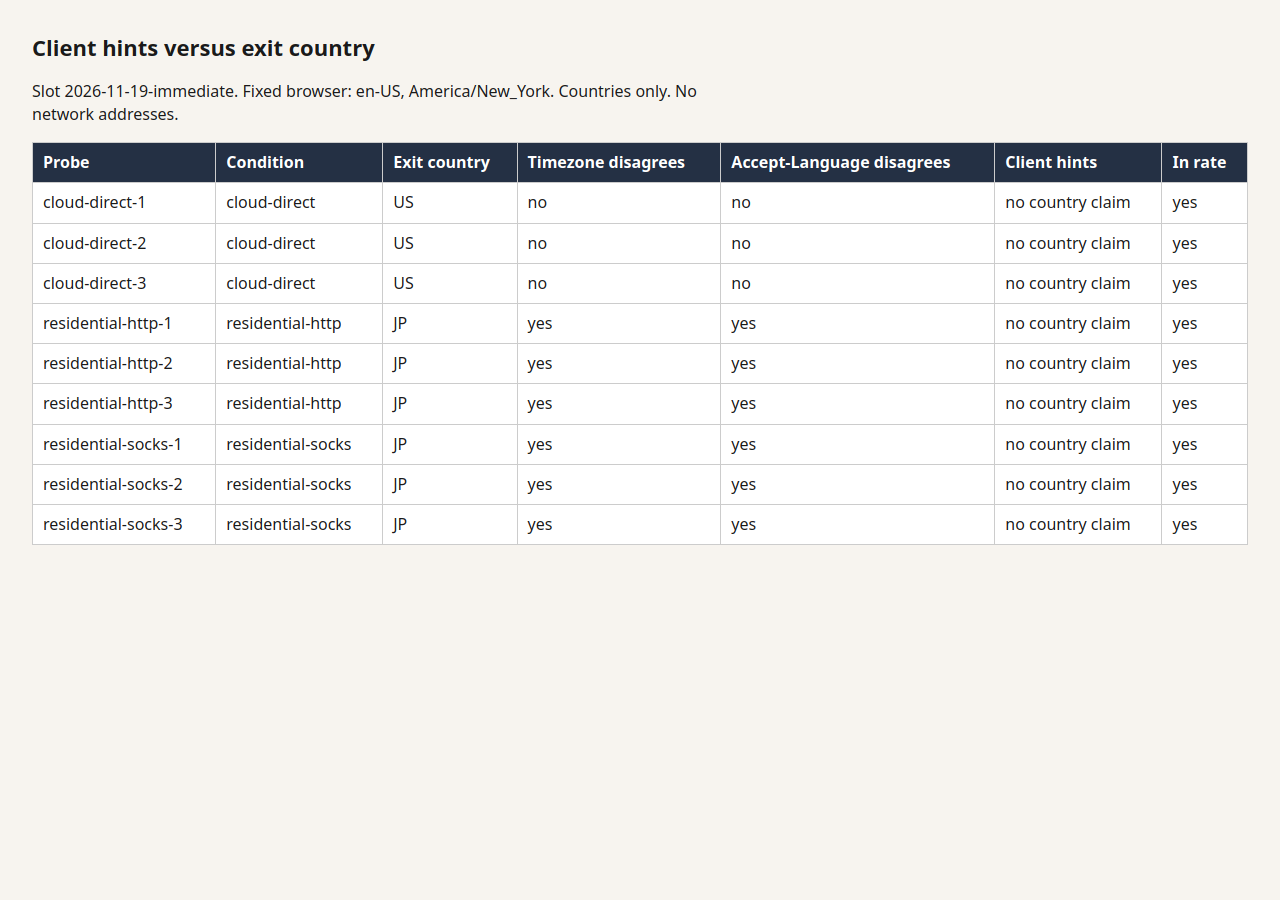
All 18 cloud-direct probes are in the primary denominator. Cloudflare said US and colo IAD every time. ipwho.is agreed, country US, timezone America/New_York. The browser zone was the same string. Accept-Language was en-US. Timezone and language disagreements are 0/18. The zone-string secondary rate is also 0/18, because the IP-geo zone happened to be New York, not Chicago or Los Angeles.
That control matters. A fixed US profile matching a US exit is the boring case, and it held on every slot, including the late one. The mismatch shows up when the exit leaves the United States. Client hints still did not confirm “US” on these 18 probes, because they have no country field. The bundle still matched the reference 18/18.
Finding 2: included residential exits disagreed every time
Twenty-nine residential probes had an agreed exit country. Japan, Spain, the United Kingdom, and Brazil contributed six each. India contributed five, because one SOCKS probe in that slot failed. On all 29, the browser still said America/New_York and en-US. Timezone disagreed 29/29. Language disagreed 29/29. The ipwho zone string also differed 29/29: Tokyo, Madrid, London, São Paulo, and Kolkata against New York.
HTTP and SOCKS agreed with each other inside every slot whose sources agreed. The same minute did not predict the next slot. The agreed residential countries, in order, were JP, then ES, then GB, then BR, then India on the late slot. We did not store raw addresses, so a repeated country inside a 30-second slot is not proof of three distinct exits, and it is not a stickiness result. The sticky-IP study owns that question. What repeated here is the country the two geo sources were willing to publish.
Finding 3: client hints named no country, and they did not change
The UA client hints draft describes the user agent. It does not define a country hint. Our scorer freezes that as a null country claim. “Client hints disagree with the exit country” therefore means they were observed and they did not confirm the exit. That rate is 47/47 on included probes. It is not a claim that a hint spelled out a different country.
On the wire, every probe, including the failed one, sent only the low-entropy set: sec-ch-ua naming HeadlessChrome 131, Chromium 131, and the grease brand Not_A Brand; sec-ch-ua-mobile: ?0; sec-ch-ua-platform: "Linux". No architecture, bitness, full version, model, platform version, wow64, or form-factor header was present. highEntropyOnWire is false on all 54 probes. Chrome’s own client-hints note says high-entropy values wait until a site asks. These echoes do not send Accept-CH, and we did not inject the headers.
The JavaScript API, on every successful probe, filled in the rest: architecture x86, bitness 64, model empty, platform Linux, platformVersion 6.12.113, formFactors Desktop, wow64 false. The platform version is the host kernel, not the exit. "Linux" did not become Japan when the exit country was JP. Cloudflare and ipwho saw the same low-entropy map whenever both requests were captured. Origin mismatch count: 0.
The canonical bundle hash on all 53 successful probes is the Day 0 reference, 29f2e0911b7a62803a09abe2a0d1a9ab563b7295279c0f99f0727d8c04762635. Included probes match it 47/47. The failed probe hashes differently because the JavaScript values were unread. Its three wire headers were still the same. HeadlessChrome in the brand list is an automation tell. It is a limit on how far this profile resembles desktop Chrome. It is still not a country.
Finding 4: one morning, the two geo sources split
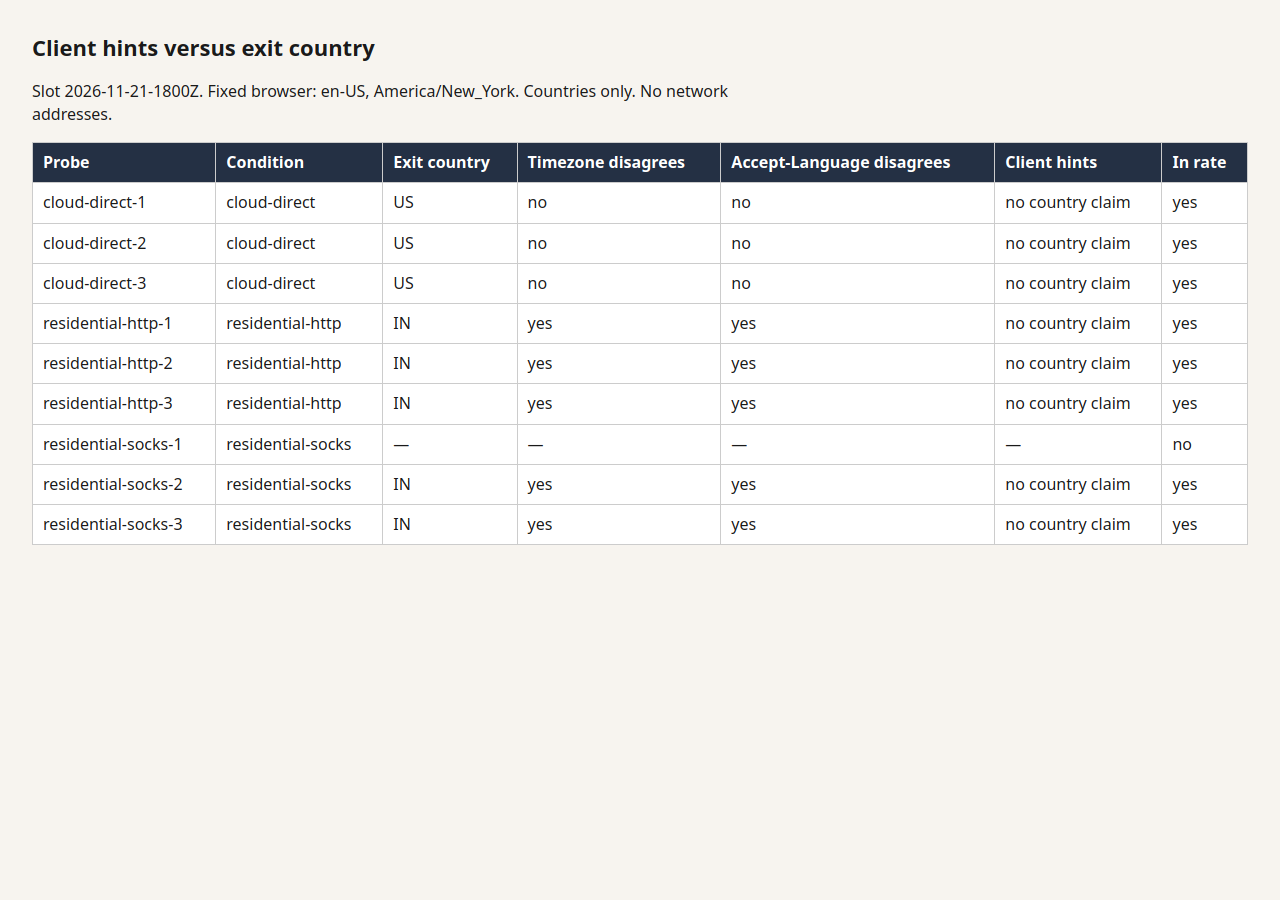
On 21 November at 06:00 the browser was still fixed and the hint bundle still matched. The exit sources were not. All six residential probes were ok. Cloudflare said RU. ipwho.is said DE, zone Europe/Berlin. Five of the Cloudflare colos were WAW. One SOCKS probe was DME. The protocol’s rule is to drop a conflict rather than pick a winner. Those six probes are not inside the 29/29.
Both labels are outside the US. Someone who trusted either source alone would still see a mismatch with New York and en-US. We do not promote that sentence into the primary rate. Two sources that disagree are the reason the exclusion exists. Cloud-direct in the same slot was US, IAD, and America/New_York on all three probes, sources matched.
Finding 5: one SOCKS probe never got a country
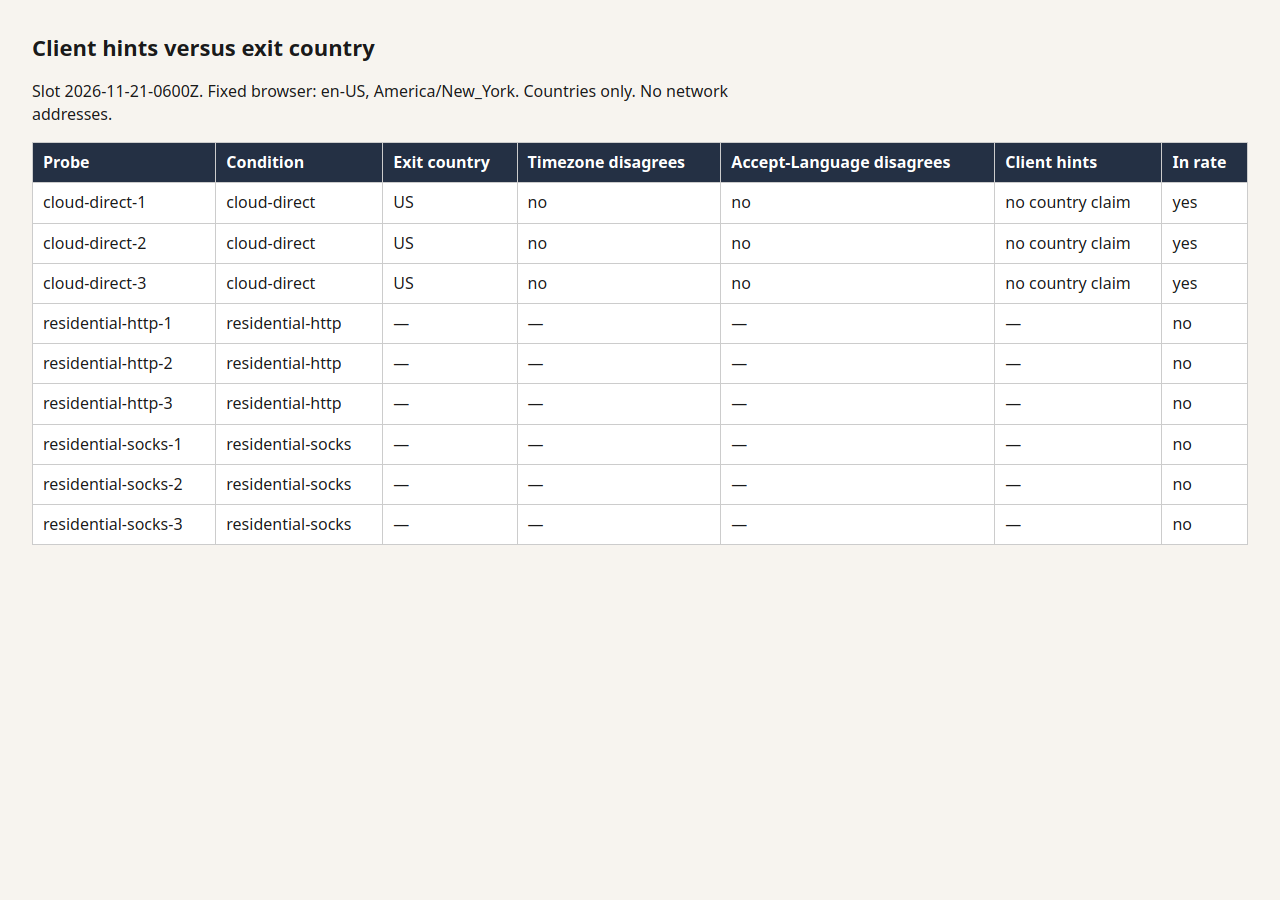
The last slot was collected late, on 24 November at 11:52 UTC, after the 21 November 18:00 window had closed. The frozen protocol said a missed window would not be backfilled. This slot is a disclosed exception so the Day 3 cell would exist. Its timestamp in design.json is 2026-11-24T11:52:09Z, not 18:00 on the 21st.
Cloud-direct was US again, 3/3. Residential HTTP was India, colo DEL, ipwho zone Asia/Kolkata, 3/3, sources matched. SOCKS probe 1 failed with ERR_TUNNEL_CONNECTION_FAILED on both endpoints. Timezone and navigator.language were unread, so the probe is not ok. The next two SOCKS probes succeeded and matched India. We did not retry. One failed attempt is a missing observation, not a country and not an uptime score.
Dropping the late slot leaves the on-window result in the same direction: cloud-direct timezone and language disagreements 0/15, included residential disagreements 24/24, plus the six conflicts already excluded.
Every slot
| Slot | Ran (UTC) | Cloud-direct | HTTP | SOCKS | Residential mismatches | Window |
|---|---|---|---|---|---|---|
| 19 Nov, first slot | 14:45Z | US · IAD | JP · KIX | JP · KIX | 6/6 | In window |
| 19 Nov, 18:00 | 18:02Z | US · IAD | ES · MAD | ES · MAD | 6/6 | In window |
| 20 Nov, 06:00 | 06:00Z | US · IAD | GB · LHR | GB · LHR | 6/6 | In window |
| 20 Nov, 18:00 | 18:00Z | US · IAD | BR · GRU | BR · GRU | 6/6 | In window |
| 21 Nov, 06:00 | 06:00Z | US · IAD | Conflict RU/DE | Conflict RU/DE | Excluded | In window |
| 21 Nov slot, run 24 Nov | 11:52Z | US · IAD | IN · DEL | IN · DEL, 2/3 | 5/5 | Collected late |
Mismatch counts use included probes only. The 21 November 06:00 residential rows are the conflict, so they are not a mismatch rate.
What a site can already see
A site that trusts the exit address will say Japan, Spain, the United Kingdom, Brazil, or India on those included residential probes. A site that also reads Intl and Accept-Language will see New York and en-US on the same visits. The two accounts disagree. RFC 9110 treats Accept-Language as a language preference, not as proof of presence. An IANA timezone is a zone name. Our scorer used a one-entry map from America/New_York to US, not the full timezone database, so we would not have quietly treated some other zone as American.
Client hints do not break the tie. They describe this Chromium on this Linux VM. A proxy that changes the exit did not rewrite them on this CONNECT path. That is a consistency check. It is not a person, and it is not a reason to treat a proxy as broken because the browser locale stayed where we pinned it.
Methods appendix
| Piece | What was frozen |
|---|---|
| Browser | Playwright Chromium 131.0.6778.33, headless, no UA override |
| Profile | en-US, America/New_York, 1360×900, fresh context, no session suffix |
| Paths | cloud-direct, ProxySeller residential HTTP, ProxySeller SOCKS5 via a local forwarder |
| Secrets | PROXYSELLER_HOST, HTTP_PORT, SOCKS_PORT, USER, PASS. Names only in git |
| Exit | Cloudflare trace loc, cross-checked with ipwho.is country_code |
| Hints | sec-ch-ua* on the request, plus userAgentData high-entropy values in the page |
| Primary denominator | ok, browser still fixed, one agreed exit country |
| Excluded | 6 source conflicts, 1 tunnel failure |
| Not run | CometVPN. No WebRTC. No sticky-session metric |
SOCKS authentication uses proxy-chain because Chromium rejects a SOCKS username and password. The local forwarder is a client constraint. Upstream remains ProxySeller. HTTPS targets use CONNECT, so we do not claim the proxy edited client hints. The headers we score are the ones Chromium attached.
What this study cannot tell you
- It is one headless build, one locale, one zone, one VM, and one residential account. HeadlessChrome is in the brand list on purpose, as a limit.
- Three probes in half a minute can be one exit seen three times. Without raw addresses we do not claim three distinct exits, and we do not claim stickiness.
- Country codes are Cloudflare’s and ipwho.is’s, not a registry we run. When they split, the probe left the rate.
- The last slot is late. The on-window subset is disclosed above and points the same way.
- High-entropy hints were not elicited as HTTP headers. A site that sends
Accept-CHcould see them on the wire. We measured the JavaScript values instead of inventing headers. - No WebRTC result, no CometVPN tunnel, and no ProxySeller uptime or logging claim.
Evidence and disclosure
Redacted files are under the public research folder: the protocol, the reference bundle, rollup.json, each slot’s probes and analysis, summary images, and SHA-256 manifests. The downloadable write-up is research-article.md. Raw addresses are not in those files. The public address scan was clean.
Affiliate disclosure. FreePolicyTools may earn a commission from ProxySeller and CometVPN links. ProxySeller HTTP and SOCKS were the measured proxy paths. CometVPN was not measured. No vendor funded, edited, or pre-approved the protocol, the scorer, or these exclusions.
Frequently asked questions
Does a proxy change the browser timezone?
Not in this study. All 53 successful probes still resolved Intl to America/New_York, the zone we set and never varied. The exit country changed. The timezone did not.
Did Accept-Language follow the residential exit?
No. Playwright’s frozen en-US locale sent Accept-Language: en-US and navigator.language was en-US on every successful probe. On the 29 included residential probes the exit country was not the US, so the language region disagreed every time.
Do client hints contain a country?
The UA client hints we observed do not. Low-entropy headers were Chromium 131, not mobile, and Linux. The JavaScript high-entropy values added architecture, bitness, an empty model, a kernel version, and Desktop. None of those is an exit country. The frozen scorer treats the country claim as none.
Did you test WebRTC or sticky sessions?
No. This study does not open a peer connection or send STUN. It does not add a session-id suffix, and it does not claim that an address stayed put. Path-leak and sticky-IP work live in other studies.
Was CometVPN measured?
No. CometVPN is VPN-only and is marked NOT_RUN. The measured proxy paths are ProxySeller residential HTTP and SOCKS. A tun device on the VM is not a tunnel result.
Why were six residential probes left out of the main rate?
On 21 November at 06:00, Cloudflare named RU and ipwho.is named DE on all six residential probes. The protocol drops a probe when the two exit sources disagree. Those probes are reported as conflicts, not averaged into one country.
Why is one slot timestamped 24 November?
The 21 November 18:00 window was missed. That slot was collected on 24 November so the Day 3 cell would exist. It is included and labeled late. Dropping it does not change the direction of the result.
Can I reproduce the collection?
The public package has the protocol, collector, scorer, redacted probes, analyses, summary images, and SHA-256 manifests. Proxy legs need the same PROXYSELLER secret names injected as Runtime Secrets. Values are not in the package.
Sources
- W3C UA Client Hints draft. The hint set describes the user agent. It does not define a country.
- Chrome: User-Agent reduction and client hints. Low-entropy hints go out by default. High-entropy hints wait to be asked.
- MDN: Accept-Language.
- RFC 9110, Accept-Language.
- IANA time zone database. We scored one frozen zone, not the whole database.