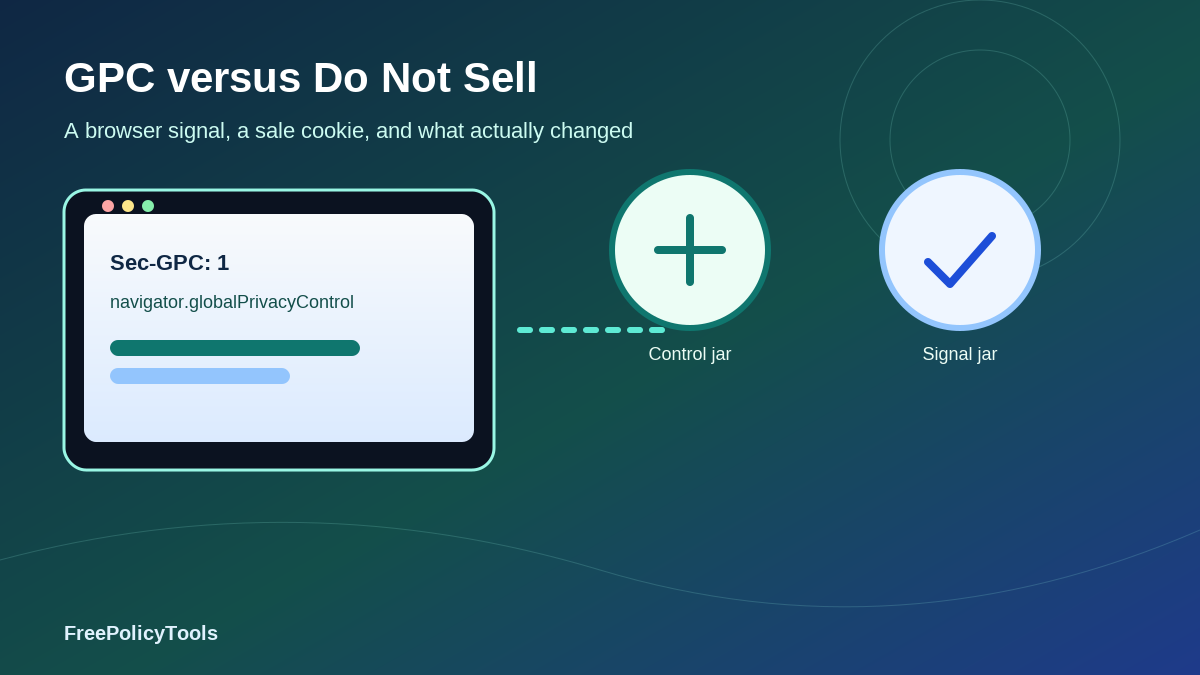
We loaded sixteen US homepages twice, at the same time, and changed one thing: the GPC visit sent Sec-GPC: 1 on every request and set navigator.globalPrivacyControl to true. The control visit stripped that header and left the property undefined. Nobody clicked “Do Not Sell”, “Your Privacy Choices”, or a cookie button.
On The Washington Post, the sale opt-out character flipped on every completed pair. The IAB US Privacy string was 1YNY without the signal and 1YYY with it, in both the wp_usp cookie and the __uspapi value. The banner text did not change. Adobe, Lowe’s, and The New York Times each had a different watched consent cookie that differed in the same direction at least four times. Twelve sites did not.
What the visits compared
Global Privacy Control is a browser signal. The W3C specification defines a Sec-GPC header and a JavaScript property. The Global Privacy Control site describes the signal as an opt-out of sale and sharing. California’s sale opt-out is the legal backdrop people cite. This study does not apply that law to anyone. It asks a narrower question that was written down before the first homepage was screened:
On a frozen set of US sites that offer a sale opt-out, does sending the signal change the opt-out cookie, the third-party script set, or the banner, compared with a no-signal visit of the same page?
A repeated effect, also frozen in advance, is the same watched cookie, the same third-party host, or the same banner flag differing in the same direction in at least four completed pairs. There are no significance tests. A cookie hash that changes because a timestamp changed is not the headline.
How a pair was measured
Each slot ran on a Cursor cloud VM. A Cloudflare trace placed the exit in country US and colo IAD every time. The raw trace was discarded. IP addresses in stored page text were redacted. The browser was system Google Chrome 157.0.8103.50, launched headed, so the user agent was a reduced Chrome token rather than HeadlessChrome. Playwright 1.49.1 drove that Chrome. Locale was en-US, the timezone was America/New_York, and the viewport was 1280 by 800.
The two contexts were fresh. Dialogs were dismissed. Navigation timed out at 30 seconds and the page then settled for 8 seconds. The visits for one site ran in parallel. No link was clicked, including the opt-out control that had qualified the site.
- Control.
Sec-GPCwas removed if a request already had it. The JavaScript property was not defined. - GPC. Every request carried
Sec-GPC: 1. An init script setnavigator.globalPrivacyControlto true onNavigator.prototypebefore page scripts ran.
Header-only versus JavaScript-only was out of scope. A conforming user agent sends both, and that is the treatment. DNT was not sent.
Watched cookie names were frozen: IAB US Privacy, GPP, OneTrust Optanon, and a short list of other consent-manager names. Values of 180 characters or fewer were stored. Longer values were stored as a SHA-256 and a length. An IAB string matching 1[YN-]{3} was parsed. A directional flip means the GPC side has opt-out character Y and the control does not. The character positions are defined in the IAB US Privacy string: version, notice, sale opt-out, LSPA signatory.
Script URLs were reduced to a registrable domain. The pair lists hosts seen on only one side. That list is whatever remained after the last document navigation during the 8-second settle. It is not a full tag audit. Banner state differs when visibility, a GPC-acknowledgement phrase, the opt-out control text, or a hash of the banner excerpt differs. The acknowledgement pattern requires a phrase such as “GPC signal detected” or “honors your”. “GPC signal not detected” does not match, and a bare “GPC” does not match.
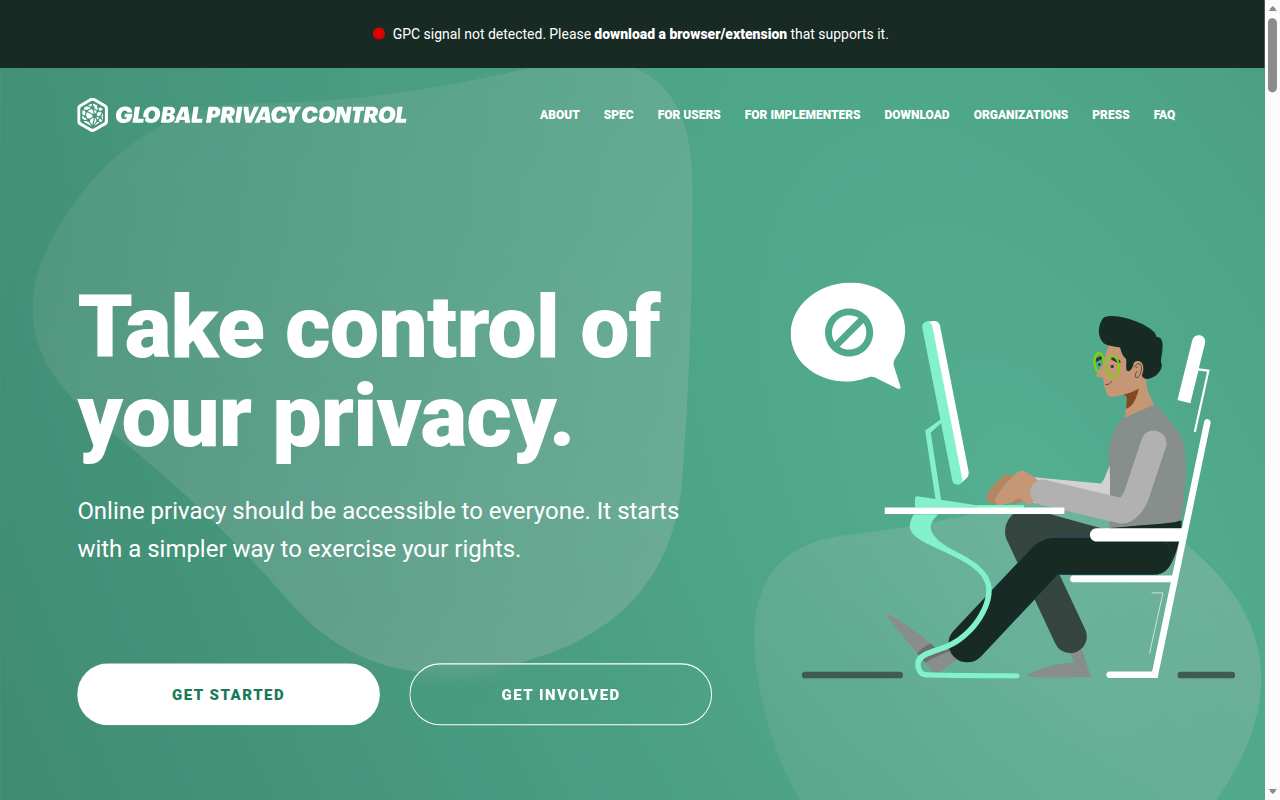
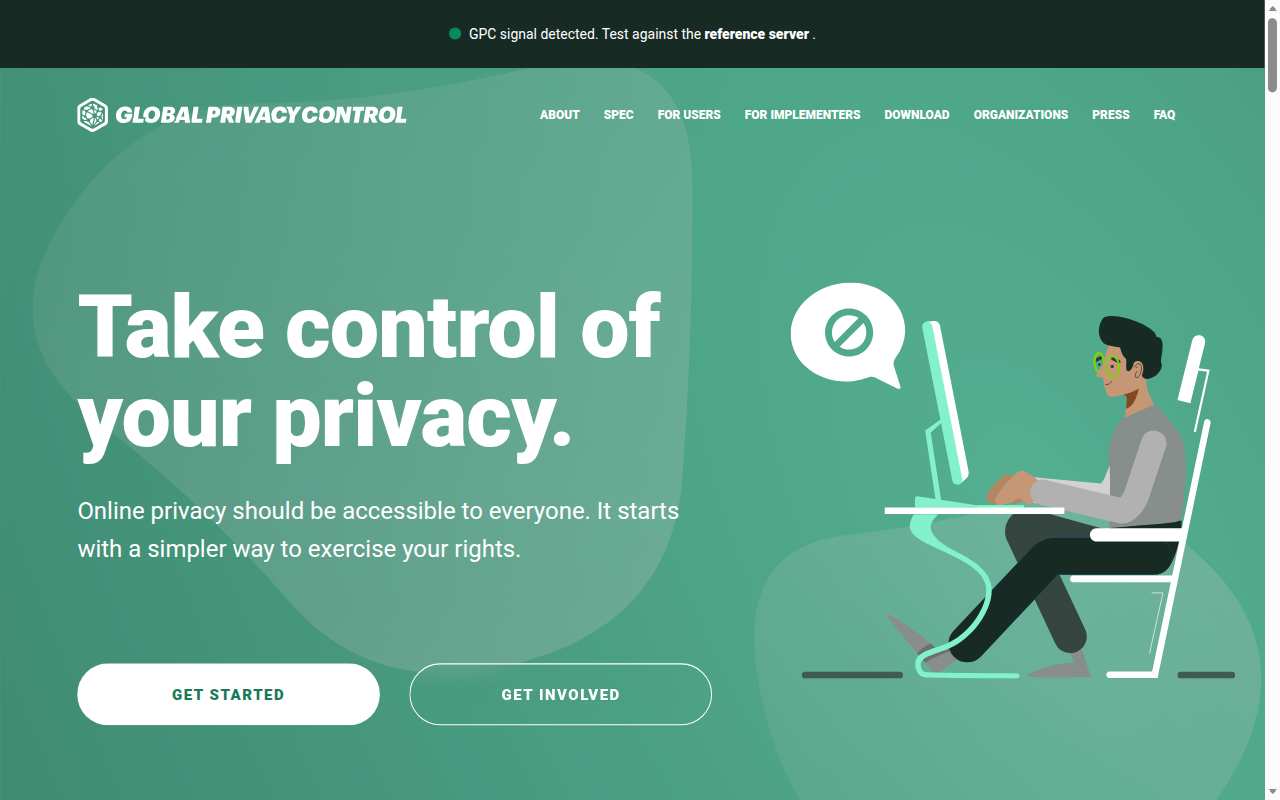
A harness visit to https://globalprivacycontrol.org/ is outside the corpus. It only checks the instrument. The control page said the signal was not detected. The GPC page said it was detected, the document header was 1, and the JavaScript property was true.
The sixteen homepages
Candidates were ordered before any outcome. A site entered only when a no-signal visit found a link, button, or role=link|button whose text, label, title, or image alt matched the frozen opt-out pattern. A sentence in a privacy policy was not enough. The cap was 16. After the corpus file was written, a later failure stayed not_run. Nobody was swapped in.
The sixteen, in list order, are The New York Times, Microsoft, Capital One, Verizon, Walmart, The Washington Post, Adobe, United Airlines, T-Mobile, Best Buy, AT&T, The Home Depot, CNN, Nike, Zoom, and Lowe’s. Screening left out Target, Salesforce, Intuit, and IBM because the homepage had no matching control. Expedia returned 429, USA Today 402, and Forbes 403. American Express failed because the page had disabled eval. American Airlines was blocked. Backup names after Lowe’s were not visited.
Cookie names and what a consent banner is for are a different question from whether this signal moved one. The cookie-policy primer is about notice text. The estudio de formulario de solicitud de privacidad stopped before submit. Neither one measured Sec-GPC.
Five collected slots
The cadence was frozen: one immediate slot after the corpus freeze on 19 November, then 18:00 UTC that day, then 06:00 and 18:00 UTC on 20 November, then 06:00 and 18:00 UTC on 21 November. A slot could start from its timestamp until 40 minutes later, and not after 21 November 2026 at 18:30 UTC.
Watched-cookie differences per slot
Each column is one collected slot. The height is the count of completed pairs whose watched consent cookie differed. The maximum on a full slot is 16.
Where the 79 pairs differed
Share of completed pairs with a watched-cookie difference, a script-host difference, or a banner-state difference. Script hosts differ most often. A GPC acknowledgement did not occur.
Repeated cookie effect
Four sites had the same watched consent field differ in the same stored direction at least four times: The Washington Post, Adobe, Lowe’s, and The New York Times. The other twelve did not.
Script-host differences across the five slots
Pairs whose third-party script-host sets differed: 11, 13, 13, 15, then 12. The line is high because tag sets rarely match exactly. It is not a count of sites that suppressed advertising.
| Slot | Pairs ok | Cookie | Scripts | Banner | USP flip to Y |
|---|---|---|---|---|---|
| 19 Nov 14:56 UTC | 15 | 6 | 11 | 0 | 1 |
| 19 Nov 18:01 UTC | 16 | 7 | 13 | 2 | 1 |
| 20 Nov 06:01 UTC | 16 | 7 | 13 | 2 | 1 |
| 20 Nov 18:01 UTC | 16 | 7 | 15 | 1 | 1 |
| 21 Nov 06:01 UTC | 16 | 7 | 12 | 1 | 1 |
| All five | 79 | 34 | 64 | 6 | 5 |
The single missing pair is The New York Times on the first slot: HTTP 403 on both sides. Later New York Times rates use four pairs. gpc_ack_only_on_gpc is 0 on every slot.
Slot 6 was scheduled for 21 November 2026 at 18:00 UTC. It did not run inside the window. On 24 November the collector wrote evidence/slots/20261121T180000Z/MISSED.json with reason past_stop. A crawl that day would have been a new measurement, so it was not stored under the missed timestamp. The five Post pairs had already met the four-pair rule.
The Washington Post string
All five pairs:
- Control
wp_uspy__uspapi:1YNY - GPC
wp_uspy__uspapi:1YYY
1YNY is version 1, notice yes, sale opt-out no, LSPA yes. 1YYY is the same string with the sale opt-out set to yes. Those four-character values do not drift across slots. The control hash is the same five times, and the GPC hash is the same five times. This is the only site where the pre-registered US Privacy flip fired, and it fired every time.
The Post also set OptanonConsent. The control value was 427 characters and the GPC value was 448 characters on every pair. Both exceed the storage cap, so the package has hashes, and those hashes change from slot to slot. The length gap is repeated. The groups are not in the file. OptanonAlertBoxClosed also differed; where that cookie was short enough to read, on Adobe, it was an ISO timestamp. We do not treat it as an opt-out.
On the 20 November 06:00 slot only, the control had an extra ccpa cookie 1YN-. One slot is not a repeated effect.
Banner visibility was true on both sides of all five pairs. The opt-out control text matched. The acknowledgement phrase was false on both sides. The first-slot screenshots look like ordinary homepages. The sale character changed in the cookie. A person looking at the page would not have seen a new banner.
Adobe’s OneTrust bit
Adobe’s OptanonConsent was short, and it was the same string on every visit of a given condition:
- Control:
groups=C0001:1,C0002:1,C0003:1,C0004:1 - GPC:
groups=C0001:1,C0002:1,C0003:1,C0004:0
The stored form is URL-encoded. Decoded, group C0004 is the only field that moves, from 1 to 0. The SHA-256 of each string is stable across all five slots. OneTrust’s stock template uses C0004 as targeting. We did not fetch Adobe’s category labels, so the finding is the bit, not a label we did not read. No US Privacy string was present. The banner flag tripped on one slot, with acknowledgement and visibility still false, so Adobe misses the repeated banner rule.
Lowe’s honor cookie
The watched cookie notice_preferences was absent on the control and present under GPC as 0: on all five pairs. That is the pre-registered repeated effect.
The jar also shows names the frozen pattern did not watch. They are reported here and are not added to the pre-registered cookie tally. On every GPC visit, and on no control visit:
gpcishonored=truenotice_gdpr_prefs=0:cmapi_cookie_privacy=permit 1 requiredcmapi_gtm_blset to the hyphenated tag-code listga-ms-ua-ta-asp-bzi-sp-awct-cts-csm-img-flc-fls-mpm-mpr-m6d-tc-tdcoptout_domains_pcpresent and empty
notice_behavior=implied,eu was on both sides. The banner flag tripped once. The cookie named the honor. The banner excerpt did not. We did not expand the short tag codes into vendor names.
The New York Times GPP string
Slot 1 is out. On the four later pairs, gpp-string was stable within each condition and different between them:
- Control:
,,DBABLA~BVQqAAAAAABo.QA - GPC:
,,DBABLA~BVQVAAAAAABo.QA
One character differs, q versus V, in the section after ~The Global Privacy Platform encoding is easy to misread. This article does not turn that character into a section bit. The repeated fact is the stored value.
The accessible opt-out text was Your Privacy Choices on every control document and an empty list on every GPC document. Banner visibility was false on both sides, and the acknowledgement phrase was false on both sides. The banner flag is true because the control text differed, not because a GPC banner appeared. The dump cannot say whether the footer link was omitted or had not reached the accessibility tree before the settle ended. The text difference is what repeated.
Strings that stayed put
CNN’s usprivacy cookie and __uspapi value were 1YYN on both sides of all five pairs. Notice yes, sale opt-out already yes, LSPA no. The signal had no character left to flip. CNN did write SecGpc: 0 on every control visit and 1 on every GPC visit. That name is not the watched token gpc, so the pre-registered cookie flag comes from OptanonConsent, whose length was 534 on the control and 565 under GPC every time. The hashes change every slot. CNN recorded the signal, kept an opt-out that was already on, and held a longer OneTrust blob we did not retain.
United Airlines returned __uspapi=1YNN on both sides of all five pairs. Notice yes, sale opt-out no, LSPA no. No watched cookie differed.
Microsoft, Capital One, Verizon, Walmart, Best Buy, AT&T, Nike, and The Home Depot had no watched-cookie difference on any completed pair. Home Depot still wrote a cookie the pattern missed. On all five GPC visits, and on no control visit, OptOutOnRequest was present. The timestamp in the value changes by slot. The groups do not: C0001:0,C0002:0,C0003:0,C0004:1,C0005:0. The name appeared twice with that same value. Because the name was not in the frozen pattern, Home Depot’s pre-registered cookie count stays 0. We are not revising the rule after looking, and we are not hiding the jar. Those group ids are not Adobe’s: Adobe turned C0004 off, and this string leaves C0004 at 1. Without Home Depot’s labels, the finding is the repeated presence of that string.
Blobs we stored only as hashes
T-Mobile’s OptanonConsent differed on all five pairs. Control length 374, GPC length 384, every time. Hashes also differ between two control visits, which is what a timestamped blob does. The groups were over the cap. A ten-character gap is a repeated size difference, not a decoded opt-out.
Zoom’s OptanonConsent differed on all five pairs and both sides were 321 characters. Hashes change from visit to visit on both sides. Zoom meets “the hash differed”. It does not meet “a stored consent field moved the same way”.
The same limit applies to the Post’s and CNN’s long OneTrust values. The fields we can quote are the ones that fit in 180 characters: the Post’s US Privacy string, Adobe’s group string, Lowe’s notice_preferences, the Times’ GPP string, CNN’s usprivacy y SecGpc, United’s __uspapi, and Home Depot’s group portion.
Script hosts went both ways
64 of 79 completed pairs had a different third-party script-host set. Many of those sets are tiny, and an 8-second settle can miss a late tag. The hosts below were one-sided on every completed pair for that site. They do not point in one direction, which is the result.
- Capital One. The control recorded exactly one third-party host every visit,
doubleclick.net. The GPC visit recorded zero hosts every visit. - Microsoft. The GPC visit recorded zero third-party hosts every visit. The control recorded 1, 3, 4, 1, and 4.
contentsquare.netwas in the control set every time. - AT&T. The GPC visit recorded seven hosts every visit, including
doubleclick.net. The control recorded 2, 0, 0, 1, and 0. That is the opposite of Capital One. - Best Buy.
doubleclick.netygoogleadservices.comwere on the control side in every pair. - Lowe’s and T-Mobile. Several marketing and tag-manager hosts appeared only on the GPC side in every pair, including
adobedtm.com. A host that shows up only under GPC is not a suppressed tag.
The full one-sided host lists are in analysis.json. Browser script behavior under a privacy setting is a different design from the fingerprint surfaces in the browser fingerprinting study.
Watched-cookie change rate by site
Numerator is pairs whose watched consent cookie differed. A full bar is not automatically an opt-out: T-Mobile, CNN, and Zoom differ by hash or length, and the decoded sale character moved only at The Washington Post.
| Sitio | Pares | Cookie | Scripts | Banner | USP flip | What repeated |
|---|---|---|---|---|---|---|
| The New York Times | 4 | 4 | 4 | 4 | 0 | GPP string, one character; privacy-choices link absent under GPC |
| Microsoft | 5 | 0 | 5 | 0 | 0 | GPC visit recorded no third-party script hosts |
| Capital One | 5 | 0 | 5 | 0 | 0 | doubleclick.net on control only; GPC host count was 0 |
| Verizon | 5 | 0 | 5 | 0 | 0 | jquery.com on the GPC side in every pair |
| Walmart | 5 | 0 | 3 | 0 | 0 | No repeated watched-cookie or one-sided host |
| The Washington Post | 5 | 5 | 3 | 0 | 5 | wp_usp and __uspapi 1YNY to 1YYY |
| Adobe | 5 | 5 | 5 | 1 | 0 | OptanonConsent C0004 from 1 to 0, same strings every slot |
| United Airlines | 5 | 0 | 2 | 0 | 0 | __uspapi stayed 1YNN |
| T-Mobile | 5 | 5 | 5 | 0 | 0 | OptanonConsent length 374 vs 384; groups not stored |
| Best Buy | 5 | 0 | 5 | 0 | 0 | doubleclick.net and googleadservices.com on control only |
| AT&T | 5 | 0 | 5 | 0 | 0 | Seven GPC hosts every visit, including doubleclick.net |
| The Home Depot | 5 | 0 | 5 | 0 | 0 | Watched cookies unchanged; OptOutOnRequest was unwatched |
| CNN | 5 | 5 | 1 | 0 | 0 | usprivacy stayed 1YYN; SecGpc cookie was 0 vs 1 |
| Nike | 5 | 0 | 1 | 0 | 0 | No repeated effect |
| Zoom | 5 | 5 | 5 | 0 | 0 | OptanonConsent hashes differed; length stayed 321 |
| Lowe’s | 5 | 5 | 5 | 1 | 0 | notice_preferences=0: only under GPC; gpcishonored=true |
The banner almost never announced it
No corpus pair showed an acknowledgement phrase on the GPC side only. The instrument page did, and it is not in the sixteen.
The six banner-state flags are The New York Times on four slots, Adobe on one, and Lowe’s on one. Only the Times reaches four pairs, and that flag is the missing “Your Privacy Choices” text described above. The Post kept a visible banner with the same opt-out text while wp_usp flipped. Cookie evidence and banner evidence diverged on the site with the cleanest sale-character change.
Limits
- The sample is sixteen homepages that exposed a matching control to this browser. It is not a random sample of US sites or of GPC adopters.
- We did not click the opt-out, open a second URL, or log in. A control that lives only past a click was out of scope after the homepage qualified.
- Header and JavaScript property were sent together. A site that honors only one of them is not separated.
- Long OneTrust values were hashed. T-Mobile, CNN, Zoom, and the Post’s
OptanonConsentcannot be quoted as groups. - Script hosts are an 8-second snapshot. A count of zero can mean the tag had not loaded yet.
- Slot 6 is missing. Rates use five pairs, or four for The New York Times. We did not impute the sixth.
- Nothing in the package is a statement that a company complied with or violated a statute.
Package and citation
Rebuild the cross-slot file from the slot JSON with node analyze.mjs inside the study directory. Re-running collection against live sites can differ. The files below are the measurement this article describes.
Citación sugerida: FreePolicyTools. “The Washington Post Sale Cookie Flipped to Opt-Out on Every Sec-GPC Visit.” Original research collected 19–21 November 2026. Slot 6 was not collected.
Preguntas
Affiliate disclosure: This article contains ProxySeller and CometVPN affiliate links. FreePolicyTools may earn a commission if you buy through them. The links did not change the corpus, the collection, or the findings. ProxySeller was not used as a path. CometVPN was NOT_RUN.