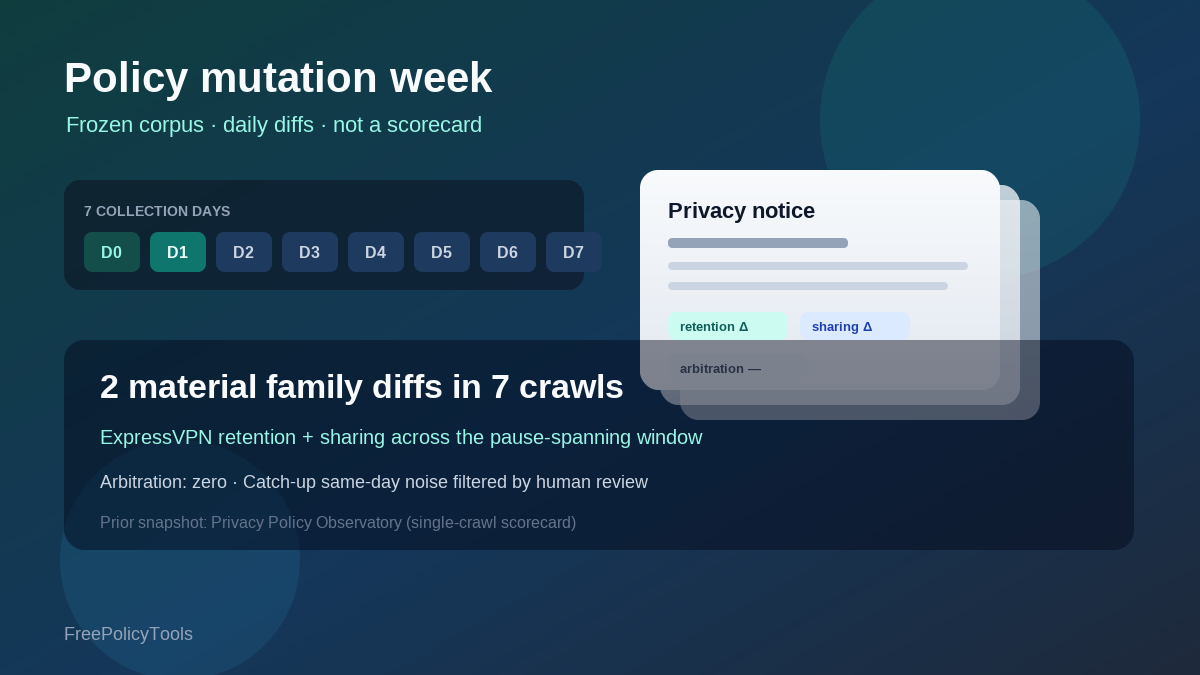
A single privacy-policy crawl answers what a notice says today. It cannot tell you how often retention, sharing, or arbitration language quietly moves. We froze the same purposive N=24 corpus used in our Privacy Policy Observatory (a one-day observability scorecard, mean index 80.5), then asked a different question: across seven collection cadences, how many material retention / sharing / arbitration diffs appear?
After human review of every family-window candidate, the answer is two. Both sit on ExpressVPN in the pause-spanning day-0 → day-1 window (18 Nov → 24 Nov 2026): a dated policy update that expanded support-correspondence retention to WhatsApp, and a new optional US WhatsApp support channel that discloses Meta as a messaging provider. Arbitration: zero material diffs. Same-calendar-day catch-up cadences after resume produced zero material confirmations once nav/promo chrome and unstable Amazon HTML were filtered.
This is a change/diff diary, not a remake of the observatory scorecard. We did not re-score the twelve observability dimensions or publish a privacy grade. Collection used cloud-direct HTTPS from a Cursor USA VM. ProxySeller Runtime Secrets were present but unused (multi-exit HTML would confound “did the policy change?”). CometVPN remains VPN-only — corpus member and affiliate context, no tunnel.
Prior snapshot: the observatory is complementary, not duplicated
On 17 November 2026 we published a structured document audit of these same notices: twelve rubric dimensions, mean observability index 80.5, widest zeros on change notice and children’s statements. That study answered “what is observable in the retrieved text on one date.” Read it at Privacy Policy Observatory.
This week-long design reuses the frozen URL list as a corpus, not as a scorecard. The primary metric is the count of material family diffs — human-confirmed substantive meaning changes in retention, sharing/sale, or arbitration/dispute language — across seven collection days. Full-document hash churn without a family hit does not count toward the primary answer.
For normative notice design (not our measured diffs), see the ICO right to be informed, GDPR.eu, y FTC privacy guidance.
Methods: freeze, families, cadence, and the pause gap
Freeze (Day 0, 18 Nov 2026, 07:58 UTC): protocol, N=24 corpus (observatory amended URLs), material-family taxonomy, and schedule locked before the dry-run. Amazon failed day 0 (HTTP 403); the URL stayed frozen for retries.
Families (pre-registered): retention (time-bounded keep / deletion), sharing (sale/share / third-party disclosure), arbitration (binding arbitration, class-action waiver, dispute venue). Keyword-anchored windows → NFKC normalize → SHA-256. Candidates require human review before counting as material.
Cadence: one crawl per collection day, cloud-direct urllib (Chrome dump-dom fallback; NordVPN PDF via pypdf), research UA FreePolicyToolsResearch/1.0 (+…; privacy-policy-mutation-week).
Pause gap (documented): collection paused 21–24 Nov for weekly usage reset. Calendar targets 19–23 Nov had no crawls. On resume (24 Nov) we ran days 1–7 as compressed sequential cadences to finish the pre-registered seven-day quota. Day 0→1 therefore spans ~6 calendar days and is the primary multi-day mutation window. Days 2–7 on the same calendar day measure short-interval fetch stability; they are labeled catch-up compressed and cannot reconstruct missed calendar days.
Related FreePolicyTools measurement work (different questions): proxy routing, proxy encryption, y privacy-request forms before submit.
Finding 1: two material family diffs across seven cadences
Human review of every automated candidate confirmed 2 material family diffs total. Both occurred on ExpressVPN in the pause-spanning interval. By family: retention 1, sharing 1, arbitration 0. By stratum: VPN only. Catch-up intervals after resume: 0 material confirmations.
Automated hashing initially surfaced more candidates (nav chrome, promo banners, Amazon footer churn). Those were reclassified as trivial or fetch artifacts. The primary question counts only material-confirmed rows after review — not raw hash churn.
Finding 2: ExpressVPN rewrote support retention and added Meta WhatsApp sharing
Between the day-0 extract (18 Nov) and day-1 extract (24 Nov), ExpressVPN’s notice “Last updated” line moved from Octubre 2, 2026 a November 19, 2026 — inside the pause window.
Retention: the support-correspondence section title expanded from “Email, Live Chat, and Feedback Forms” to include WhatsApp. New body text states WhatsApp support correspondence is retained under the support retention policy, and clarifies those records never include VPN connection data.
Sharing: a new optional “VIP WhatsApp support” channel (US users) discloses collection of the mobile number and message content for support, and names Meta Platforms, Inc. as the messaging provider that independently processes WhatsApp data. Sale/lease stance language (“we do not sell or lease…”) was unchanged.
Arbitration: no substantive dispute/arbitration rewrite; the family-window hash moved from insert-induced boundary/TOC noise and was marked trivial.
Policy language remains only one input when evaluating VPN products. For product context see our Revisión de CometVPN (VPN-only; not used as a tunnel here) and affiliate path /cometvpn/.
Finding 3: most hash churn was chrome, not clause edits
Nine rows were confirmed trivial: Black Friday / webinar banners (CometVPN, CookieYes, Termly), product-nav reorders (Bright Data, 1Password), and window-boundary drift without body rewrites. Seven rows were fetch artifacts, including day-0 Amazon 403 recovery and repeated same-day Amazon footer/help-nav instability during catch-up.
Two services showed full-document text-hash churn without a family-window hit (IPRoyal 0→1; CookieYes 1→2) — logged as out-of-family churn, excluded from the primary total.
Lesson for longitudinal policy monitoring: keyword windows catch real clause moves y marketing chrome. Human review against the policy body is mandatory before publishing a mutation count.
Finding 4: compressed catch-up days were stable after filtering
After resume, six same-calendar-day intervals (1→2 … 6→7) completed with 24/24 usable extracts each. Automated candidates in those intervals were Amazon sharing-window flicker only; all were classified fetch artifacts. No retention or arbitration candidates appeared in catch-up.
That stability is useful: it suggests the ExpressVPN day-0→day-1 diffs were not collector noise. It does no prove that no other corpus member would have mutated on the missed calendar days 19–23 Nov — those days were not observed.
Finding 5: limits, bounded claims, and what we did not measure
N=24 is purposive and small. We claim only what appeared in retrieved notice text between these UTC timestamps. We did not audit production retention systems, submit privacy requests, solve CAPTCHAs, or run ProxySeller exits. Hosted VMs lack a reliable TUN path; CometVPN was not tunnelled.
The pause forced catch-up compression: the study still delivers seven collection cadences and a documented gap, but it is not a perfect calendar-daily diary for 19–23 Nov. Quote windows can include surrounding chrome; we mitigated with human review, not with claiming OCR perfection.
If you are comparing proxy products after reading their notices, confirm the exact HTTP/SOCKS path with the provider — FreePolicyTools may earn a commission via /proxyseller/. Behavioural path tests live in our routing and encryption studies, not in this diary.
A practical mutation-watch checklist
- Freeze URLs before the first crawl; log substitutions instead of silent drift.
- Diff named families (retention, sharing, arbitration) — not only full-page hashes.
- Separate marketing chrome from the legal body before counting “material.”
- Treat appear/disappear of a family window after a prior fetch failure as a fetch artifact until a clean two-day baseline exists.
- Record last-updated date moves; they often accompany real clause edits (as with ExpressVPN here).
- Keep a one-shot scorecard (observatory) and a time diary (this study) as complementary artifacts.
Drafting your own notice? Start with qué política de privacidad debe incluir un sitio web o el Generador de políticas de privacidad — neither replaces counsel or this measured diary.
Evidence pack, disclosure, and hosting
Public package under /research/privacy-policy-mutation-week/: protocol, corpus, material-families, schedule, collection-gap, day-00…day-07 fetch logs & family hashes, human-review.json, analysis.json, diary.json, SHA-256 manifest. Raw bodies stay in untracked private/.
Affiliates: ProxySeller y CometVPN. FreePolicyTools may earn a commission if you purchase through them. Affiliates did not design the taxonomy, classify diffs, or sponsor the crawls. Coolify hosts the site; ignore Vercel PR checks.
Charts and material diary
Material diffs by family
Primary answer after human review. Arbitration remained zero.
Material diffs by interval
Only the pause-spanning 0→1 interval carried material confirmations.
Candidate classification mix
- Material confirmed2
- Trivial (chrome/nav)9
- Fetch artifact7
Raw hash candidates are not the primary answer — reviewed classifications are.
Usable extracts per day
Day 0 Amazon 403 recovered from day 1 onward (URL remained frozen).
| Servicio | Familia | Interval | What changed |
|---|---|---|---|
| ExpressVPN | retention | 0→1 | Last updated October 2 → November 19, 2026. Support retention section expanded to WhatsApp; WhatsApp correspondence retained under support retention policy. |
| ExpressVPN | sharing | 0→1 | New optional US VIP WhatsApp support channel discloses Meta as messaging provider and collection of phone number + message content for support. |
Prior single-crawl scorecard: Privacy Policy Observatory (mean index 80.5).
Descargar la investigación
Day folders: /research/privacy-policy-mutation-week/day-00/ … day-07/. Coolify host — ignore Vercel.
Preguntas frecuentes
Bounded claims only: retrieved notice text between the listed UTC timestamps on a purposive N=24 corpus. Not a compliance audit, prevalence estimate, or privacy grade.