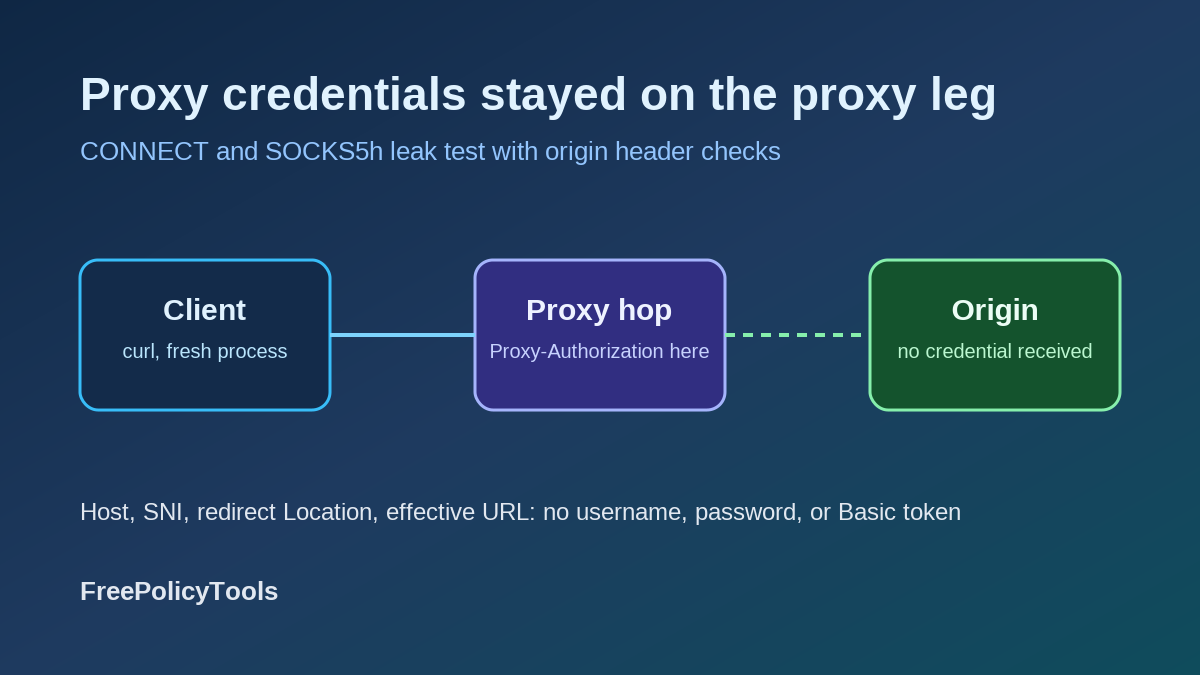
In six diary slots, proxy credentials stayed on the proxy leg. Across 90 HTTPS probes and 12 in-process tunnel inspections, no username, password, or Basic token appeared in the Host header an origin received, in a redirect Location, in an effective URL, or in the CONNECT authority or TLS server name we sent to a destination. Proxy-Authorization was sent on the CONNECT request to the proxy in all 30 residential HTTP probes, and it never reached an origin header echo.
That is a narrow negative for one client, one residential product, one cloud source, and six slots. It is not proof that no provider or client leaks credentials.
The residential endpoints in this diary were ProxySeller
The HTTP and SOCKS5h measurements used ProxySeller residential endpoints. The link is an affiliate link. It is not a ranking, and the leak counts do not change if you use it.
Visite ProxySellerThe answer
Proxy credentials did not leak to the targets on the surfaces we could observe. Credentials were used at the proxy hop and not past it. The origin saw its own hostname and no proxy authorization header. The one place the credential was expected to appear, the CONNECT request to the proxy, is where it appeared.
The useful comparison is with the question itself. The surfaces here are the upstream Host, the TLS server name, and redirect URLs. None of them carried a token in six slots. The rest of this article shows how that was measured and where it stops.
What the question was
Faites Proxy-Authorization or username tokens appear in the upstream Host, the TLS server name (SNI), or redirect URLs when a client reaches HTTPS sites through an authenticated proxy? Two modes were in scope: HTTP CONNECT and SOCKS5 with remote DNS (SOCKS5h).
This was not a stickiness study, a kill-switch study, or a VPN measurement. It is not a browser study either, so it is separate from the path-leak study et les fingerprint work. Les proxy encryption study asked whether proxy bytes were protected on a local network. The proxy routing research asked whether traffic reached a proxy at all. This diary asks what the destination sees once the request leaves the proxy. The earlier HTTP/3 diary used the same proxy product and the same client family, but it measured protocol version, not credentials.
Méthode
Client and vantage
The client was the system curl on a USA cloud agent virtual machine. Every probe was a fresh process, HTTPS only, with redirects inspected through Location rather than followed. The connect timeout was 10 seconds and the total timeout 20 seconds. The residential endpoints came from ProxySeller, an affiliate link. CometVPN was not part of the run.
Credentials came from runtime secrets and were passed to curl through a private config file. They were never placed on the command line, printed, or committed. Every committed JSON file was scanned for usernames, passwords, proxy hostnames, Basic tokens, and raw addresses before it was written.
Frozen hosts and the screen
Frozen hosts, screen, and candidate order
A Day 0 screen probed candidates in a fixed priority order over residential HTTP only. A candidate was accepted when the transport succeeded and its role check passed. The screen froze four URLs. httpbingo.org/headers ranked first for the echo role but failed the screen with no HTTP response, so the next echo candidate was used. The order was not changed after any outcome.
https://httpbingo.org/redirect-to?url=https://example.com/&status_code=302, redirecthttps://postman-echo.com/headers, header echohttps://postman-echo.com/redirect-to?url=https://example.com/, redirecthttps://example.com/, clean host
With one header echo service, origin-side header evidence rests on one third party. That is a real limit.
Probes and tunnel inspection
Each slot ran 15 probes: the four frozen URLs plus one Cloudflare trace path check, under each of three conditions. Each proxy condition also ran one in-process tunnel inspection to example.com:443. The inspection opened the CONNECT or SOCKS5h tunnel by hand, performed a TLS handshake with that server name, and recorded whether the destination field and SNI matched and whether any credential token was present.
Expected placement is not a leak. On residential HTTP, Proxy-Authorization belongs on the CONNECT request to the proxy. On direct and SOCKS5h rows it is not expected at all. The first slot ran on 24 November, the same day the list was frozen. The last slot was collected at 17:50 UTC on 26 November, before the planned stop at 18:30 UTC. Every slot was collected inside its window and no slot was added after the stop.
Coverage and transport failures
| État | Probes | Transport completed | Tunnel inspections OK |
|---|---|---|---|
| direct | 30 | 30 des 30 | Sans objet |
| residential-http | 30 | 28 des 30 | 6 des 6 |
| residential-socks5h | 30 | 29 des 30 | 6 des 6 |
Completed probes by condition
Horizontal bars. Each bar is the 30 probes on one condition, split into completed responses and probes with no HTTP status.
Outcome of all 90 probes
Donut chart of every probe across the three conditions.
Three probes returned no HTTP status: a residential HTTP path check on 24 November (curl exit 28), a residential HTTP redirect on the 24 November evening slot (curl exit 28), and a SOCKS5h redirect on the final slot (curl exit 97, a proxy-level handshake failure). They contribute no leak evidence.
What the origin received
Only the header echo role shows what an origin actually received. It was reached six times per condition. In every probe, the origin’s Host matched the target, and neither Proxy-Authorization nor Authorization appeared.
The set of header names the origin received was identical across all three conditions: accept, accept-encoding, host, user-agentet x-forwarded-proto. The last one appeared on direct requests too, so it comes from the origin’s edge rather than the proxy. No Via ou X-Forwarded-For header appeared at the origin on any proxied probe.
Redirect targets and effective URLs
Redirects were read through their Location header without being followed. Every completed redirect on every condition pointed to example.com with no username, password, Basic token, or userinfo. Effective URLs carried no userinfo in any row. The missing redirect on each proxy condition is one of the transport failures above.
CONNECT authority, destination, and SNI
On residential HTTP, the CONNECT authority equalled target:443 in all 30 probes, including the two that later timed out. In the tunnel inspection, the destination and SNI matched example.com in 6 of 6 inspections on each proxy condition, and no credential token appeared in either. The TLS version was TLSv1.3 in all 12.
The SOCKS5 username and password exchange happens between client and proxy and is not sent to the origin. What we checked on SOCKS5h is the destination field the client sent, which carried only the hostname.
Surface checks by proxy condition
Radar chart. Each axis is the share of applicable checks that came back clean, from 0 to 100.
Where Proxy-Authorization went
On the residential HTTP path, Proxy-Authorization appeared on the CONNECT request in all 30 probes and on no origin header echo. It did not appear on direct or SOCKS5h rows. The proxy-facing request carried the credential, and the origin-facing request did not.
| Lieu | Residential HTTP | Residential SOCKS5h | Direct |
|---|---|---|---|
| Proxy-Authorization on the CONNECT request | 30 des 30, expected | Sans objet | Sans objet |
| Proxy-Authorization on an origin echo | 0 des 6 | 0 des 6 | 0 des 6 |
| Username, password, or Basic token in Host, SNI, or redirect | 0 | 0 | 0 |
Test residential routing yourself
If you want to repeat a check like this on your own endpoints, start with the credential placement table above. The link is an affiliate link, and it does not change the results.
Explore ProxySeller residential proxiesExits and results, slot by slot
Exit country is what the Cloudflare trace reported on each condition’s path check. Addresses are hashed and not published.
| Slot (UTC) | Direct | Residential HTTP | Residential SOCKS5h | HTTP completed | SOCKS5h completed | Leak on any surface |
|---|---|---|---|---|---|---|
| 24 Nov, immediate | US, IAD | Timed out | US, IAD | 4/5 | 5/5 | Numéro |
| 24 Nov, 18:00 UTC | US, IAD | UZ, WAW | UZ, WAW | 4/5 | 5/5 | Numéro |
| 25 Nov, 06:00 UTC | US, IAD | NL, AMS | NL, AMS | 5/5 | 5/5 | Numéro |
| 25 Nov, 18:00 UTC | US, IAD | RU, ARN | RU, ARN | 5/5 | 5/5 | Numéro |
| 26 Nov, 06:00 UTC | US, IAD | TW, TPE | TW, TPE | 5/5 | 5/5 | Numéro |
| 26 Nov, 18:00 UTC | US, IAD | RU, ARN | RU, ARN | 5/5 | 4/5 | Numéro |
Completed probes per slot
Column chart. Each slot had five probes per proxy condition, so the maximum is 5.
Where both proxy path checks completed, the HTTP and SOCKS5h traces reported the same hashed exit. In the first slot the SOCKS5h trace reported US, IAD, but with a different hashed address from direct, so it was not the VM’s own address passing through. The direct address also changed between slots, so the cloud source is not a fixed IP. Exit countries rotated across slots, so no single slot stands in for the product.
CometVPN was not part of this measurement
This diary has no VPN arm. A VPN would be a different path with its own policy, and these counts do not estimate it. The link is an affiliate link, separate from the results.
Visitez CometVPNWhat this does and does not show
The data supports this claim: on these probes, from this source, through this residential product, over HTTP CONNECT and SOCKS5h, no credential token appeared in the upstream surfaces we could observe. The origin’s view of Host and its received headers matched the target and carried no proxy credential.
- It does not show what the proxy does on the wire to the origin. We recorded the client’s SNI and destination fields and the origin’s echoed headers. We did not capture packets on the proxy-to-origin leg, so a transparent rewrite there is outside this vantage.
- It does not cover other providers, plans, protocols, or auth methods. A datacenter proxy or a different SOCKS server could behave differently.
- It does not test the SOCKS5 authentication bytes, which go to the proxy and not to the origin.
- It is a diary of six slots with 15 probes each. It is not a rate with a confidence interval.
Limites
One curl binary on one cloud source. One residential product. One header echo service for origin-side headers. Four frozen URLs: two redirects to the same destination, one echo, and one clean host. Three transport failures with no response.
The check for Proxy-Authorization on CONNECT relies on curl’s verbose output. That output was not saved, because it contains the proxy authorization header. Each result is a boolean recorded from a scratch-space process. Header names are reported; header values are not published.
Exits rotated across slots. One path check per condition does not prove that every request in a slot shared an exit.
Preuves
Every slot summary and results file contains boolean leak flags and aggregate counts only. Proxy hostnames, usernames, passwords, the private curl config, the hash salt, and raw addresses are not in any committed file.
- Article, Markdown
- Protocole
- Frozen hosts
- Day 0 screen summary
- 24 Nov, immediate summary
- 24 Nov, 18:00 summary
- 25 Nov, 06:00 summary
- 25 Nov, 18:00 summary
- 26 Nov, 06:00 summary
- 26 Nov, 18:00 summary
Questions
Did any credential reach the target site?
Not in these probes. Across six slots, the origin’s received headers, redirect targets, effective URLs, and destination names carried no username, password, or Basic token.
Where did Proxy-Authorization go?
It was sent on the CONNECT request to the proxy in every residential HTTP probe, as expected. It never appeared in an origin header echo.
Does this prove a proxy is safe?
No. It is one residential product, one cloud source, and six slots. It rules out a leak on these surfaces for this setup only.
Why were there transport failures?
Three probes timed out or failed at the proxy level and returned no HTTP status. With no response there was nothing to inspect, so those rows are not counted as clean or dirty.
Is this about VPNs?
No. There is no VPN arm, and CometVPN was not run.
Sources
- RFC 9110, HTTP semantics, including the CONNECT method and the
Hostfield. - RFC 7235, HTTP authentication, including
Proxy-Authorization. - RFC 1928, SOCKS protocol version 5.
- RFC 1929, username and password authentication for SOCKS V5.
- RFC 6066, TLS server name indication.
Cite as FreePolicyTools, “Proxy Auth Never Reached the Origin: A Six-Slot CONNECT and SOCKS5h Leak Test” (2026).
Affiliate disclosure. This article links to ProxySeller et CometVPN. FreePolicyTools may earn a commission if you buy through those links. The residential HTTP and SOCKS5h probes used ProxySeller residential endpoints. CometVPN was not used or measured. The links are not a comparative test and do not change the methods, the counts, or the limits.