Methods, every slot’s rates, per-host stability, limits, and evidence are below. Numbers on this page are generated from the committed slot files by a build script, not typed by hand.
The short answer
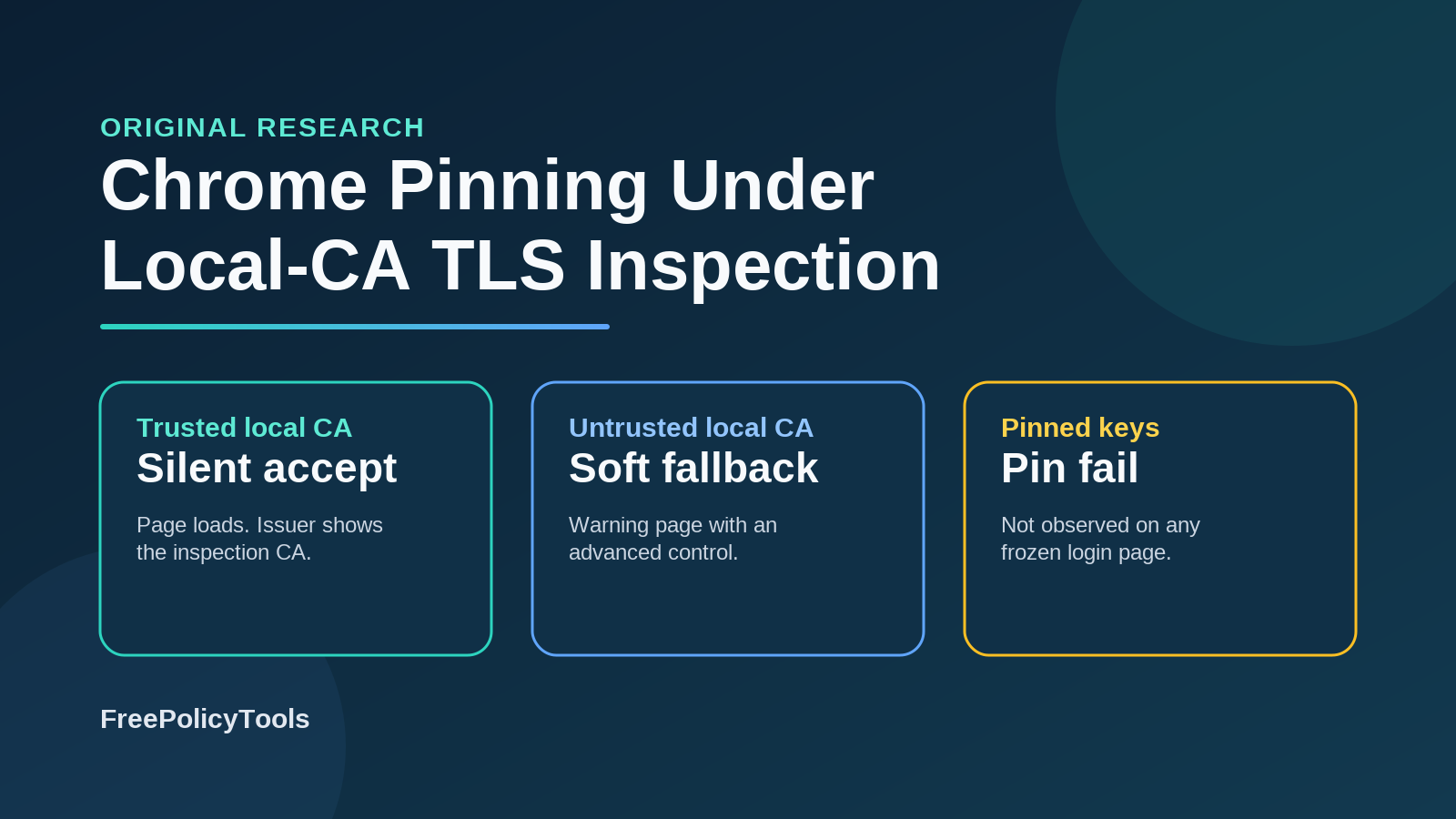
On twelve frozen public login pages, Chrome 157.0.8103.50 accepted a locally trusted inspection certificate silently in all 72 primary visits, meaning six slots times twelve pages. With the same inspection CA not trusted, all 72 visits produced a certificate warning with a proceed control. Across all 216 primary visits, which ran three browser conditions each, the study recorded zero pin failures, zero hard certificate failures, and zero other failures.
The pinning question therefore resolved to silent accept in the configuration that matters for an inspection deployment: the inspection root is installed in the browser’s trust store. Nothing here says public-key pinning never breaks. It says that, in this browser, on these pages, the local root was never refused on pin grounds.
| Outcome class | Trusted local CA | Untrusted local CA | Direct (no proxy) |
|---|---|---|---|
| Silent accept | 72 of 72 | 0 of 72 | 72 of 72 |
| Soft fallback (warning plus proceed control) | 0 of 72 | 72 of 72 | 0 of 72 |
| Pin fail | 0 of 72 across all arms | — | — |
| Cert fail (non-pin) or other fail | 0 across all primary arms | — | — |
Why this question matters
HTTP Public Key Pinning, specified in RFC 7469 and later deprecated by browsers, let a site declare which public keys its certificate chain must contain. A proxy that re-signs TLS with its own certificate authority would fail such a check. Operators who run TLS inspection care about three distinct outcomes, and each one looks different to a user:
- Pin fail. The page does not load and there is no bypass. The user sees a block.
- Soft fallback. The browser shows a certificate warning, usually with an advanced or proceed control. The user can continue, which moves the decision to the user.
- Silent accept. The page loads with no warning. The inspection is invisible to the user, and whether it is acceptable depends entirely on policy.
Managed networks, endpoint security suites, and privacy tools that install their own root all produce one of these outcomes. The practical question is which login pages fall into which bucket once the local root is either trusted or not.
Methods
Vantage and browser
- Cloud agent virtual machine in the United States, using direct egress with no residential exit. The Cloudflare trace reported location US and colo IAD पर आईपीवी4. The IP address was not recorded.
- Google Chrome 157.0.8103.50 driven by Playwright in headless mode. Locale en-US, timezone America/New_York, viewport 1360 by 900, JavaScript enabled.
- Each visit used a fresh browser context, so cookies and cache did not carry over.
- No credentials were typed, no challenges were solved, dialogs were dismissed, and interstitials were never clicked through.
The local-CA instrument
A mitmproxy instance ran on loopback only, with a study-private configuration directory that was never published. Three Chrome conditions were measured for every page:
| शर्त | प्रॉक्सी | Local CA in browser trust store | भूमिका |
|---|---|---|---|
direct | कोई नहीं | लागू नहीं | Baseline: the page must load |
inspect-trusted | mitmproxy on loopback | Yes, imported into an isolated NSS database | Primary answer |
inspect-untrusted | mitmproxy on loopback | No, fresh empty NSS database | Instrument contrast |
The inspection CA’s public SHA-256 fingerprint was 5884c3df6b667a7a77fe0341782afe83c35ff90d64fd6f12297df1281a1f9289. The CA private key never left the private directory. Each NSS database was used as a separate browser home, so the trusted and untrusted runs could not contaminate each other.
Outcome classes
Outcomes were assigned to the document navigation of each frozen URL, after redirects. The classes were fixed before the first slot. Primary rates use the trusted condition only; direct and untrusted arms are the baseline and contrast.
| Class | Definition used |
|---|---|
silent_accept | Navigation completes with no TLS error. The final page is not a Chrome interstitial. Under inspection, the first HTTPS document’s issuer matches the inspection CA. |
pin_fail | A failure or interstitial whose text or net error matches a pinning error such as ERR_SSL_PINNED_KEY_NOT_IN_CERT_CHAIN, or visible pinning language. |
soft_fallback | A TLS warning interstitial appears and a proceed or bypass control is present, or a same-site alternate host loads without changing trust. |
cert_fail | A TLS failure that is not pin-class, such as ERR_CERT_AUTHORITY_INVALID, and does not meet the soft-fallback test. |
other_fail | Timeout, connection reset, HTTP-only failure, or collector fault. |
The freeze
The candidate list was written before any screen ran: 16 primary and 6 backup login URLs, plus two no-login controls. On 24 November 2026 between 13:18 and 13:20 UTC, each candidate was visited directly from the cloud. A candidate qualified when all three held: the document loaded with an OK-class status and no TLS error; a login surface was visible; and the title and excerpt did not match the challenge keywords challenge, captcha, access deniedया unusual traffic. The first twelve qualifiers in listed order were frozen at 13:20:07 UTC and never edited after the first slot.
Diary schedule
| Slot | Scheduled window (UTC) | Actual start (UTC) |
|---|---|---|
| तत्काल | 2026-11-24 00:00:00 to 2026-11-24 17:50:00 | 2026-11-24 13:20 |
| 24 Nov 18:00 | 2026-11-24 17:50:00 to 2026-11-24 18:45:00 | 2026-11-24 18:00 |
| 25 Nov 06:00 | 2026-11-25 05:50:00 to 2026-11-25 06:45:00 | 2026-11-25 06:00 |
| 25 Nov 18:00 | 2026-11-25 17:50:00 to 2026-11-25 18:45:00 | 2026-11-25 18:00 |
| 26 Nov 06:00 | 2026-11-26 05:50:00 to 2026-11-26 06:45:00 | 2026-11-26 06:00 |
| 26 Nov 18:00 | 2026-11-26 17:50:00 to 2026-11-26 18:30:00 | 2026-11-26 18:00 |
Each slot visited 12 frozen pages and 2 controls under all three conditions, finishing in about three minutes. No slot was missed or backfilled. The study stopped after 26 November 2026 18:30 UTC.
Redaction
Public evidence contains outcome classes, issuer common names such as mitmproxy, the public CA fingerprint, and trace location fields. It does not contain IP addresses, credential values, or the private CA key. The redaction check ran before each slot was committed, and the final pass covered all 272 committed files.
The twelve frozen pages
| लेबल | Stratum | Path sampled | Title at screen time |
|---|---|---|---|
| Google Accounts | पहचान | accounts.google.com/ | Sign in - Google Accounts |
| Microsoft account | पहचान | login.live.com/ | Sign in |
| Apple ID | पहचान | appleid.apple.com/ | Apple Account: Sign-in and Manage |
| social | www.facebook.com/login | ||
| GitHub | dev | github.com/login | Sign in to GitHub · GitHub |
| Yahoo | पहचान | login.yahoo.com/ | Sign in | Yahoo |
| डिसकॉर्ड | social | discord.com/login | डिसकॉर्ड |
| Dropbox | cloud | www.dropbox.com/login | Login or Sign Up |
| Microsoft Entra | पहचान | login.microsoftonline.com/ | Sign in to your account |
| स्लैक | work | slack.com/signin | Login | Slack |
| Stack Overflow | dev | stackoverflow.com/users/login | Log In - Stack Overflow |
| Tumblr | social | www.tumblr.com/login | Register - Login |
Two no-login controls were measured in every slot: example.com और httpbin.org/get.
Who was screened out
Twenty-two candidates were screened. 15 qualified, 12 were frozen, and 3 qualifiers were not reached because the freeze stopped at twelve. Seven candidates did not qualify.
| उम्मीदवार | Screen result | श्रेणी |
|---|---|---|
| Amazon | HTTP 404 on the candidate path; no login surface. | path-404 |
| लिंक्डइन | HTTP 403 security-verification interstitial; no login surface. | challenge |
| PayPal | HTTP 403 with no readable page text. | blocked-403 |
| HTTP 200 network-security block page; no login surface. | block-page | |
| X | Navigation failed with ERR_HTTP_RESPONSE_CODE_FAILURE and an access-denied page. | other-fail |
| Spotify | Login surface present, but the freeze rule’s challenge keyword filter matched in page text and excluded it. | keyword-filter |
| eBay | HTTP 403 error page; no login surface. | blocked-403 |
Pinterest, Twitch, and Adobe also qualified, but the freeze reached its cap of twelve before them.
Spotify is worth a specific note. Its login page was real and qualified on the login test. It was excluded because the keyword filter matched the word “captcha” in its page text. That text came from the boilerplate notice that the site is protected by reCAPTCHA, not from a live challenge. This was a false-positive exclusion. Once the freeze was written, it could not be corrected without breaking the pre-registration rule. A replication should match only on response status and page title.
The Day 0 screen also made one cost decision. The protocol allowed a single optional ProxySeller HTTP retry for candidates blocked on cloud. The study did not spend it, which is why the LinkedIn and PayPal blocks are cloud-direct blocks and not measurements through a residential exit.
Why seven candidates did not qualify
Categories from the Day 0 screen. The keyword filter exclusion was a false positive.
Finding 1: a trusted local CA produced silent accept on every frozen page
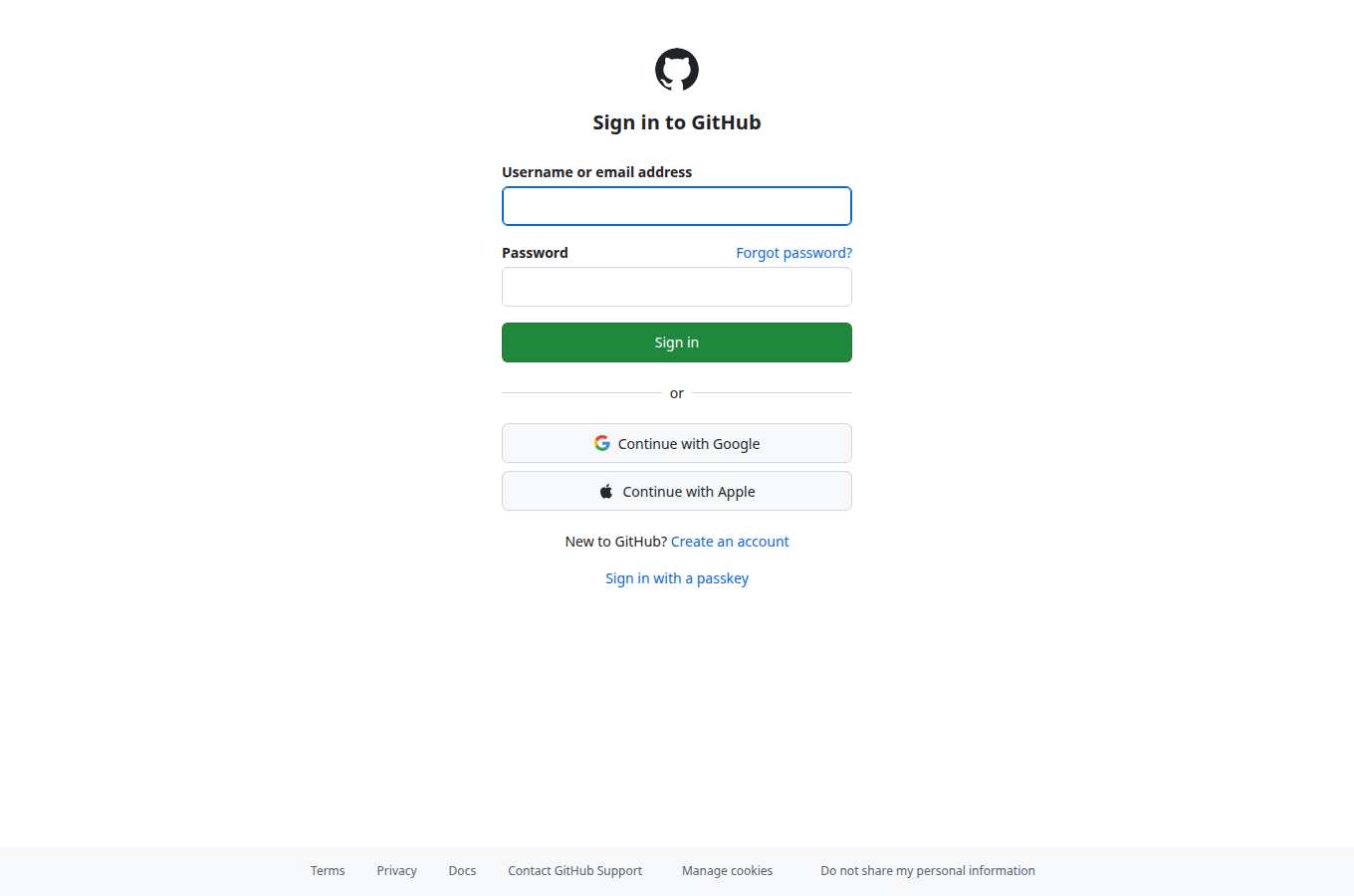
Every one of the 72 primary inspect-trusted visits loaded the page with no certificate warning. Every HTTPS document in those visits had an issuer of mitmproxy, which shows the inspection certificate was served and accepted. Across six slots, the trusted arm recorded 228 HTTPS document responses, including redirect hops and frames.
The direct baseline loaded all 72 pages with their real public certificates. The inspection path therefore changed only the issuer, not whether the page loaded.
Primary visits by outcome and condition
Each condition ran 72 primary visits across 12 pages and 6 slots. Teal is silent accept; blue is soft fallback.
All 216 primary visits
Silent accept and soft fallback split cleanly by trust state. No pin, certificate, or other failures.
Finding 2: without trust, the outcome is a warning, not a block
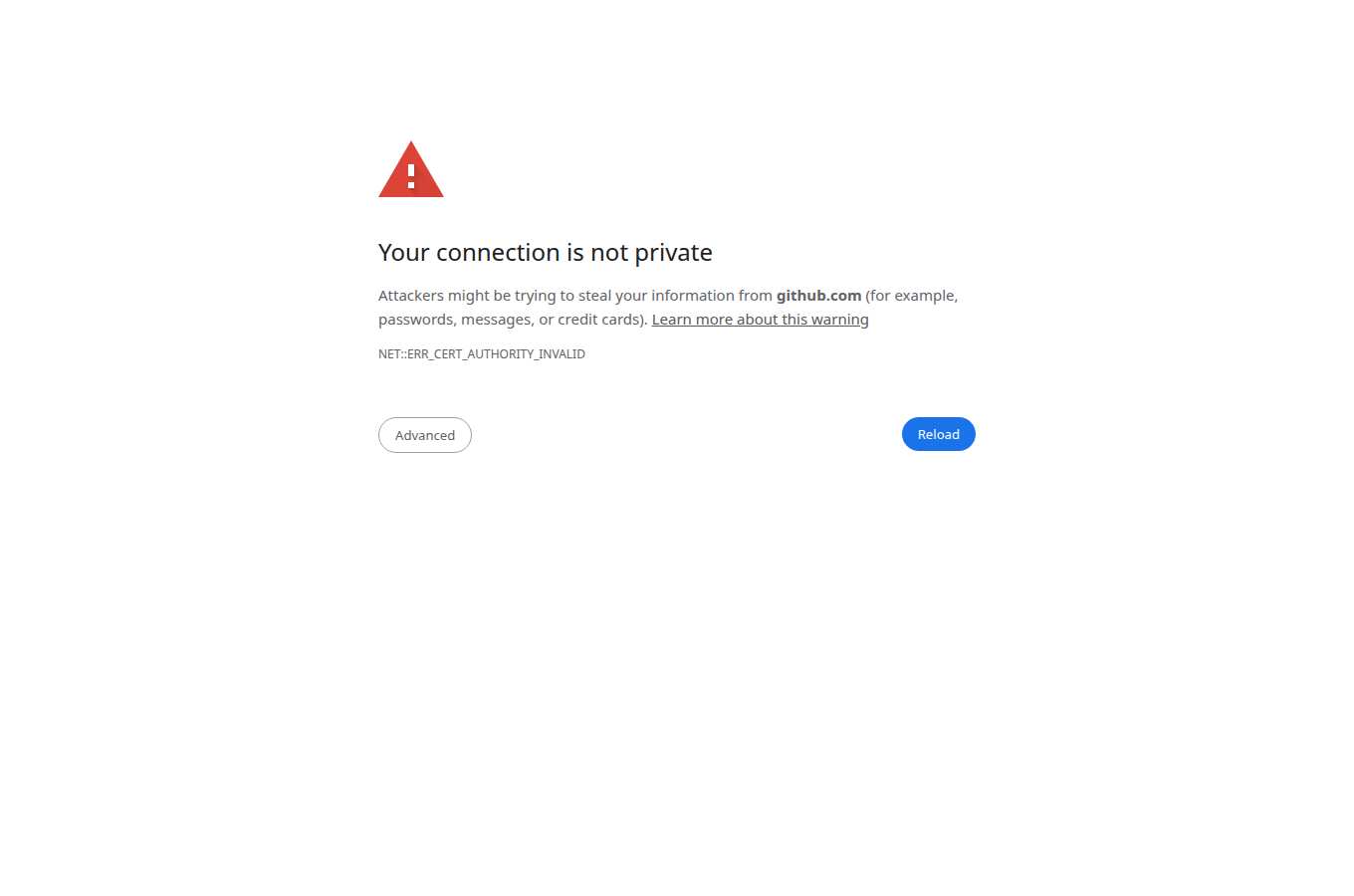
Every one of the 72 inspect-untrusted visits failed navigation with net::ERR_CERT_AUTHORITY_INVALID. In every one, a proceed or advanced control was present in the interstitial. The study recorded presence only. It did not click through, so this finding does not describe what happens after a user proceeds.
This is the pattern a user sees when an inspection root has not been installed. It is a warning, and the decision to continue is in the user’s hands.
Finding 3: no pin failure appeared, and the untrusted arm could not have shown one
Zero visits recorded a pinning error, including the 36 control visits.
As we understand Chromium’s implementation, pins are evaluated only after the chain validates. Because the untrusted arm fails validation first with ERR_CERT_AUTHORITY_INVALID, that arm cannot show whether a pin would have fired. The trusted arm validates, so it is the only arm where a pin check could have failed, and it passed every time.
The likely reason is that Chromium’s built-in pins are meant for chains issued by publicly known roots, and a root added to the user’s own trust store falls outside that set. We did not test Chromium’s pin code path directly. We observed the outcome and did not inspect the source.
This means the study cannot conclude that pinned apps or pinned API calls will accept a local root. Those are different code paths and need their own tests.
Finding 4: stability across six slots
Eleven of twelve hosts presented the same direct issuer in every slot. Yahoo was the exception. Its direct issuer changed at every slot boundary, moving across four distinct issuers over the study. The pin result did not change, because Yahoo still loaded silently under the trusted CA in all six slots. A pin set built around one host’s direct chain would still have been fragile, and any operator relying on pins should expect that kind of change.
HTTPS documents per trusted navigation
Redirect hops and frames each count. The same number appeared in every slot.
Consistency across six slots
Each line counts pages out of 12 in that slot. The lines stay flat, so no slot changed the answer.
Per-slot profile, out of 12 pages
Each axis is one slot. A full polygon at 12 means every frozen page showed that outcome in that slot.
| Host | Direct issuer | Issuer changes | Docs per trusted navigation | Trusted outcome | Untrusted outcome |
|---|---|---|---|---|---|
| Google Accounts | WE2 | 0 | 4 | 6 of 6 silent | 6 of 6 soft |
| Microsoft account | Microsoft TLS G2 RSA CA OCSP 04 | 0 | 3 | 6 of 6 silent | 6 of 6 soft |
| Apple ID | Apple Public EV Server RSA CA 1 - G1 | 0 | 3 | 6 of 6 silent | 6 of 6 soft |
| DigiCert Global G2 TLS RSA SHA256 2020 CA1 | 0 | 1 | 6 of 6 silent | 6 of 6 soft | |
| GitHub | Sectigo Public Server Authentication CA DV E36 | 0 | 1 | 6 of 6 silent | 6 of 6 soft |
| Yahoo | Amazon RSA 2048 M04 / RapidSSL TLS RSA CA G1 / DigiCert Global G2 TLS RSA SHA256 2020 CA1 / YE2 | 5 | 6 | 6 of 6 silent | 6 of 6 soft |
| डिसकॉर्ड | WE1 | 0 | 1 | 6 of 6 silent | 6 of 6 soft |
| Dropbox | WE2 | 0 | 6 | 6 of 6 silent | 6 of 6 soft |
| Microsoft Entra | DigiCert Global G2 TLS RSA SHA256 2020 CA1 | 0 | 4 | 6 of 6 silent | 6 of 6 soft |
| स्लैक | WE2 | 0 | 6 | 6 of 6 silent | 6 of 6 soft |
| Stack Overflow | YE1 | 0 | 1 | 6 of 6 silent | 6 of 6 soft |
| Tumblr | YE1 | 0 | 2 | 6 of 6 silent | 6 of 6 soft |
Every direct and trusted navigation returned HTTP 200 on the final document, and every trusted document issuer was mitmproxy. Negotiated protocol was TLS 1.3 on 143 of the 144 primary direct and trusted arms that recorded security details. One arm recorded TLS 1.2.
Finding 5: the controls behaved like the frozen pages
| नियंत्रण | Trusted outcome | Untrusted outcome |
|---|---|---|
| उदाहरण.com | 6 of 6 silent | 6 of 6 soft |
| httpbin.org/get | 6 of 6 silent | 6 of 6 soft |
The controls confirm that the instrument does not depend on the login surface. The same two outcomes appear for pages with no login at all.
यह अध्ययन आपको नहीं बता सकता
- Twelve pages, one region, one browser build. The sample is small. The vantage was a United States cloud datacenter. The browser was Chrome 157.0.8103.50 in headless mode. Results for other versions or for headed sessions could differ.
- Document navigation only. The study measured whether the document loaded and which certificate chain served it. It did not measure pinning on API hosts, asset hosts, or subresources that a login flow calls later.
- No logins. Nothing was typed. A real sign-in can trigger additional requests, and those could behave differently.
- Not every client. Native mobile apps, desktop applications, Firefox, Edge, and Safari were not measured. Pins in apps are a separate question.
- Trust installed by the user, not by policy. The CA was imported into a user-level NSS database. An enterprise trust policy could behave differently.
- Residential exits were not used. LinkedIn, PayPal, eBay, and Amazon did not qualify on the cloud, and the study did not test whether a residential path would have changed their results.
- The keyword filter removed a real login page. Spotify was excluded by a false-positive keyword match.
- The proceed control was detected, not used. Soft fallback here means a warning with a proceed control was present. The study did not click it and did not measure the page that follows.
- Yahoo’s direct chain moved every slot. The pin result was unaffected, but the movement is itself a finding about stability.
Practical takeaways
- A trusted inspection root is silent on mainstream login pages in Chrome. That is the expected behavior, and it is also why it is hard to notice. Treat silent acceptance as a visibility question for your own monitoring, not as a sign that nothing changed.
- An untrusted inspection root produces a warning, and the warning is the signal. The risk is not the warning itself. The risk is users learning to click through it.
- Check the issuer, not just whether the page loads. The
securityDetailsissuer in this study was the only reliable way to tell which chain served the page. - Do not generalize to app pins. Apps and API clients can pin differently. Test them separately.
- Keep the inspection scope narrow. Inspect only the hosts that need it, and do not let an inspection root become a broad trust anchor.
Evidence and downloads
Public package at /research/cert-pin-break-modes-3day/. Each slot folder also holds per-visit JPEG captures that show the page state at the end of each visit. The raw mitmproxy configuration and CA private key stay in an untracked private directory.
Download the evidence
Related FreePolicyTools research
- Browser path leak research looks at where browser traffic goes when the route changes.
- HTTP/3 proxy fallback research tests what a browser does when a faster transport is blocked.
- Browser fingerprinting research measures what a cloud Chromium profile reveals across routes.
- Machine-readable AI opt-out research checks which opt-out signals sites actually publish.
External references
प्रकटीकरण
This study was run independently by FreePolicyTools. No proxy vendor, security product, or affiliate chose the targets, designed the protocol, or saw the results before publication. The candidate list was fixed before screening.
All traffic ran over a direct cloud egress path through a local loopback mitmproxy instance. ProxySeller was NOT_RUN in every slot—the optional Day 0 cloud-block retry was not used—so this page does not include a ProxySeller promotion or affiliate CTA.
अक्सर पूछे जाने वाले प्रश्न
Window: 20261124-immediate to 20261126T1800Z, all times UTC. Chrome 157.0.8103.50, Playwright headless, cloud-direct vantage.