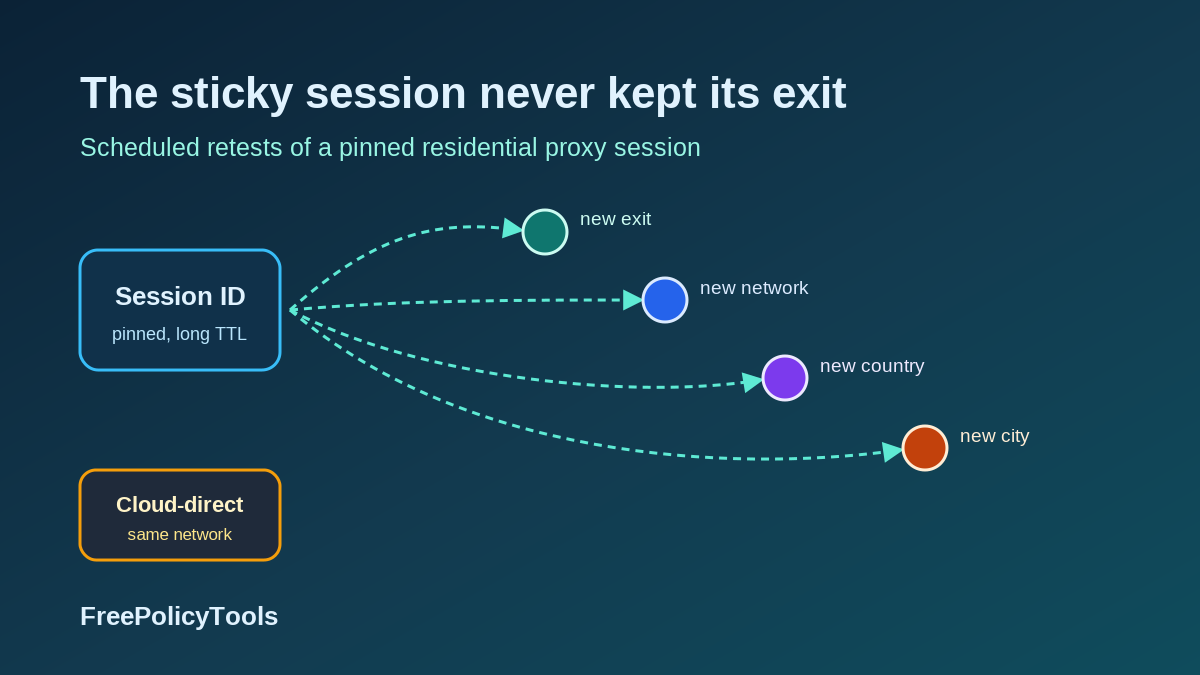
We pinned one residential proxy session ID with a 168-hour lifetime and checked its exit every six hours. It never came back on the same address. Across 26 scheduled retests over 10 calendar days, the sticky session changed IP in 25 of 25 retest intervals. Every change also moved the city, and 24 of 25 moved the network. The 26 retests landed on 26 different exits in 17 countries and 23 networks, and none repeated.
A control that asked for a fresh session at every retest behaved the same way, and it shared the sticky session’s exit at सब 26 retests. Cloud-direct egress from the same US virtual machine never left Amazon’s network in Ashburn, Virginia, even though its address varied.
The plain reading: on this account, a sticky session did not carry an exit across a six-hour gap with no traffic in between. The provider documents a 60-minute inactivity expiry, which this design could not rule out.
The answer
The sticky session’s silent-rotate rate was 100% (25/25). The Wilson 95% interval runs from 86.7% to 100%, so even the most generous reading of this sample puts the chance that a sticky session survives a six-hour idle gap on this setup at no more than about 13%. The table below summarises all three arms.
| Measure (26 retests, 25 intervals) | स्टिकी सत्र | Fresh-session control | Cloud-direct |
|---|---|---|---|
| Samples with a usable exit | 26 / 26 | 26 / 26 | 26 / 26 |
| Intervals with an IP change | 25 / 25 | 25 / 25 | 23 / 25 |
| Intervals with an ASN change | 24 / 25 | 24 / 25 | 0 / 25 |
| Intervals with a location change | 25 / 25 | 25 / 25 | 0 / 25 |
| Distinct exit addresses | 26 | 26 | 16 |
| Distinct countries | 17 | 16 (+1 unlabelled sample) | 1 |
| Distinct ASNs | 23 | 22 (+1 unlabelled sample) | 1 |
| Same exit as sticky at the same retest | लागू नहीं | 26/26 | 0 / 26 |
Why the run lasted 10 days and 26 retests
The study was designed as one week: seven days of four retests, 28 scheduled slots from 19 November 2026. A usage pause stopped collection after the 06:00 UTC slot on 21 November. We did not backdate the missed slots. 12 slots (day 3 at 12:00 through day 6 at 06:00) are recorded as a pause gap, and collection resumed on 24 November. The protocol was amended to extend the calendar only far enough to still collect 28 real slots.
We ended collection after the day 10 06:00 UTC retest, because the study was scoped to one week and the calendar had reached study day 10. The last two extension slots were not collected. The final dataset is 26 primary retests across study days 1 to 10, with samples on eight of those days. A Day 0 dry-run on 18 November is kept as scaffolding and excluded from every rate.
The gap affects one interval per arm, which spans 78 hours instead of six. Excluding it leaves the sticky result at 24 changes in 24 six-hour intervals.
Retests collected per study day
Column chart. Four slots per day; orange marks scheduled slots that were not collected (pause gap on days 3–6, and we stopped on day 10).
Prior study and what this one adds
The prior FreePolicyTools study, Proxy Connected, Browser Still Direct: WebRTC Left the Cloud Path Open, asked a one-shot path question: when Chromium is told to use a residential proxy, do document echoes and WebRTC candidates follow that path? It measured one moment.
This study adds the time dimension. There is no browser and no WebRTC here. It asks whether the egress identity of a pinned residential session (address, network, location) stays put across scheduled retests, compared with an explicit fresh-session control and with cloud-direct egress. It is not an uptime or speed review either. For background on the proxy types involved, see residential vs datacenter proxies और प्रॉक्सी श्रृंखला और घूर्णन प्रॉक्सी. Related time-series work includes the blocking outcome flip diary, which tracked whether residential paths were blocked, not whether their identity held.
विधि
Vantage and instrument
A Cursor Cloud Agent VM in a US datacenter ran Python’s urllib over HTTPS through an HTTP proxy using the CONNECT method, one fresh connection per echo. Each sample queried three public echoes in fixed order: ipinfo (address, ASN and org, city, region, country), ipify (address only), and Cloudflare’s trace endpoint (address, country, and the Cloudflare edge colo). The residential gateway was ProxySeller on port 10000, with credentials read from runtime secrets by name only. If HTTP versus SOCKS is new to you, see HTTP vs SOCKS proxies.
Frozen conditions
| शर्त | Intent | Suffix appended to the base login |
|---|---|---|
sticky-http | Keep one exit for the whole study | _s_fptcontweek01_ttl_168h |
rotating-http | Ask for a new session at each retest | _s_fptrot{cadenceId}{nonce}_ttl_5m |
cloud-direct | Control, no proxy | कोई नहीं |
The suffixes follow ProxySeller’s documented session controls: _s_ sets a session ID and _ttl_ its lifetime. The documentation says the same ID returns the same exit “while session is alive” and that “inactive sessions expire after 60 minutes”. No country, ASN or city targeting was used.
Schedule and taxonomy
Retests ran at 00:00, 06:00, 12:00 and 18:00 UTC, each allowed ±30 minutes. Samples started a median 5.42 minutes after the slot (maximum 6.69). Within a retest the arms ran back to back: sticky, fresh session, cloud-direct. The sticky arm’s first echo and the fresh-session arm’s last echo were 3.2 to 44.8 seconds apart (median 9.6 seconds). No traffic went through the sticky session between retests.
Each sample is ok when at least one echo returns a public address plus a country or org; otherwise it is an engagement, echo or guard failure. Between consecutive ok samples of one arm we label ip_changed, asn_changed, geo_changed (country, region or city), silent_rotate (any of the three) or stable. The primary metric is sticky silent_rotate intervals over sticky ok→ok intervals, reported with a confidence interval for a proportion (Wilson score).
Raw addresses stay in a private folder. Public files carry a 16-character SHA-256 prefix of each address, plus ASN, org, location and Cloudflare colo, and every committed file was scanned for address-shaped strings before each commit.
Finding 1: the sticky session never survived a six-hour retest
सब 25 sticky intervals changed address, including the 78-hour interval across the pause gap. Location changed in all 25. The network changed in 24; the exception was day 8, 12:00 to 18:00 UTC, when the exit moved from Cheboksary to Saratov inside the same Russian network (AS12389 Rostelecom).
The 26 sticky exits were all different, so the longest run on one address was a single retest. A 168-hour TTL was requested. The lifetime we observed, at six-hour resolution, was under six hours every time.
Share of retest intervals where each identity layer changed
Horizontal grouped bars, percent of 25 intervals per arm.
Cumulative distinct addresses over the run
Line chart. A sticky session that held would stay flat at 1.
Finding 2: sticky and fresh-session IDs shared the same exit at every retest
The fresh-session control used a new session ID every time with a five-minute TTL, so it should have been free to land anywhere. Instead, at all 26 retests it reported the same exit, country and network as the sticky session sampled seconds earlier. This is the most unexpected result in the dataset. Three explanations fit, and this design cannot separate them:
- Exit assignment followed the gateway port. Every request used port 10000, and the provider documents that each port from 10000 to 10999 maps to a distinct exit. A port-level mapping may outweigh session labels for a short window.
- The session suffix did not change assignment on this account. The gateway accepted the suffixed logins (malformed variants were rejected with
407 Proxy Authentication Requiredon Day 0), but acceptance does not prove the label took effect. - A short default reuse window. If the account reuses its current exit briefly for any login, two requests seconds apart would match whatever their labels.
What the data do rule out is the strong claim that a different session ID guarantees a different residential exit within seconds. It did not, 26 times out of 26.
Finding 3: where the exits came from
With no targeting suffix, the sticky session’s 26 exits covered 17 countries and 26 different cities. Russia supplied six, Vietnam, Brazil, Türkiye and India two each, and twelve other countries one each. Most networks were consumer ISPs or national carriers; AS12389 Rostelecom appeared four times. One Amsterdam exit (AS212477) carried an org name that reads as a hosting company. We do not classify networks as residential or not, so we report the label as given.
Sticky exits by region
Pie chart of all 26 sticky exits.
Cloudflare edge colos seen by sticky exits
Column chart, top eight of 18 colos.
| देश | Sticky retests | शेयर |
|---|---|---|
| रूस (RU) | 6 | 23.1% |
| Vietnam (VN) | 2 | 7.7% |
| Brazil (BR) | 2 | 7.7% |
| Türkiye (TR) | 2 | 7.7% |
| भारत (IN) | 2 | 7.7% |
| Moldova (MD) | 1 | 3.8% |
| जर्मनी (DE) | 1 | 3.8% |
| Spain (ES) | 1 | 3.8% |
| संयुक्त राज्य अमेरिका (US) | 1 | 3.8% |
| यूनाइटेड किंगडम (GB) | 1 | 3.8% |
| Uzbekistan (UZ) | 1 | 3.8% |
| Kazakhstan (KZ) | 1 | 3.8% |
| नीदरलैंड (NL) | 1 | 3.8% |
| कनाडा (CA) | 1 | 3.8% |
| Ukraine (UA) | 1 | 3.8% |
| Taiwan (TW) | 1 | 3.8% |
| चीन (CN) | 1 | 3.8% |
If an application needs one country, this is the practical warning: without a country suffix, a retest six hours later may be on another continent. Pinning a country bounds that drift but does not create stickiness, and we did not test it.
Finding 4: inside a retest, the session did hold
The three echoes in a sample are separate HTTPS connections made over about three seconds. In 25/26 sticky samples, every echo that answered reported the same address, so the session held for at least those seconds. The exception, day 3 at 06:00 UTC, is instructive: ipinfo and Cloudflare both saw a Moscow address on AS8402, while ipify, queried between them a second later, saw a different address. The fresh-session arm showed the same split at the same retest, with its own different ipify address.
So the session lifetime on this setup sits between a few seconds and six hours. The six-hour cadence cannot narrow it further.
Finding 5: cloud-direct kept its network but not its address
Cloud-direct stayed on AS14618 Amazon in Ashburn, Virginia, and on the Cloudflare IAD edge, in all 26 samples. Its network and location never changed, but its address changed in 23 of 25 intervals, with two stable intervals on 20 November.
The reason shows up inside each sample. The three cloud-direct echoes returned three different addresses in 20 of 26 samples, two in 5 and one in 1. Across all cloud-direct echo responses we saw 28 distinct addresses, and one primary address recurred at four retests. That pattern fits a pool of outbound addresses chosen per connection, as cloud NAT gateways can do, rather than rotation over time.
The lesson is about metrics. An IP-only counter would rate plain cloud egress as 92% unstable, while the network and location layers show zero change. A continuity claim needs all three layers. This also echoes our earlier note on क्यों बदलना IP अपने ब्राउज़र फिंगरप्रिंट को नहीं बदलता है: an address is only one layer of identity.
Cloud-direct: addresses seen within one sample
Donut chart of 26 samples, three echoes each.
Identity profile: sticky vs cloud-direct
Radar chart, percent on each axis.
Finding 6: two independent sources agreed on location
ipinfo derives location from its geolocation database, and Cloudflare reports the country it assigns to the connecting address. Wherever both returned a country, they agreed: zero mismatches in any arm. Residential exits also reached 18 different Cloudflare colos while cloud-direct used one. The location changes in Finding 1 are therefore not an artefact of one geolocation database.
Why the sticky session did not survive
ProxySeller’s documentation points to the most likely mechanism. A session holds “while session is alive”, and “inactive sessions expire after 60 minutes”. Our protocol sent nothing through the sticky session between retests, so each six-hour gap was six idle hours. If inactivity expiry applies even when a longer _ttl_ is set (the documentation does not say which wins), every retest would see a new exit, which is exactly what we observed.
That is a hypothesis grounded in the provider’s own documentation, not a measured cause. A follow-up would send a keepalive request through the sticky session every few minutes and check whether the exit then survives the six-hour retest. We did not run that arm.
What this means in practice
- Do not read a sticky label as hours of continuity. On this setup, a long TTL with idle gaps gave a new exit every time.
- Check the exit before relying on it. One request to an IP echo before a login or checkout shows whether the exit is still the one you expect.
- Keep the session active if it must last. The documented inactivity rule implies traffic at least hourly. We did not test keepalive, so treat it as the documented requirement.
- Bound the drift you can tolerate. Country or ASN suffixes limit where a new exit can land if the session rolls over.
- Do not rely on session IDs to separate identities. Two IDs shared one exit at every retest; use distinct ports and verify.
- Measure continuity on three layers. IP alone overstates churn on cloud egress and understates how far a residential exit moves.
For a broader look at the provider, see our ProxySeller review. For how credentials behave on the proxy hop, see Proxy Auth Never Reached the Origin.
All 26 retests
Every primary retest, in order. Exit hashes are the first eight characters of the public 16-character hash. The fresh-session column shows whether that arm reported the same exit hash as the sticky session at the same retest.
| Retest (UTC) | Sticky exit | नेटवर्क | Hash | Fresh session same? | Cloud-direct |
|---|---|---|---|---|---|
| 11-19 00:00 | Tiraspol, MD | AS1547 INTERDNESTRKOM, Sovmestnoe Zakrytoe Aktsionernoe Obshchestvo | 5d91a4ff | हाँ | US AS14618 e424b541 |
| 11-19 06:00 | Phú Thọ, VN | AS7552 Viettel Group | 68506f30 | हाँ | US AS14618 bc2cf3d1 |
| 11-19 12:00 | Freising, DE | AS3320 Deutsche Telekom AG | 843b8e5f | हाँ | US AS14618 e424b541 |
| 11-19 18:00 | Orihuela, ES | AS57970 OLE COMUNICACION S.L. | 385f4195 | हाँ | US AS14618 9c4815d3 |
| 11-20 00:00 | Nashville, US | AS7922 Comcast Cable Communications, LLC | 79298391 | हाँ | US AS14618 c4189d2a |
| 11-20 06:00 | London, GB | AS201838 Community Fibre Limited | f312793a | हाँ | US AS14618 c4189d2a |
| 11-20 12:00 | Rostov-on-Don, RU | AS58096 Viter Evgeniy Vasilevich | 5d4a5795 | हाँ | US AS14618 c4189d2a |
| 11-20 18:00 | Santo André, BR | AS28573 Claro NXT Telecomunicacoes Ltda | 38172ed8 | हाँ | US AS14618 bc2cf3d1 |
| 11-21 00:00 | Avsallar, TR | AS205570 SIBANET TELEKOM LIMITED SIRKETI | abe2c257 | हाँ | US AS14618 ce666ad8 |
| 11-21 06:00 | Moscow, RU | AS8402 PJSC "Vimpelcom" | b74a67da | हाँ | US AS14618 82db85e0 |
| 11-24 12:00 | Patna, IN | AS55836 Reliance Jio Infocomm Limited | 1048f72b | हाँ | US AS14618 e3e6d45a |
| 11-24 18:00 | Tashkent, UZ | AS8193 "Uzbektelekom" Joint Stock Company | 2d74463f | हाँ | US AS14618 c1aadb97 |
| 11-25 00:00 | Astana, KZ | AS9198 JSC Kazakhtelecom | c55c746f | हाँ | US AS14618 753c91bb |
| 11-25 06:00 | Amsterdam, NL | AS212477 RoyaleHosting BV | ee4d9b95 | हाँ | US AS14618 e3e6d45a |
| 11-25 12:00 | Adana, TR | AS9121 Turk Telekomunikasyon Anonim Sirketi | a55ec998 | हाँ | US AS14618 753c91bb |
| 11-25 18:00 | Hanoi, VN | AS18403 FPT Telecom Company | 3db5d5cb | हाँ | US AS14618 9709e76b |
| 11-26 00:00 | Caruaru, BR | AS267345 BOM JESUS NET LTDA | 1d91b7b1 | हाँ | US AS14618 753c91bb |
| 11-26 06:00 | Tirur, IN | AS9829 National Internet Backbone | 3e5a8d9c | हाँ | US AS14618 e3e6d45a |
| 11-26 12:00 | Cheboksary, RU | AS12389 PJSC Rostelecom | 963b57e9 | हाँ | US AS14618 06ae80cd |
| 11-26 18:00 | Saratov, RU | AS12389 PJSC Rostelecom | 013c1fd4 | हाँ | US AS14618 8036bb02 |
| 11-27 00:00 | Dartmouth, CA | AS11260 EastLink | 39cdf1bb | हाँ | US AS14618 7533c895 |
| 11-27 06:00 | Velikiye Luki, RU | AS12389 PJSC Rostelecom | d7b3f0ef | हाँ | US AS14618 dff3fc69 |
| 11-27 12:00 | Kyiv, UA | AS47359 "Tvoi Net" Ltd. | 4deb1041 | हाँ | US AS14618 9709e76b |
| 11-27 18:00 | Voskresensk, RU | AS12389 PJSC Rostelecom | f322028a | हाँ | US AS14618 a7ba584b |
| 11-28 00:00 | Taichung, TW | AS3462 Data Communication Business Group | 88904b3f | हाँ | US AS14618 e3e6d45a |
| 11-28 06:00 | Nanjing, CN | AS4134 CHINANET BACKBONE | ba345750 | हाँ | US AS14618 733d8de1 |
सीमा
- One provider, one account, one gateway port, one US cloud vantage and one HTTP CONNECT client. Results do not generalise to other providers, plans, regions or SOCKS clients.
- Six-hour resolution: the study cannot say how long a session lasted between retests, only that it never lasted six idle hours.
- No keepalive arm and no targeting suffixes, so the inactivity hypothesis and country pinning are untested.
- The fresh-session arm always ran seconds after the sticky arm, so the shared-exit result may depend on that ordering.
- 26 retests, not 28: a 12-slot pause gap, never backfilled, and we ended collection early. One interval spans 78 hours.
- Disclosed taxonomy deviation: on day 1 at 18:00 UTC the fresh-session arm got an address only from ipify, with no country or org. The collector labelled it
ok; strictly it is an echo failure. Treated strictly, that arm has 24 intervals, all changed. The sticky arm is unaffected. - 229 of 234 echo requests answered (three timeouts on day 1 at 18:00, two ipify errors on day 10 at 06:00). Every sample still had a usable address.
- Location and network labels come from ipinfo and Cloudflare, not the provider. They agreed, but both are third-party databases.
- This is not an uptime, speed or provider ranking. All 78 samples succeeded, and success is not a quality score here.
साक्ष्य और उत्तरदायित्व
Raw addresses and credentials are not published. Everything else is: the protocol frozen on 18 November 2026 with its amendment log (pause, resume and stop), one redacted JSON file per retest and arm, the pause-gap record, the scripts, and the whole-run summary that feeds this page.
अक्सर पूछे जाने वाले प्रश्न
How long did the sticky residential session keep the same IP?
Does this mean Proxy-Seller sticky sessions do not work?
How can I keep a sticky residential IP for hours?
Why did the fresh-session control land on the same IP as the sticky session?
Why did the study run for 10 days instead of 7?
Did cloud-direct egress rotate too?
Is this a proxy uptime or speed review?
Can I reproduce the study?
स्रोत
Primary sources and citation
- ProxySeller: Connect and target via login (session ID and TTL suffixes)
- RFC 9110, HTTP Semantics: the CONNECT method
- NIST/SEMATECH e-Handbook: confidence limits for a proportion
- AWS: NAT gateways
- ipinfo developer documentation
- Prior FreePolicyTools study: Proxy Connected, Browser Still Direct: WebRTC Left the Cloud Path Open
Cite as: FreePolicyTools, “Sticky Residential Proxy Sessions Changed IP and Location at Every 6-Hour Retest Over 10 Days”, 28 November 2026. Evidence slug sticky-residential-continuity-week.
संबद्ध प्रकटीकरण: FreePolicyTools is a ProxySeller affiliate and may earn a commission from purchases made through the links on this page. ProxySeller supplied the residential endpoints measured here through a normal account. The affiliate relationship did not change the protocol, the data or the conclusions, and ProxySeller did not review this article.