Limitation first: the test VM had no working IPv6 connectivity in any of the six slots, so there was no cloud IPv6 address for a leak to reveal. This study does not show that IPv4-only proxies protect a dual-stack host. The clear result is a separate one: WebRTC reported the VM’s own public IPv4 through the proxy in 5 of 12 residential probes.
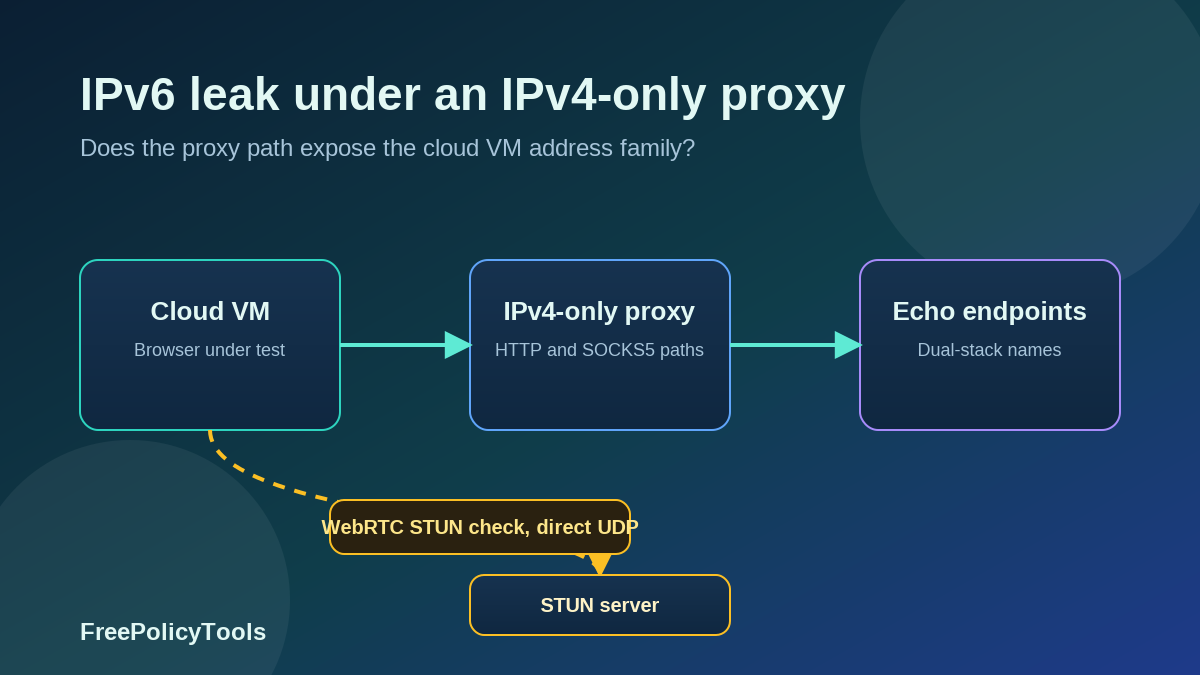
FreePolicyTools ran a six-slot, three-day diary from a US cloud VM. Each slot sent one probe direct, one through an HTTP proxy, and one through a SOCKS5 proxy, both IPv4-only ProxySeller paths. The question was whether AAAA DNS records, the IP family seen by public echo endpoints, or WebRTC ICE candidates revealed the VM’s IPv6 address while traffic went out over IPv4.
Short answer: no IPv6 was exposed, but that result is weaker than it looks. The VM had no working IPv6 connectivity in any of the six slots, so there was no cloud IPv6 address for a leak to reveal. This study cannot show that IPv4-only proxies are safe for a dual-stack host. A separate result is more concrete: in 5 of 12 proxied probes, WebRTC reported the VM’s own public IPv4 address through the proxy.
What the study asked
- DNS. Do dual-stack names return AAAA records to the VM?
- Documents. Do public echo endpoints report an IPv6 egress family through the proxy?
- WebRTC. Do STUN-based ICE candidates include a public IPv6 address, or an IPv4 address that matches the VM’s direct baseline?
The study does not measure a Happy Eyeballs race across many networks, sticky residential sessions, or a VPN tunnel. No VPN tunnel was run because the VM had no usable TUN path. This study builds on our WebRTC en IPv6 lekgids, and it uses ProxySeller endpoints like the HTTP/3 diary. The earlier browser path-leak study asked a related question about document echoes and WebRTC.
How it was measured
The protocol was frozen on 24 November 2026 before the first collection and did not change afterward. It lists six hosts, which is the cap. Three are dual-stack names (dns.google, cloudflare.comen one.one.one.one). Three are fixed echo and trace URLs (api.ipify.org, api64.ipify.orgen cloudflare.com/cdn-cgi/trace). WebRTC used one STUN server,stun.cloudflare.com:3478, for ICE gathering only.
Each slot ran three probes in a fixed order: cloud-direct, residential-httpen residential-socks. That makes six direct probes and twelve residential probes. The browser was headless Chromium. The SOCKS path used a local anonymizer, because Chromium does not accept SOCKS username and password. SOCKS5 itself is specified in RFC 1928. The WebRTC check loaded a local fixture page, created an RTCPeerConnection, gathered ICE candidates for eight seconds, and classified each candidate by family and scope. Public evidence stores salted or truncated hashes, not addresses.
Six slots
| Slot (UTC) | AAAA on all three names | Cloud IPv6 reachable | Residential echo IPv6 | Residential WebRTC public IPv6 | Residential WebRTC matched cloud IPv4 (of 2) |
|---|---|---|---|---|---|
| 24 Nov, immediate | Ja. | Nee | 0 | 0 | 0 |
| 24 Nov, 18:08 | Ja. | Nee | 0 | 0 | 1 |
| 25 Nov, 06:08 | Ja. | Nee | 0 | 0 | 0 |
| 25 Nov, 18:08 | Ja. | Nee | 0 | 0 | 1 |
| 26 Nov, 06:08 | Ja. | Nee | 0 | 0 | 2 |
| 26 Nov, 18:08 | Ja. | Nee | 0 | 0 | 1 |
Direct probes matched their own IPv4 baseline in all six slots. That confirms the WebRTC check can see the VM’s public IPv4 when there is no proxy. Slot times are UTC; the immediate slot ran on 24 November at 13:21.
The IPv6 result has a hole
The cloud IPv6 connectivity probe, a UDP connect to a public IPv6 DNS address, failed in every slot. The direct echo requests returned IPv4. A leak test on that VM has nothing to leak, so “no IPv6 exposure” here means “no IPv6 was present to expose.”
The AAAA results show that the DNS names advertise IPv6, which is the condition a dual-stack client would meet. This test does not show what such a client would do, which resolver it would use, or whether a browser would try IPv6 first through the proxy. Browsers that race the two families follow the pattern in Happy Eyeballs version 2 (RFC 8305). A dual-stack VM is the next test.
The WebRTC IPv4 result
The five matches are not IPv6, but they are a real exposure. Under the proxy, WebRTC’s STUN request still reported the VM’s public IPv4. The hashes match the VM’s own direct baseline in the same slot, so the address is not the proxy’s exit.
The pattern is uneven. One slot had both residential paths match. Three slots had one path match, two HTTP and one SOCKS, and two slots had neither. With one probe per condition per slot, this study cannot tell whether that comes from routing, timing, or the browser’s ICE choices. The exit country also changed between slots, so the matches do not depend on one exit.
For a browser behind an IPv4-only proxy, this is the more concrete finding. Anyone who relies on a proxy to hide a host’s address should test WebRTC with that same proxy in that same browser.
Residential probes that matched
Share of the 12 residential probes whose WebRTC candidate matched the VM’s direct IPv4 baseline.
Matches by proxy type
HTTP matched in three slots and SOCKS5 in two, out of six probes each.
Cumulative residential matches
Running total across the six slots, in order. It rose in four of the six slots.
Matches per slot
Why WebRTC can report the VM’s address behind a proxy
WebRTC gathers candidate addresses with Interactive Connectivity Establishment (ICE), defined in RFC 8445. Host candidates are the local interface addresses. Server-reflexive candidates come from a STUN server, which reports the public address a packet arrived from, as described in RFC 8489.
The STUN request is a UDP packet sent by the browser’s own network stack. A proxy setting in Chromium governs the page’s HTTP and HTTPS requests. In the configuration tested, it did not carry that UDP packet. We did not capture packets, so this is an inference. It fits the result: the reflexive address equaled the VM’s direct baseline, which is what a packet sent from the VM’s own public address would report.
What to check if you use a proxy
- Run a WebRTC candidate test in the same browser, through the same proxy, before you rely on it. Compare the server-reflexive candidates with your real public address.
- Check whether the host has a working IPv6 route. If it does not, an IPv6 test on that host proves little. Repeat the test on a dual-stack host.
- Check DNS separately from the document path. The AAAA answers and the resolver a browser uses can differ from the proxy’s exit. The DNS leaks guide covers the resolver side.
- Repeat the test over several slots. One exit does not show the whole pattern, and our matches changed from slot to slot.
- If WebRTC must stay off a page, use a browser setting or policy that limits non-proxied UDP. Confirm it with a candidate test, not with the setting alone.
For background on how a browser fingerprint and network identity interact, see the browser fingerprinting research.
What this does not show
- It does not show that IPv4-only proxies are safe for a dual-stack host.
- It does not show that any other browser, OS, or VPN behaves the same way.
- It is not a population rate. Six slots, one VM, and one residential account make this a diary.
- It does not test a VPN tunnel or a VPN with its own UDP policy.
- It does not test a sticky residential session.
- The echo endpoints are not a single ground truth.
- The browser was headless Chromium. A desktop profile may behave differently.
Next test
Repeat the same protocol on a dual-stack VM with working IPv6, with the same six hosts and the same three conditions. Keep the WebRTC check, because the IPv4 result shows it can expose the host even when the document path is clean.
Vragen
Package and citation
Voorgestelde aanhaling: FreePolicyTools. “IPv6 Leak Test Behind an IPv4 Proxy: No IPv6 Leak Measured, but WebRTC Revealed the Real IPv4 in 5 of 12 Probes.” Original research collected 24 to 26 November 2026, six slots, UTC.
Affiliate disclosure. This article links to ProxySeller. FreePolicyTools may earn a commission if you buy through those links. ProxySeller endpoints were the residential paths in this study. The links did not change the protocol, the collection, or the results.