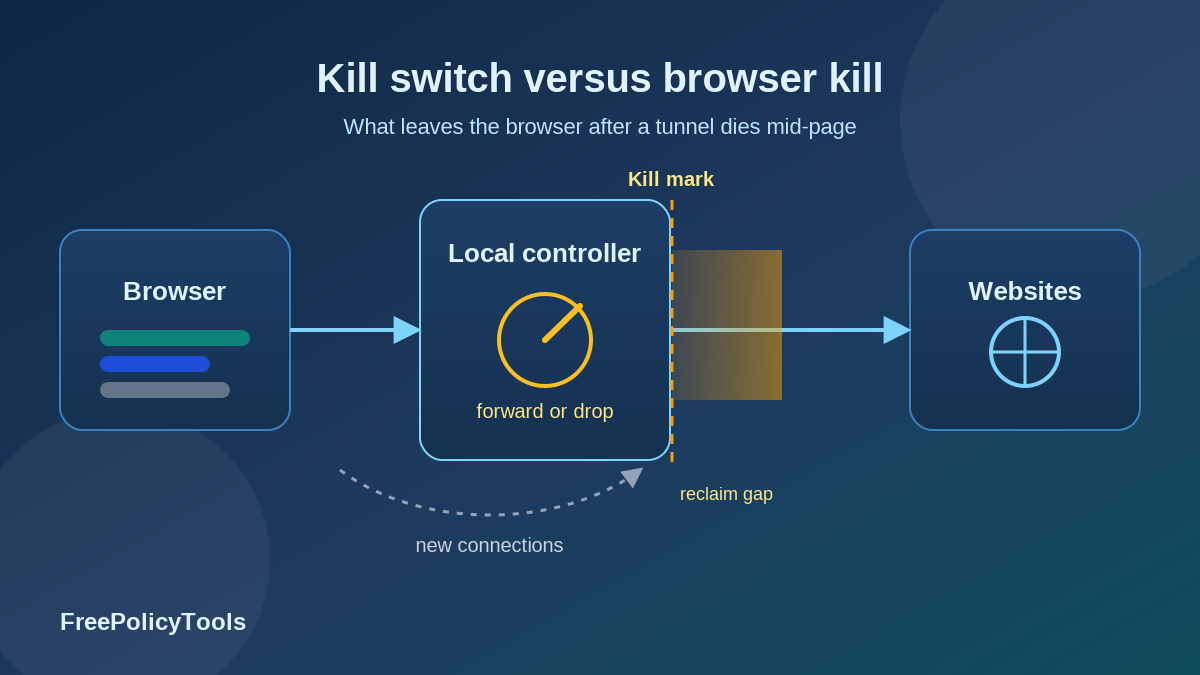
In a local CONNECT lab run from a USA cloud virtual machine, a tunnel kill mid-page left new WebSocket connections alive and new DNS-bound CONNECTs were forwarded. With no reclaim, every new WebSocket and DNS-bound CONNECT was forwarded to the underlay: 60 联 合 国 60 WebSocket and 60 联 合 国 60 DNS-bound across six slots. With a 500 ms reclaim delay, about one WebSocket left the browser per slot and about one DNS-bound CONNECT was forwarded, both before the drop took effect. With a 0 ms reclaim, all 66 new WebSocket and all 66 DNS-bound CONNECTs were dropped.
HTTPS did not answer the question. The fixture reused a tunnel that was already open, so no new HTTPS CONNECT reached the controller after the kill in any arm. Requests kept leaving over existing connections in every kill arm, including the 0 ms arm. The lab blocked new connections, not established ones.
This is a controlled lab model, not a test of any VPN product. No VPN tunnel was run and ProxySeller was not used. For the broader series, see the HTTP/3 fallback diary,则 blocking outcome flip diary, and the DNS path intermittency diary.
The question we froze
After a tunnel kill in the middle of a page load, do new HTTPS, WebSocket, and DNS-bound connections leave the browser before the kill switch reclaims the path? The protocol was frozen on 24 November 2026 at 13:18 UTC, before any measurement. Six slots ran from 24 to 26 November. Every slot landed inside its window, and none was marked missed.
The study compared three arms against a stable baseline: a kill with the underlay left open, a kill followed by a reclaim after a registered delay, and a browser kill with the tunnel left up.
What the lab is, and is not
Chromium, driven by Playwright 1.49.1 in headless mode, sent all non-loopback traffic to a local HTTP CONNECT controller. The controller had three modes: tunnel forwarded new CONNECTs, open kept forwarding them to model an underlay with no reclaim, and ks refused them with HTTP 503 to model the kill switch after reclaim.
- It is a reproducible way to separate "the browser tried to leave" from "the path forwarded it."
- It is not a VPN. There is no WireGuard session, no vendor client, and no separate exit address. Forwarding in both
tunnel财务报告和审定财务报表openused the cloud underlay. - No VPN tunnel was run. The machine has a TUN device, but the presence of
/dev/net/tundoes not count as a tunnel, and no credentials or WireGuard peer were configured. - ProxySeller is
NOT_USED. Its environment variables were recorded as present only.
How the probes worked
A fixture page on loopback ran three probes repeatedly, with a loop interval of about 300 ms plus request time. The HTTPS probe fetched Cloudflare's /cdn-cgi/trace with a cache buster. The WebSocket probe opened and closed a wss:// connection to an echo service. The DNS-bound probe fetched a fresh .invalid hostname, a reserved name under RFC 6761 that cannot resolve.
The controller logged every CONNECT with its decision: forwarded, upstream error, or dropped by the kill switch. The controller log is the authority for new-connection counts. The browser's own report is secondary.
Eight hosts were frozen from twelve candidates before the first slot. Membership never changed after the freeze, and the list is published as hosts.frozen.json.
Results across six slots
Every diary condition gave the same verdict in every slot. The table below lists the verdict for each slot.
| Arm | Day 0 | 24 Nov 18:00 | 25 Nov 06:00 | 25 Nov 18:00 | 26 Nov 06:00 | 26 Nov 18:00 |
|---|---|---|---|---|---|---|
| Stable tunnel | 稳定 | 稳定 | 稳定 | 稳定 | 稳定 | 稳定 |
| Kill, no reclaim | left, no reclaim | left, no reclaim | left, no reclaim | left, no reclaim | left, no reclaim | left, no reclaim |
| Kill, 0 ms reclaim | blocked | blocked | blocked | blocked | blocked | blocked |
| Kill, 500 ms reclaim | left in gap | left in gap | left in gap | left in gap | left in gap | left in gap |
| Browser kill | stopped | stopped | stopped | stopped | stopped | stopped |
UTC times. Slot 1 is the Day 0 slot, run after the freeze. Pills summarize the verdict label written by the collector.
| Arm, six slots | Post-kill attempts | New WebSocket CONNECTs | New DNS-bound CONNECTs | HTTPS left (new CONNECTs) |
|---|---|---|---|---|
| Kill, no reclaim | 180 | 60 forwarded, 0 dropped | 60 forwarded, 0 dropped | 60 left (0 new) |
| Kill, 0 ms reclaim | 198 | 0 forwarded, 66 dropped | 0 forwarded, 66 dropped | 66 left (0 new) |
| Kill, 500 ms reclaim | 213 | 6 forwarded, 65 dropped | 6 forwarded, 65 dropped | 71 left (0 new) |
| Browser kill | 0 | 0 forwarded, 0 dropped | 0 forwarded, 0 dropped | 0 left (0 new) |
Post-kill attempts by outcome, six slots
Stacked bars. Each bar is one arm's full post-kill total across six slots.
- New CONNECT forwarded
- New CONNECT dropped
- HTTPS over existing tunnel
New connections that got through, by channel
Column chart. Six slots combined. Bar heights are counts; the number above each bar is the count.
- WebSocket forwarded
- DNS-bound forwarded
First new leave after the kill mark, per slot
Line chart. Dashed line marks the 500 ms reclaim delay. Leaves cluster just under 300 ms because the probe loop fires about every 0.3 to 0.5 s, so this shows the probe schedule as much as a leak threshold.
- No reclaim (ms)
- 500 ms reclaim (ms)
- 500 ms reclaim delay
Outcome of new WebSocket and DNS-bound CONNECTs
Donut chart. Combined across the no-reclaim, 0 ms, and 500 ms arms, six slots. The arms were designed differently, so this shows composition, not a rate.
- Forwarded: 132 (33.5%)
- Dropped: 262 (66.5%)
Channel by channel
HTTPS: the channel that did not test reclaim
Across six slots the controller logged zero new HTTPS CONNECTs after any kill mark. Requests still reported as left in every kill arm: 60 in the no-reclaim arm, 66 in the 0 ms arm, and 71 in the 500 ms arm. The most likely explanation is that Chromium reused a tunnel opened before the kill. That was not isolated directly. A real teardown may close those connections, but this design does not test it.
WebSocket: a clean signal
Each WebSocket probe opened a new connection and so required a new CONNECT. With no reclaim, all 60 were forwarded. At 0 ms, all 66 were dropped. At 500 ms, 6 left during the gap, about one per slot, and 65 were dropped after reclaim.
DNS-bound CONNECTs: a forwarding decision, not a resolver packet
The browser reported the .invalid probe as failed in every arm, including the stable one, because the name does not resolve. The controller's forwarding decision is the signal. Forwarded means the controller tried to connect on the cloud path, which is an attempt to resolve there. This study does not capture stub resolver traffic, so it cannot say whether a real resolver would have sent a query.
Reclaim timing
The 500 ms arm measured a reclaim lag of 501 改为 502 ms in every slot. The 0 ms arm measured 1 改为 2 ms.
| Extra arm (Day 0 only) | Reclaim lag | Leaves in the gap | After reclaim | Reading |
|---|---|---|---|---|
| 100分钟 | 103 ms | 0 (0 WebSocket, 0 DNS-bound) | 11 WebSocket, 11 DNS-bound dropped | No probe fired inside the gap, so the verdict is not a timing test. |
| 2000 ms | 2001 ms | 10 (5 WebSocket, 5 DNS-bound) | 11 WebSocket, 11 DNS-bound dropped | Leaves spread across the longer gap. |
The probe loop limits what the timing arms can show. The first new leave after the kill mark came between 273 财务报告和审定财务报表 302 ms in the no-reclaim arm, and between 281 财务报告和审定财务报表 342 ms in the 500 ms arm. Those figures mostly reflect when the first probe fired after the kill. They are not a measured leak threshold.
The Day 0 extra arms show that reclaim below about 300 ms may simply go unsampled. In the 100 ms arm, no probe fired inside the 103 ms gap. Only the 0 ms and 500 ms arms are good evidence about timing.
Browser kill
In all six slots, the browser-kill arm recorded zero post-kill events. Closing the page and context ended new requests. That follows from the design. It shows that closing the browser stops the browser's own traffic, and says nothing about whether a network kill switch would stop a live page.
Ecological mid-page check
Each slot also ran one visit to the first frozen host under the no-reclaim arm. It logged zero forwards and zero drops after the kill in all six slots, with one page request after the kill. We did not isolate why, and the check adds no evidence about new-connection leaks, so this page does not interpret it further.
限制
- Lab model, not a VPN. The controller is a local CONNECT proxy with no WireGuard session and no vendor client.
- Kill acts on new connections only. Established connections survive the kill. This matters most for the HTTPS result.
- Small per-slot counts. About 10 to 12 post-kill probes per channel per arm. The sample comes from one vantage point and one Chromium setup.
- Timing resolution. The probe loop limits what the study can say about reclaim delays below about 300 ms.
- DNS is not a resolver test. The DNS-bound probe measures forwarded CONNECTs, not DNS packets.
- Extra arms ran once. The 100 ms and 2000 ms arms ran only on the Day 0 slot.
- No VPN tunnel run, ProxySeller not used. No claim about any product is made here.
证据
The full article, protocol, frozen hosts, environment discovery record, cadence index, and per-slot summaries are published with the study. Public copies contain no raw IP addresses, no ProxySeller values, no secrets, and no full synthetic hostnames.
问 题
Did new HTTPS connections leave after the kill?
Not observed. The fixture reused a tunnel that was open before the kill, so the controller logged no new HTTPS CONNECT after any kill mark in six slots. The requests that kept leaving did so over existing connections, which the lab did not sever.
Did new WebSocket connections leave before reclaim?
Yes in the no-reclaim arm: all 60 new WebSocket CONNECTs were forwarded across six slots. With a 500 ms reclaim delay, about one per slot left during the gap. With a 0 ms reclaim, all 66 were dropped.
Were DNS-bound CONNECTs forwarded before reclaim?
Under the same conditions. The DNS-bound probe used a fresh .invalid hostname. The controller forwarded these CONNECTs to the underlay, which is an attempt to resolve on the cloud path. The study does not capture resolver packets, so it cannot say whether a real resolver query would have left.
Does closing the browser stop new leaves?
In this lab, yes, because the page and context are closed and no new requests are made. That shows browser behavior, not the effect of a network kill switch.
Was a real VPN or kill switch tested?
No. The controller is a local CONNECT proxy that models a tunnel. No VPN tunnel or vendor client was tested. The findings describe this controller model only.
Was ProxySeller used?
No. ProxySeller was not used in this measurement. Its environment variables were recorded as present but were not used for routing.
来源
- RFC 9110, section 9.3.6, the CONNECT method.
- RFC 6455, The WebSocket Protocol.
- RFC 6761, Special-Use Domain Names, including
.invalid. - Playwright documentation on browser contexts and proxy settings.
Cite as FreePolicyTools, "VPN Kill Switch vs Browser Kill: Do Connections Leak in the First 500 ms?" Keep the six slots and the Day 0 extra arms separate. This is one lab model, with no population sample and no product ranking.
Affiliate disclosure. This article links to ProxySeller. FreePolicyTools may earn a commission if you buy through that link. ProxySeller was not used in this measurement. The link does not change the methods, counts, or limits.