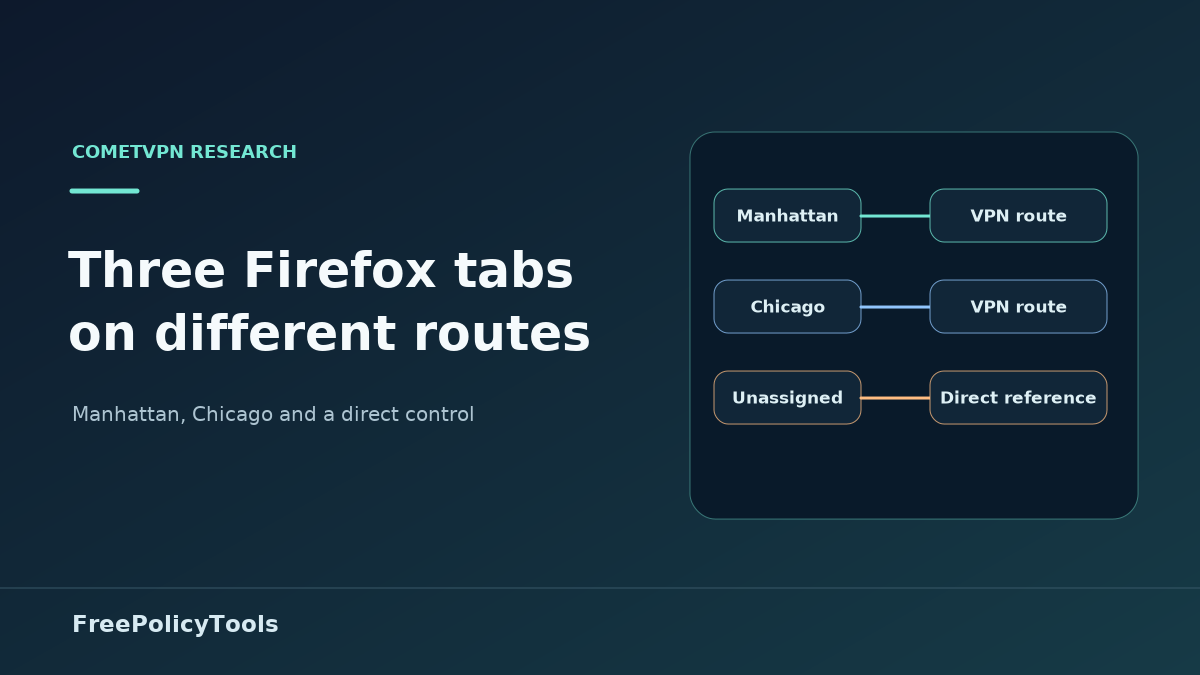
Three tabs in one Firefox window sent requests over three distinct public routes. The tab assigned to Manhattan held one address, the tab assigned to Chicago held a second, and the unassigned tab matched the direct public IP in all four paired rounds.
Per-tab VPN routing makes one browser window a mixed network environment. We tested the public addresses that three tabs actually presented to the same echo endpoint, then compared them with a direct reference measured independently of the browser settings.
- Tabs in one window
- 3
- Manhattan, Chicago and an unassigned control
- Observed routes
- 3
- One stable route per tab during sampling
- Successful probes
- 12 / 12
- Four requests per tab in the three-tab run
Four interleaved rounds in one Firefox window. The scoring unit was a fresh top-level document request.
Results at a glance
Fresh requests matching the direct IPv4 in the primary run
| Tab condition | Successes | Distinct routes in tab | Matched direct reference |
|---|---|---|---|
| Assigned to Manhattan | 4 / 4 | 1 | 0 / 4 |
| Assigned to Chicago | 4 / 4 | 1 | 0 / 4 |
| Unassigned control | 4 / 4 | 1 | 4 / 4 |
Measurement design
- Browser and extension
- Firefox 153.8 ESR and signed CometVPN 1.3.0 add-on
- Treatment
- Manhattan and Chicago per-tab assignments with a deliberately unassigned third tab
- Probe order
- Manhattan, unassigned and Chicago in each round, using a fresh query
- Positive control
- Independent direct IPv4 equals the unassigned tab’s observed address
What changed for each Firefox tab
The Manhattan and Chicago labels came from the extension interface after the selected location had connected. The browser requests verified the route effect. Across the scored rounds, the Manhattan tab returned one IPv4 label consistently and the Chicago tab returned a different label consistently. The unassigned tab returned a third label that matched the independently observed direct IPv4 address.
All three tabs were open under one authenticated extension installation in one Firefox window. Each requested the same echo origin. That rules out differences caused simply by choosing another browser, another Firefox profile or another destination. The test controls for the endpoint and the browser and varies the per-tab assignment.
The stable tab results also matter when comparing privacy controls. An IP check in one assigned tab cannot describe the whole browser window. A direct check in the third tab was the expected treatment because we deliberately left it unassigned. This is useful when comparing localized sessions side by side, and it matters when a reader expects all open tabs to share a single route.
How the paired browser test was set up
We installed the signed CometVPN 1.3.0 add-on from Mozilla Add-ons in a dedicated Firefox 153.8 ESR profile. Once the account was linked, we confirmed the Per-tab locations setting was off and enabled it in the extension interface. We used the same account and Native Residential option for both assigned tabs.
The assigned tabs selected Manhattan and Chicago through the extension’s visible search interface, and both connections were confirmed before sampling. Each assigned tab kept its identifier when the runner navigated it to the echo page. We opened a distinct control tab with no location assigned. The control’s IPv4 reference came from an independent request outside the extension before scoring the paired rounds.
Each round sampled Manhattan, the unassigned tab and Chicago using a fresh query at the public ipify endpoint. All three tabs remained open throughout the test. The requests were interleaved inside each round and were not synchronized at the same instant. We recorded the results by tab and round so a reader can compare route consistency without treating every request as a new exit assignment.
The runner kept the raw IPv4 only while comparing it with the reference and computing an opaque route label. The downloadable data includes the resulting labels, roles, timestamps and direct-match flags. A new labeling key was used for the three-tab run, so a label can be compared within that run and must be treated as a separate identifier from the earlier two-tab file.
Earlier controls and an instrumentation correction
Before testing assignments, we ran two unassigned Firefox tabs against the staging collector. Both completed six probes and returned the same route. This gave us a working two-tab control before adding the extension assignments. A follow-up two-tab comparison with Manhattan assigned returned 12 successful IPv4 observations split across two routes.
An earlier collection attempt navigated Firefox to the JSON endpoint and then tried to fetch from the resulting document. That attempt yielded zero usable IPv4 readings through the runner. We switched to a plain-text top-level response, recorded the completed comparisons with that method, and kept the failed attempt outside the success denominator rather than assigning it a route.
The three-tab comparison added an independent direct reference and a second assigned location. That step matters because two distinct addresses can show that two tabs diverged, but only the separate direct reference shows which route was the ordinary connection in this setup.
Practical scope of a per-tab VPN test
The completed run evaluated a top-level HTTPS IPv4 document in each tab after the selected location was connected. It leaves open what happens to requests initiated before an assignment, connections inherited across navigation or browser restart, and traffic using WebRTC, IPv6 or browser extensions outside the measured tabs.
This is a test of one Firefox build and one short session with two selected cities. It does not estimate how long a tab retains the same IPv4, how all provider locations behave, or how sites identify the locations of the addresses. Readers reproducing the comparison should record the toolbar selection, a direct reference and the per-tab outputs separately, then repeat the comparison after any tab or browser state change they care about.
How to read the recorded evidence
The three-tab sequence spans roughly nine seconds between its first and last scored request. It confirms short-window consistency for those three already-open tabs. The timestamped rows can be grouped by block to check whether the assigned routes stayed both stable and distinct.
A follow-up in the worker-routing study later saw an initially direct unassigned tab return a VPN route in two of three phases. The contrast makes assignment history, the timing of the direct check and the exact browser context important controls when repeating this baseline.
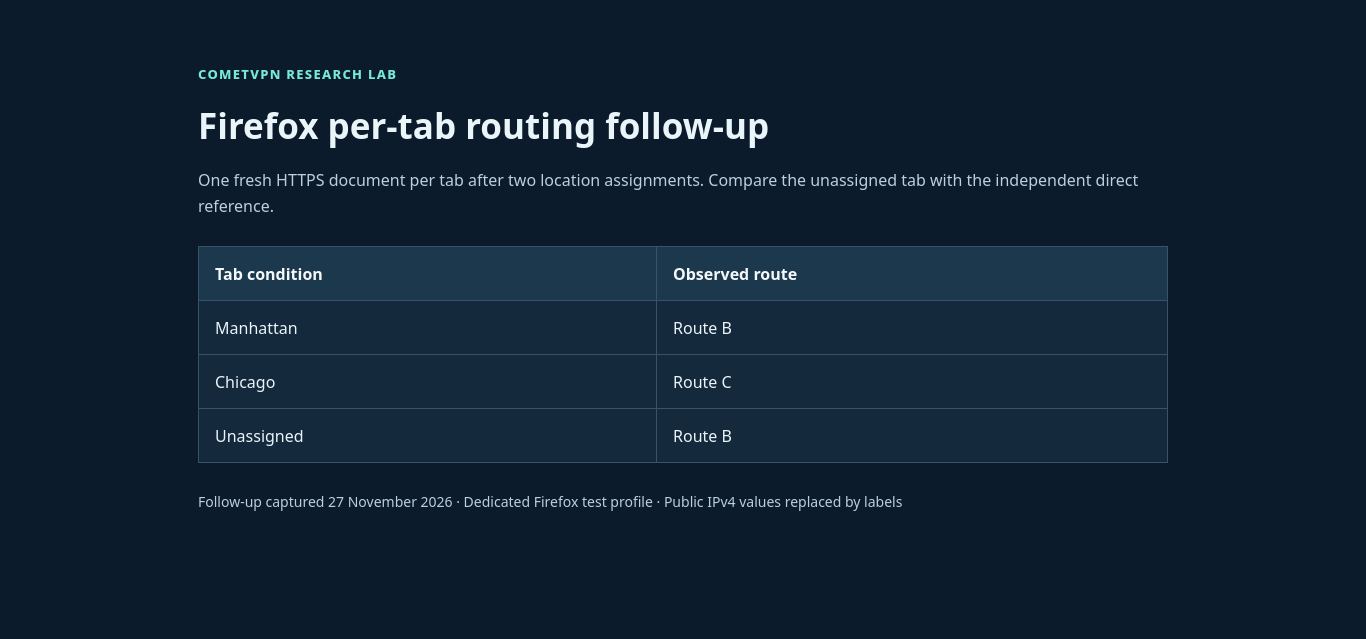
On November 27, we took one new HTTPS observation per tab. Manhattan and Chicago still had distinct routes, but the unassigned tab shared the Manhattan route. This follow-up was kept outside the original four-round result and its address labels are local to the follow-up.
| الجولة | Manhattan | Unassigned | Chicago |
|---|---|---|---|
| 1 | R1 | R2 · direct | R3 |
| 2 | R1 | R2 · direct | R3 |
| 3 | R1 | R2 · direct | R3 |
| 4 | R1 | R2 · direct | R3 |
Research lab screenshots
الأسئلة المتكررة
Downloads, sources and citation
Suggested citation. FreePolicyTools. CometVPN Firefox Per-Tab VPN Test: Three Tabs, Three Routes. Original Research, November 26, 2026. Permanent article link.
FreePolicyTools may earn a commission if you purchase through this link.
Explore CometVPN plansRelated research
- CometVPN Browser Restart Test: The First Restored Request
- CometVPN City Switch Test: What Happened to an Open WebSocket?
- CometVPN City Selection vs. IP Geolocation in Two Databases
- CometVPN WebRTC Leak Test: ICE Candidates and Data Channels
- CometVPN WebRTC Protection On vs. Off: A Paired IP Leak Test
- CometVPN browser IP rotation and recovery