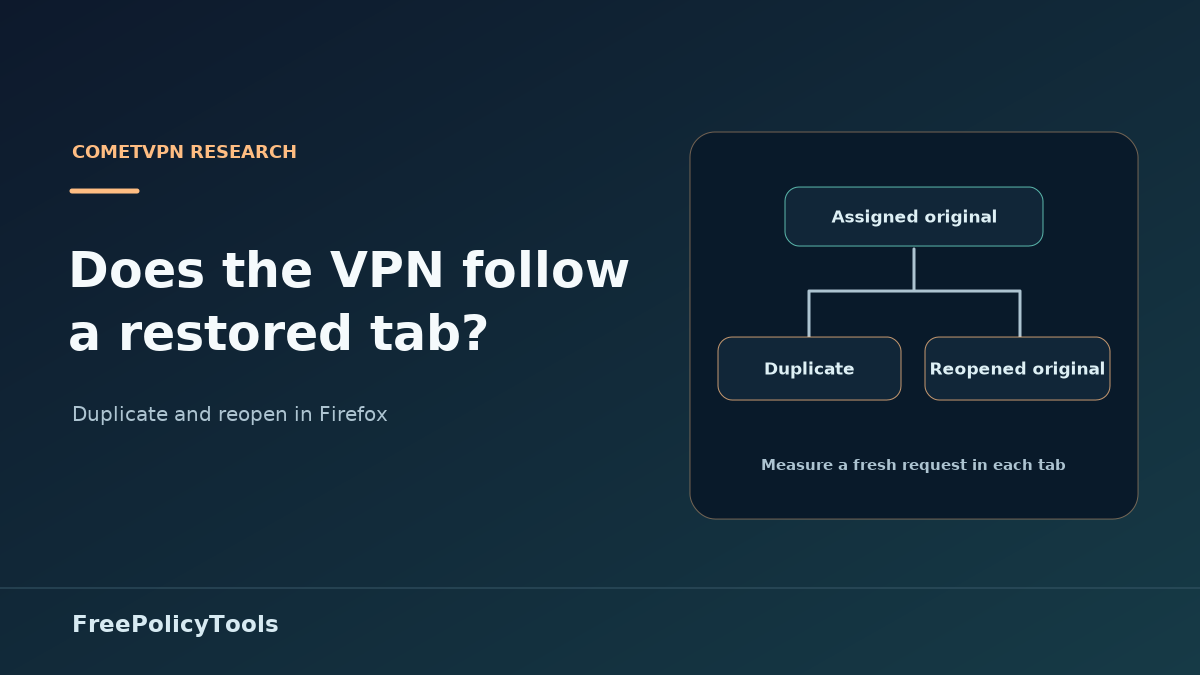
In seven usable Firefox trials, an assigned CometVPN tab kept its Manhattan IPv4 through ordinary navigation. Every duplicate and every recently closed original that Firefox reopened used the workstation’s direct IPv4 on the measured fresh request.
Duplicating or reopening a tab can bring back the same page and browsing history. A per-tab VPN adds a separate question. Does the restored page also get the route assigned to the original tab? We measured that route from new HTTPS responses while the browser stayed open.
- Original tab navigation
- 7 / 7
- Retained its assigned Manhattan egress
- Duplicated tabs
- 7 / 7
- Fresh navigation used the direct IPv4
- Reopened tabs
- 7 / 7
- Fresh navigation used the direct IPv4
Seven usable Manhattan lifecycle blocks. The recorded reopened result is a new navigation after Firefox restored the tab.
Results at a glance
Trials with the original tab’s VPN IPv4 on a fresh request
| Tab and operation | Solicitudes | Matched original VPN egress | Matched direct IPv4 |
|---|---|---|---|
| Original after ordinary navigation | 7 | 7 | 0 |
| Duplicate after fresh navigation | 7 | 0 | 7 |
| Original rechecked after duplication | 7 | 7 | 0 |
| Original closed, then reopened | 7 | 0 | 7 |
| Standing comparison tab | 7 | 0 | 0 |
Measurement design
- Dependencia
- One new source tab with a verified Manhattan assignment
- Sequence
- Ordinary navigation, duplication, source recheck, close and reopen
- Medición
- One unique echo URL per observation and a workstation direct reference
- Exclusions
- Browser-operation errors or an unconfirmed starting assignment
A tab’s page and its VPN assignment can diverge
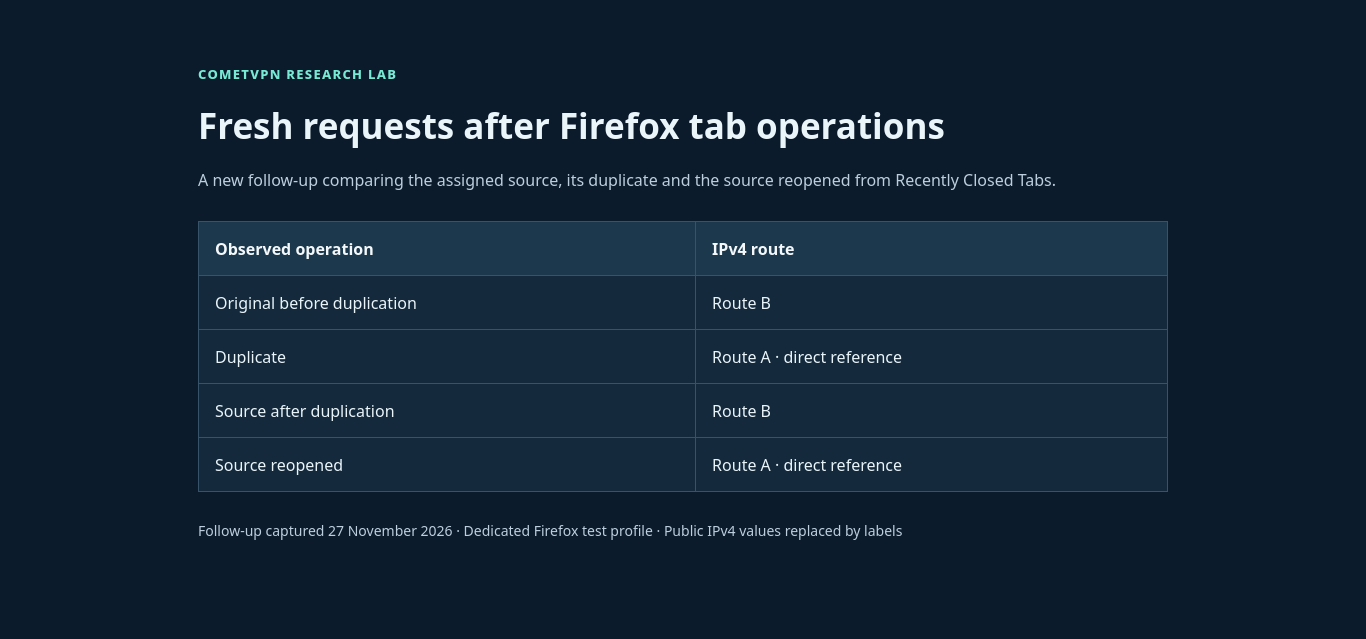
The original and duplicate were open at the same time. In each usable trial the duplicate’s request returned the same IPv4 as the workstation’s independent direct reference. The original still returned its assigned VPN address when checked again. The duplication therefore produced a tab with a different observed route while the source stayed on its VPN route.
Reopening the most recently closed tab also produced a direct result each time. Firefox brought the original document back into the window. We then made a fresh navigation in that tab to see which address a server observed. The resulting address matched the direct reference. This experiment covers fresh navigation after reopening. It cannot identify the egress of Firefox’s own initial restore request.
Ordinary navigation was a useful comparison because it changed the URL while retaining the tab. We sent a unique URL each time. Those requests kept the address established when the location was assigned, which indicates that navigation within the same open tab behaved differently from duplicating or reopening a tab.
How we measured the tab operations
We used Firefox 153.8.0 ESR and the signed CometVPN extension version 1.3.0, with per-tab locations enabled in a dedicated profile. Each attempt began with a fresh source tab. We assigned Manhattan in the extension, confirmed the selected location and required an IPv4 distinct from the independently established direct reference.
The procedure requested an IPv4 echo in the source tab, navigated the same tab to a fresh echo URL, then invoked Firefox’s duplicate-tab operation. It checked the duplicate and returned to the source for another fresh request. Next it closed the source and immediately used Firefox’s recently closed-tab operation. The restored tab was identified as a newly available browser tab before it was navigated to a fresh echo URL.
Every probe included a unique query string. The automation waited until the target URL was present and the document body contained a parseable IPv4. We compared addresses in memory and shared only labels and direct-match flags. The measuring endpoint observed the public route of each successful request. It did not inspect the process or the service storing the tab assignment.
The direct reference and the unexpected comparison tab
An independent HTTPS request from the workstation outside Firefox established the direct IPv4 at the beginning of the run. Each duplicate and reopened result matched it exactly. A separate standing Firefox tab, which this run did not deliberately assign, reported a third stable address in all seven trials. We retained that observation and used the independent reference for classification.
The standing tab’s routing history could matter. This was a previously linked research profile that had been used to make other per-tab connections. The experiment did not establish why the standing tab had a third route. It cannot be treated as confirmation that a new, unassigned tab always uses the direct route.
The final Manhattan series attempted eight lifecycle blocks. Seven had a verified assignment and all required observations. The eighth could not confirm the assignment and never entered the outcome denominator. Three earlier setup attempts also produced no complete lifecycle record. The evidence records their stage and keeps them outside the seven usable blocks.
How to interpret a restored tab
A tab’s visible content and the current exit of a fresh request answer different questions. In this experiment, a new request in a duplicate or recently reopened tab used the direct reference, while the still-open original kept its assigned address. To reproduce it, record a source address first and check both source and duplicate with unique URLs before closing anything.
These were several repeats in one profile and one selected location, over a short session. They do not estimate how often the behavior occurs across devices or versions. The result covers four observed operations and successful IPv4 requests. It does not cover background traffic, what happened between observations, a whole-browser restart, other tab-management extensions, or the desktop client.
How to read the recorded evidence
The primary comparison is within each source tab. The source address can differ across blocks, so compare original to same_tab and parent_after_duplicate inside the same record. For duplicate and reopened, inspect the direct flag against the independently established workstation reference.
A fresh URL after reopen answers what later navigation used. Firefox can also make a request while restoring the original page. A recorder that can observe that earlier request is required to distinguish the two, as the separate Chromium startup study does for its own scenario.
| Observación | Route label | Direct reference match |
|---|---|---|
| Original | route-1 | No |
| Same tab navigation | route-1 | No |
| Duplicate | route-2 | Sí. |
| Source after duplicate | route-1 | No |
| Reopened original | route-2 | Sí. |
| Standing comparison | route-3 | No |
Research lab screenshots
Preguntas frecuentes
Downloads, sources and citation
Suggested citation. FreePolicyTools. CometVPN Firefox Tab Test: Do Duplicated and Reopened Tabs Keep the VPN?. Original Research, November 26, 2026. Permanent article link.
FreePolicyTools may earn a commission if you purchase through this link.
Explore CometVPN plansRelated research
- CometVPN City Switch Test: What Happened to an Open WebSocket?
- CometVPN City Selection vs. IP Geolocation in Two Databases
- CometVPN WebRTC Leak Test: ICE Candidates and Data Channels
- CometVPN WebRTC Protection On vs. Off: A Paired IP Leak Test
- CometVPN Firefox IP Rotation: 8 Trials, One Direct IP Result
- CometVPN browser IP rotation and recovery