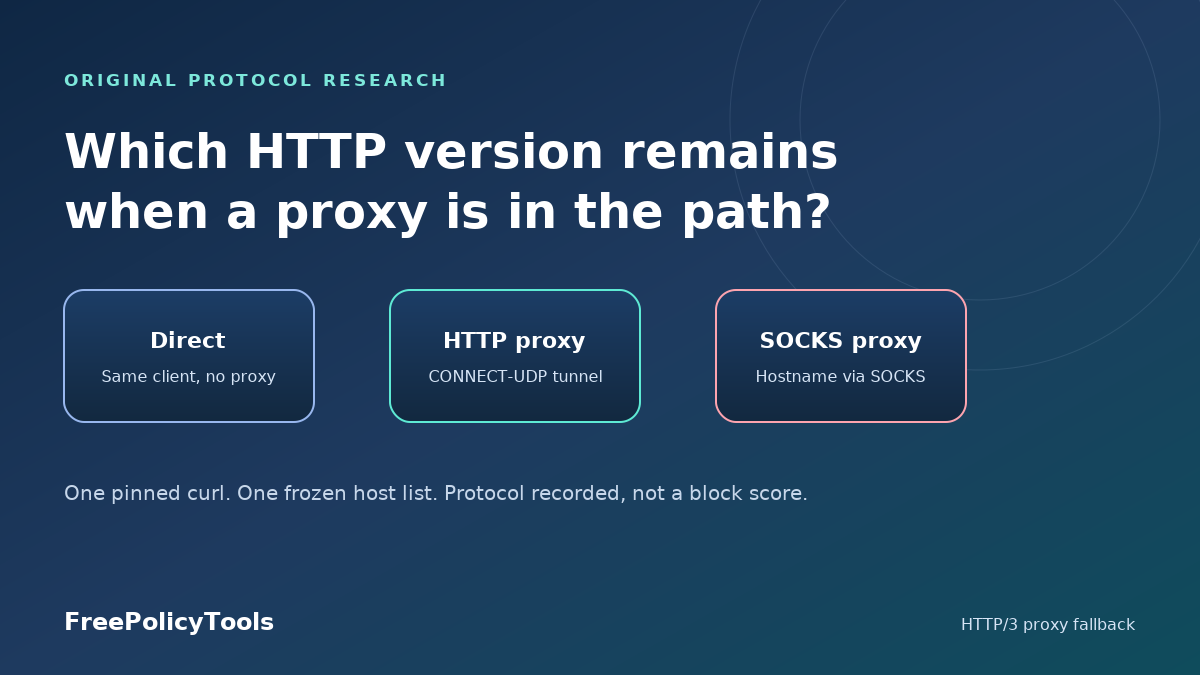
A pinned curl 8.23.0 client was willing to use HTTP/3. From a USA cloud virtual machine, it never finished HTTP/3: all 60 direct requests on the frozen list stayed on HTTP/2, and all 60 attempts that forbade fallback timed out. Through one residential HTTP proxy, HTTP/3 usually did finish, inside a CONNECT-UDP tunnel. Through residential SOCKS5h, the same binary refused HTTP/3, and the requests that finished stayed on HTTP/2.
The rate below is five on-time slots and twelve hosts: 60 requests per path. A sixth slot, scheduled for 18:00 UTC on 21 November, was collected on 24 November and is marked late. It is not inside the 60. This is a protocol diary. Status codes are recorded so you can see that a request finished. They are not a block score. For that, see the separate censorship diary.
What the diary asked
The frozen question was: on a list of hosts that can complete HTTP/3, which protocol remains — HTTP/3, HTTP/2, or HTTP/1 — when the same client uses a residential HTTP proxy and when it uses residential SOCKS5h?
“Remains” is the version curl reported when HTTP/3 was allowed to win (--http3). A second flag, --http3-only, asks whether the request can finish if no earlier version is permitted. Those answers are not the same, and the gap between them is a result, not a rounding error.
An earlier routing study asked whether clients sent traffic to a proxy at all. Here the proxy was configured on purpose. An encryption study asked whether a proxy password was exposed on the local network. This diary does not open that question. It also does not use a browser, so it is not the path-leak lub odcisk palca measurements.
The client and the two tunnels
The measurement host’s system curl was 8.5.0. It can speak HTTP/2 and cannot speak HTTP/3, so it was not used. The client was the stunnel static curl 8.23.0 glibc build, with ngtcp2 1.25.0 and nghttp3 1.18.0. The binary SHA-256 is b19756efa22538f0af3bb293626841c9dbf0d168489a1924f0e3edec2f560ba6. Every request used a fresh process, HTTPS only, no redirects, a 12-second transfer limit, and a 6-second connect limit. A timeout or connect failure was retried once.
Toward the HTTP proxy, this curl does not open QUIC to the proxy. It opens HTTP/1.1, sends Upgrade: connect-udp, and requests /.well-known/masque/udp/{host}/443/. A 101 response means the proxy accepted a CONNECT-UDP tunnel, and HTTP/3 then runs inside it. That is RFC 9298, nie --proxy-http3. The collector marks connect-udp when the verbose stream says the tunnel was established. Verbose logs were not saved: they contain proxy authorization and the raw exit address.
Toward SOCKS5h (--socks5-hostname, RFC 1928), the same binary prints that HTTP/3 is not supported over a SOCKS proxy. With --http3-only it exits before a transfer. With --http3 it continues and negotiates HTTP/2 over the SOCKS tunnel. That is the client we measured. It is not a general fact about UDP on the SOCKS path.
Selection rule, modes, and what was excluded from the rate
If at least eight priority hosts had completed direct --http3-only, the diary would have been the first twelve of those. Direct completions were zero. The applied rule froze the first twelve priority hosts that completed residential HTTP --http3-only. Freeze time: 2026-11-19T15:04:00Z. The screen found seventeen such successes and kept twelve. The screen is not a rate.
Wikipedia is the negative control because it completed HTTP/2 and did not complete forced HTTP/3. example.com and example.net negotiated HTTP/3 through the proxy, so they were rejected as controls. cloudflare-quic.com is a probe. CometVPN was not run. The HTTP and SOCKS ports in the environment were the same number; both transports still completed requests.
How the twelve hosts were frozen
Membership required a completed residential HTTP --http3-only request on the screen: exit success, a verified certificate, a status from 100 to 599, and a final host that matched the URL. All twelve used CONNECT-UDP on that screen request. Redirects were not followed, so jsDelivr’s 301 counts as a finished response on that URL.
| Order | Host | Screen status |
|---|---|---|
| 1 | www.cloudflare.com | 200 |
| 2 | blog.cloudflare.com | 200 |
| 3 | one.one.one.one | 200 |
| 4 | dns.google | 200 |
| 5 | www.google.com | 200 |
| 6 | www.youtube.com | 200 |
| 7 | www.gstatic.com/generate_204 | 204 |
| 8 | www.facebook.com | 200 |
| 9 | www.instagram.com | 200 |
| 10 | www.litespeedtech.com | 200 |
| 11 | www.fastly.com | 200 |
| 12 | cdn.jsdelivr.net | 301 |
one.one.one.one is a hostname. The evidence stores that hostname, not an address. Hosts past the cap of twelve stayed out, including at least one that had completed HTTP/3.
What remained on the three paths
Across the five on-time slots, direct prefer-h3 was HTTP/2 on every host, every time. All 60 of those HTTP/2 responses included Alt-Svc advertising HTTP/3 (RFC 7838). The origins were willing. Forcing HTTP/3 on the direct path timed out 60 times. Curl’s own HTTP/3 documentation describes --http3 as a preference that may fall back and --http3-only as a request that fails when HTTP/3 cannot be used. Each process starts clean, so this is not a browser applying an Alt-Svc hint from an earlier visit.
Residential HTTP prefer-h3 stayed on HTTP/3 in 47 of 60 requests, fell back to HTTP/2 in 9, and finished no version in 4. Forcing HTTP/3 on that path completed 55 of 60. SOCKS prefer-h3 stayed on HTTP/2 in 56 of 60 and timed out in 4. Forcing HTTP/3 on SOCKS never left the client: all 60 are h3_unsupported_by_client. No frozen row in the 360 on-time protocol rows negotiated HTTP/1.
Protocol that remained when HTTP/3 was allowed
Five on-time slots, 12 frozen hosts, 60 requests per path. HTTP/1 was zero in every row.
- HTTP/3
- HTTP/2
- No version
Residential HTTP, prefer-h3, as shares of 60
- 47 HTTP/3
- 9 HTTP/2
- 4 No version
Requests that finished when HTTP/3 was required
curl --http3-only. Bar height is completed HTTP/3 out of 60.
When HTTP/2 won and HTTP/3 still worked
On residential HTTP, every prefer-h3 attempt recorded two connections and a CONNECT-UDP mechanism, including the nine that finished as HTTP/2 and the four that finished as nothing. The tunnel line is not the version. The version is whichever connection carried the response.
Pairing prefer-h3 with the forced request on the same host in the same slot: 47 pairs were HTTP/3 both ways; 8 were HTTP/2 when fallback was allowed and HTTP/3 when it was required; 1 was HTTP/2 with the forced request unfinished; 4 finished neither mode. The eight are the reason “the proxy fell back to HTTP/2” is the wrong sentence. The preferring client kept HTTP/2 while a request that forbade fallback still completed HTTP/3.
The single unchecked fallback was www.litespeedtech.com at 18:00 UTC on 19 November. The four double misses were Facebook that same evening, and YouTube, Facebook, and Instagram at 06:00 UTC on 21 November. Those three morning misses also timed out on SOCKS.
| Slot | Host | prefer-h3 | h3-only | SOCKS prefer-h3 |
|---|---|---|---|---|
| 19 Nov, 18:00 | one.one.one.one | h2 200 | h3 200 | h2 |
| 19 Nov, 18:00 | dns.google | h2 200 | h3 200 | h2 |
| 19 Nov, 18:00 | www.google.com | h2 200 | h3 200 | h2 |
| 19 Nov, 18:00 | www.youtube.com | h2 200 | h3 200 | h2 |
| 19 Nov, 18:00 | www.facebook.com | none | none | h2 |
| 19 Nov, 18:00 | www.litespeedtech.com | h2 200 | none | h2 |
| 20 Nov, 18:00 | www.cloudflare.com | h2 200 | h3 200 | h2 |
| 20 Nov, 18:00 | dns.google | h2 200 | h3 200 | h2 |
| 20 Nov, 18:00 | www.google.com | h2 200 | h3 200 | h2 |
| 20 Nov, 18:00 | cdn.jsdelivr.net | h2 301 | h3 301 | h2 |
| 21 Nov, 06:00 | www.youtube.com | none | none | none |
| 21 Nov, 06:00 | www.facebook.com | none | none | none |
| 21 Nov, 06:00 | www.instagram.com | none | none | none |
Rows are on-time host-slots where residential HTTP was not HTTP/3 in both modes. The other host-slots were HTTP/3 in both modes. SOCKS is shown beside them and was HTTP/2 whenever it finished.
Slot by slot, including the exits
Two slots were uniform on residential HTTP. The first measurement and the morning of 20 November kept all twelve hosts on HTTP/3 in both modes. The evening of 20 November is the clearest race: prefer-h3 reported HTTP/2 for www.cloudflare.com, dns.google, www.google.com, and cdn.jsdelivr.net, while forced HTTP/3 completed on all twelve, including those four. The evening of 19 November was the noisiest: six HTTP/3, five HTTP/2, one miss, and forced HTTP/3 still completed on ten. The morning of 21 November had no HTTP/2 on the HTTP proxy. Nine hosts completed HTTP/3, three timed out, and www.fastly.com returned 403 as HTTP/3.
A Cloudflare trace ran once per condition, not once per host. Direct traces stayed in the United States, colo IAD, on HTTP/2. Residential traces moved. In three on-time slots the HTTP trace taken while preferring HTTP/2 and the HTTP trace taken while forcing HTTP/3 are different countries, so those slots are not one exit. The first slot has both in Japan, colo KIX. The morning of 21 November has no HTTP prefer-h2 trace, because that request timed out. Countries and colos are in the table. Hashes in the JSON are salted for this study only. They cannot be lined up with another FreePolicyTools project, and they are not raw addresses.
Residential HTTP: how many of the 12 hosts stayed on HTTP/3
Prefer-h3 only. A later point, when present, is the late observation and is not part of the 47.
| Slot | Bezpośrednie | HTTP, HTTP/2 trace | HTTP, HTTP/3 trace | SOCKS trace |
|---|---|---|---|---|
| 19 Nov, first | US / IAD / http/2 | JP / KIX / http/2 | JP / KIX / http/3 | JP / KIX / http/2 |
| 19 Nov, 18:00 | US / IAD / http/2 | LV / TLL / http/2 | ES / MAD / http/3 | ES / MAD / http/2 |
| 20 Nov, 06:00 | US / IAD / http/2 | JP / NRT / http/2 | GB / LHR / http/3 | GB / LHR / http/2 |
| 20 Nov, 18:00 | US / IAD / http/2 | RU / WAW / http/2 | BR / GRU / http/3 | BR / GRU / http/2 |
| 21 Nov, 06:00 | US / IAD / http/2 | timeout | RU / WAW / http/3 | RU / WAW / http/2 |
| Host | 19 Nov, first | 19 Nov, 18:00 | 20 Nov, 06:00 | 20 Nov, 18:00 | 21 Nov, 06:00 |
|---|---|---|---|---|---|
| www.cloudflare.com | h3 / h3 | h3 / h3 | h3 / h3 | h2 / h3 | h3 / h3 |
| blog.cloudflare.com | h3 / h3 | h3 / h3 | h3 / h3 | h3 / h3 | h3 / h3 |
| one.one.one.one | h3 / h3 | h2 / h3 | h3 / h3 | h3 / h3 | h3 / h3 |
| dns.google | h3 / h3 | h2 / h3 | h3 / h3 | h2 / h3 | h3 / h3 |
| www.google.com | h3 / h3 | h2 / h3 | h3 / h3 | h2 / h3 | h3 / h3 |
| www.youtube.com | h3 / h3 | h2 / h3 | h3 / h3 | h3 / h3 | none / none |
| www.gstatic.com | h3 / h3 | h3 / h3 | h3 / h3 | h3 / h3 | h3 / h3 |
| www.facebook.com | h3 / h3 | none / none | h3 / h3 | h3 / h3 | none / none |
| www.instagram.com | h3 / h3 | h3 / h3 | h3 / h3 | h3 / h3 | none / none |
| www.litespeedtech.com | h3 / h3 | h2 / none | h3 / h3 | h3 / h3 | h3 / h3 |
| www.fastly.com | h3 / h3 | h3 / h3 | h3 / h3 | h3 / h3 | h3 / h3 |
| cdn.jsdelivr.net | h3 / h3 | h3 / h3 | h3 / h3 | h2 / h3 | h3 / h3 |
Each cell is residential HTTP prefer-h3, then h3-only. Direct prefer-h3 was HTTP/2 in every cell of every on-time slot, so it is not repeated here.
Late observation, not part of the 60
Observed after the scheduled window because collection was unavailable at 2026-11-21T18:00:00Z. generated_at is the actual clock, not the scheduled slot time. Collected 2026-11-24T11:57:40Z. Residential HTTP prefer-h3: 11 HTTP/3, 1 HTTP/2, 0 unfinished. Forced HTTP/3: 12 of 12. Direct trace: US / IAD / http/2. HTTP/3 trace: IN / DEL / http/3. SOCKS trace: IN / DEL / http/2.
| Host | Bezpośrednie | HTTP prefer | HTTP forced | SOCKS prefer |
|---|---|---|---|---|
| www.cloudflare.com | h2 | h3 200 | h3 200 | h2 |
| blog.cloudflare.com | h2 | h3 200 | h3 200 | h2 |
| one.one.one.one | h2 | h3 200 | h3 200 | h2 |
| dns.google | h2 | h3 200 | h3 200 | h2 |
| www.google.com | h2 | h3 200 | h3 200 | h2 |
| www.youtube.com | h2 | h3 200 | h3 200 | h2 |
| www.gstatic.com | h2 | h3 204 | h3 204 | h2 |
| www.facebook.com | h2 | h3 200 | h3 200 | h2 |
| www.instagram.com | h2 | h3 200 | h3 200 | h2 |
| www.litespeedtech.com | h2 | h2 200 | h3 200 | h2 |
| www.fastly.com | h2 | h3 200 | h3 200 | h2 |
| cdn.jsdelivr.net | h2 | h3 301 | h3 301 | h2 |
SOCKS stayed on HTTP/2 for a client reason
Fifty-six completed SOCKS requests were HTTP/2. The four timeouts were www.cloudflare.com on the evening of 19 November, and YouTube, Facebook, and Instagram on the morning of 21 November. The three morning timeouts match the HTTP-proxy timeouts. The Cloudflare one does not: the HTTP proxy completed that host as HTTP/3 in the same slot.
All 60 forced SOCKS requests ended in the client, including the four whose preferring request had timed out. The forced attempt does not wait to see whether UDP would have worked. Nothing in the on-time SOCKS rows negotiated HTTP/3 or HTTP/1. A claim that this SOCKS product cannot carry QUIC would need a client willing to try. This one was not, and we did not swap in another stack to manufacture the missing attempt.
Wikipedia, and a probe that is not the rate
www.wikipedia.org negotiated HTTP/2 with status 200 on direct, residential HTTP, and SOCKS in every on-time slot. Forced HTTP/3 timed out on direct and on the HTTP proxy. On SOCKS it hit the same client refusal as every other forced SOCKS request. One residential HTTP preferring request, on the evening of 20 November, did not record a CONNECT-UDP mechanism and still finished as HTTP/2. The control never became an HTTP/3 success.
cloudflare-quic.com is outside the 60. With fallback allowed and no proxy, it returned HTTP 200 as HTTP/2 in every on-time slot, and forced HTTP/3 timed out. The name is not an HTTP/3-only result for this client when fallback is allowed. Through the HTTP proxy, the preferring request was HTTP/3 in all five on-time slots. The forced request was HTTP/3 in four and timed out on the evening of 19 November.
Granice
One binary, one USA cloud source, one residential product, two fronts. Browsers remember Alt-Svc and may try QUIC on a later navigation. These processes cannot. A browser on the same VM could record a different remaining version on the direct path for that reason alone. The direct timeouts use a 6-second connect limit and one retry. They are not a map of UDP on the public Internet. The origins advertised HTTP/3.
The SOCKS result must stay worded as a client refusal plus HTTP/2 fallback. The HTTP-proxy result is CONNECT-UDP on this product during these slots, across exits that changed country inside a slot. It is not a rate for residential proxies, and it is not a rate for a city. There is no VPN arm. We did not capture packets, so the race is inferred from two connections, the tunnel line, and the paired forced request. That shows HTTP/2 sometimes won while HTTP/3 was still completable. It is not a timing diagram.
Screen error labels for hosts that were not frozen used an earlier classifier and are not confirmed causes. The five on-time slots are the rate. The screen is not. The late slot is not.
Dowody
Slot JSON is redacted. A writer refuses raw addresses and proxy-authorization text. Proxy configuration, the hash salt, and the runtime binary path are not in the package.
Pytania
Did these sites stop offering HTTP/3?
No. All 60 direct prefer-h3 responses on the frozen list were HTTP/2 and all 60 carried an Alt-Svc header advertising HTTP/3. Forcing HTTP/3 from the same virtual machine timed out. The offer and the completed path are different facts.
Does this show that SOCKS blocks UDP?
No. curl 8.23.0 exits before a transfer when HTTP/3 is required over SOCKS, and when HTTP/3 is only preferred it completes the request as HTTP/2. That is a client limitation. A different QUIC stack could behave differently. This study did not add one.
If the client kept HTTP/2, was HTTP/3 down on the proxy?
Not in eight of the nine on-time cases where residential HTTP prefer-h3 stayed on HTTP/2. The same host, in the same slot, still completed when HTTP/3 was required. One case, LiteSpeed on the evening of 19 November, did not.
Is a 403 a failed protocol?
No. On the morning of 21 November, www.fastly.com returned HTTP 403 and the negotiated version was HTTP/3. This diary counts the version. It does not rescore status codes as blocks. That is a different study.
Was a VPN included?
No. CometVPN was not connected. There is no VPN protocol count. The affiliate link is separate from the measurement.
Źródła
- RFC 9114 — HTTP/3.
- RFC 9298 — CONNECT-UDP, the tunnel used toward the HTTP proxy.
- RFC 7838 — Alt-Svc, present on all 60 direct HTTP/2 responses.
- RFC 1928 — SOCKS protocol version 5.
- HTTP/3 with curl —
--http3oraz--http3-only.
Cite as FreePolicyTools, “HTTP/3 Was Advertised. Direct and SOCKS Stayed on HTTP/2.” Keep the five on-time slots and the late observation separate. There is no population sample and no provider ranking.
Affiliate disclosure. This article links to ProxySeller and CometVPN. FreePolicyTools may earn a commission if you buy through those links. The residential HTTP and SOCKS paths were ProxySeller endpoints. CometVPN was not used. The links are not a comparative test and do not change the methods, the counts, or the limits.