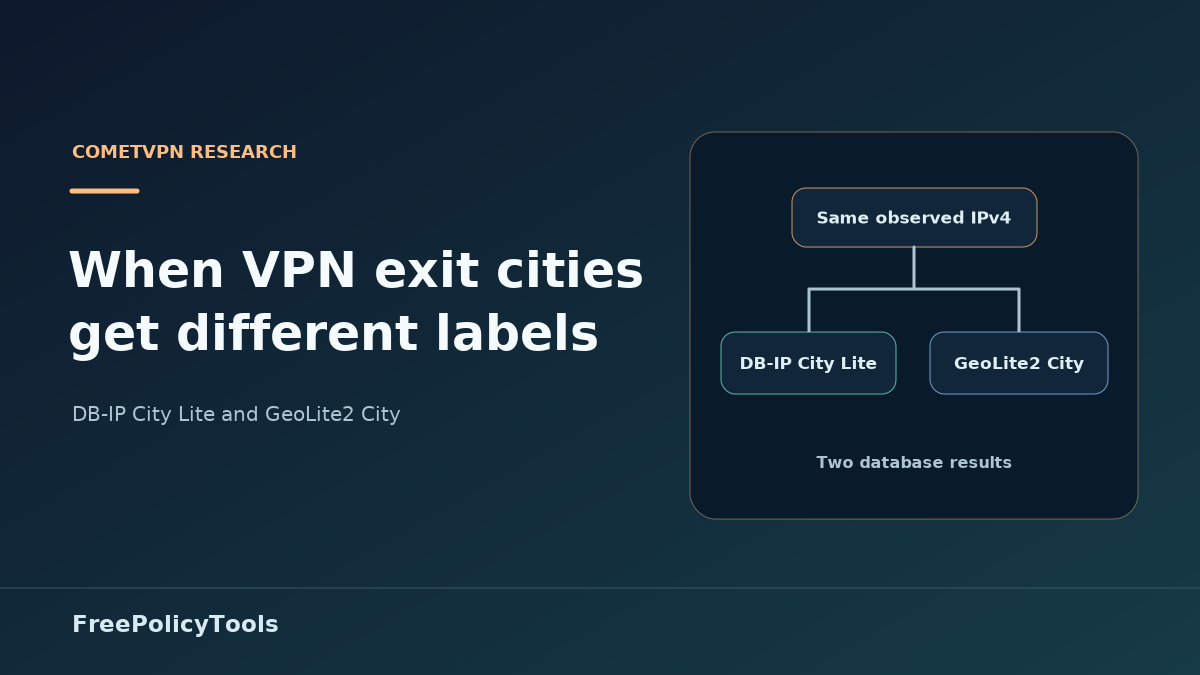
Two IP geolocation databases returned New York for all four usable Manhattan selections. For Los Angeles, GeoLite2 returned Los Angeles in all four usable sessions, while DB-IP returned Los Angeles once and Beverly Hills three times. Both databases agreed on the US state and country for every usable session.
A location in a VPN’s picker gives the browser a requested exit. A website may interpret the resulting IP using a different geographic vocabulary and a different data source. We measured those two steps separately with real browser requests and offline database lookups.
- Connection attempts
- 10
- Five per selected location
- Usable observations
- 8
- Four Manhattan and four Los Angeles sessions
- City-level disagreements
- 3 / 8
- All three at the Los Angeles selection
Ten attempted connections across two city selections. Eight yielded a usable IPv4 and paired offline lookups.
Results at a glance
Usable sessions with matching city labels across both databases
| Extension selection | Usable sessions | DB-IP City Lite | GeoLite2 City |
|---|---|---|---|
| Manhattan, New York | 4 of 5 | New York × 4 | New York × 4 |
| Los Angeles, California | 4 of 5 | Beverly Hills × 3, Los Angeles × 1 | Los Angeles × 4 |
Measurement design
- Inputs
- One browser-observed IPv4 per successful connection
- Database versions
- DB-IP City Lite 2026-11-01 and GeoLite2 City IPv4 redistribution dated 2026-11-26
- Scoring
- Exact city-name agreement with a separate state and country comparison
- Unscored attempts
- One from each city without a confirmed IPv4 in the collection window
The city labels the databases returned
The Manhattan result was consistent across both datasets. Manhattan is a borough of New York City, so the broader New York label is compatible with the selected city area at the level of this comparison. We retained the database string as returned. We did not make up a Manhattan record or score a borough name that neither dataset supplied.
Los Angeles illustrates a different kind of difference. Beverly Hills is a separate city in Los Angeles County. A metro-level rule might group it with Los Angeles, while a service that applies an exact city name could show a different location. We report the exact city strings and state-level agreement so readers can apply their own grouping rule.
For each Los Angeles session we compared both database results for the very same observed IPv4. The three city-level disagreements therefore reflect differences between the two lookups for those addresses. Differences in which exit Chrome selected cannot explain the within-session disagreement, though the exit selection can affect how often that disagreement appears.
How the city-pair test worked
We used the CometVPN Native Residential option in a dedicated Chromium 151 profile with extension version 1.3.0. The browser alternated between Manhattan and Los Angeles for five rounds. Each round attempted both locations. The script selected the city through the extension’s search results and waited for the requested city and connected state to be visible.
After connection, a browser tab made a fresh request to the public ipify IPv4 echo. We used that observed exit for local lookups against DB-IP City Lite dated November 1, 2026 and a GeoLite2 City IPv4 build dated November 26, 2026. The two files came from separate underlying providers. The GeoLite2 copy was redistributed in the ip-location-db format, which exposes the city and region fields differently from the native DB-IP file.
We retained the selected location, both database outputs and a keyed label for the observed address. Raw addresses and database files stay outside the public evidence. For reproducibility, the DB-IP file’s SHA-256 starts with 5f64491f77c2c78b and the GeoLite2 file’s starts with 14111e896ace77d7. The downloadable evidence contains both full digests.
An attempt entered the geographic denominator after the extension confirmed the connection and the browser returned an IPv4. One Manhattan attempt and one Los Angeles attempt missed this requirement. Both stayed in the attempt log and neither was assigned a city result. The eight successful sessions had distinct observed route labels in this batch.
How to apply the comparison
The choice of scoring level changes the question. As a California selection, all four usable Los Angeles sessions agreed at state level. As a test for the exact string Los Angeles across both databases, only one session had that agreement. As a broader metro test, all four DB-IP outcomes were compatible with the selected area under the grouping described above.
This distinction can matter when testing a localized website. For instance, if a site serves state-specific content, the region result may be closest to its decision rule. If a service picks a branch based on a database city string, the exact city is more relevant. The site can also use a different database or its own signals, so it helps to test the user-facing outcome as a separate measurement.
The most transferable method is to freeze the database versions and retain paired lookups. A comparison that checks one provider in the morning and another after a reconnect can accidentally compare different addresses. Recording the pair and the lookup dates avoids that ambiguity and makes later database drift easier to study.
What the sample supports
This was a one-day sample of two US selections and one browser configuration. Repeated rounds show variation within the tested locations. They cannot estimate disagreement across the complete residential network, across national borders or across time.
The city fields report database estimates for IPs. Neither lookup certifies the physical address of a residential connection. A stable city reading also does not establish a stable IP, and a city disagreement is not evidence that a connection bypassed the VPN. The two failed connection attempts report collection availability for this pilot only.
How to read the recorded evidence
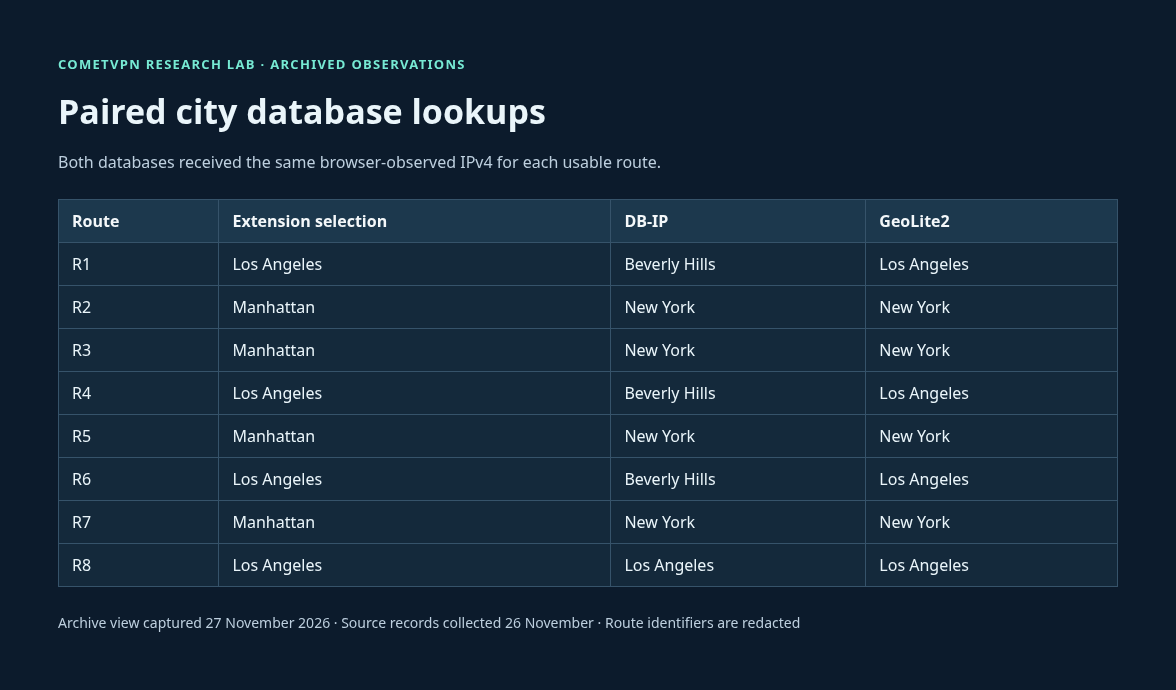
Across the eight valid samples, the databases agreed on the city string five times and agreed on state and country eight times. The three disagreements all came from the Los Angeles selection. The four Manhattan observations returned New York in both sources, which is city-level labeling for a selection named for a borough.
The dated database files have separate version and SHA-256 fields in the JSON. Reproducing this type of comparison means recording both database dates and looking up the same address in each. A fresh address or updated database can legitimately change the result.
| Rota | DB-IP city | GeoLite2 city | Both state and country |
|---|---|---|---|
| R1 | Beverly Hills | Los Angeles | California, US |
| R4 | Beverly Hills | Los Angeles | California, US |
| R6 | Beverly Hills | Los Angeles | California, US |
| R8 | Los Angeles | Los Angeles | California, US |
Research lab screenshots
Perguntas frequentes
Downloads, sources and citation
Suggested citation. FreePolicyTools. CometVPN City Selection vs. IP Geolocation in Two Databases. Original Research, November 26, 2026. Permanent article link.
FreePolicyTools may earn a commission if you purchase through this link.
Explore CometVPN plansRelated research
- CometVPN Browser Restart Test: The First Restored Request
- CometVPN WebRTC Leak Test: ICE Candidates and Data Channels
- CometVPN WebRTC Protection On vs. Off: A Paired IP Leak Test
- CometVPN Firefox Tab Test: Do Duplicated and Reopened Tabs Keep the VPN?
- CometVPN Firefox IP Rotation: 8 Trials, One Direct IP Result
- CometVPN Firefox Per-Tab VPN Test: Shared Workers Used One Exit
- CometVPN browser IP rotation and recovery