The first successful page request from a restored Chromium tab matched our direct public IPv4 address in all three measured cold starts. All three warm reloads matched the VPN route seen immediately before the restart. The browser had been connected to Manhattan through CometVPN’s Native Residential extension during preparation.
A restored tab can look like a continuation of yesterday’s browsing. From a remote server’s perspective it can also be a new document request. We tested which path that request took when the browser restarted with its previous tabs, using a public IPv4 echo as the restored page and the same profile for the warm control.
- Cold session restores
- 3 / 3
- First document matched the direct IPv4
- Warm reloads
- 3 / 3
- Matched the prepared Manhattan route
- Earlier start attempts
- 9
- No usable restored document from that collector path
One Chromium profile, one selected location and three successful automatic restorations. Earlier collector attempts are reported separately.
Results at a glance
Restored and reloaded documents matching the direct reference
| Судебный процесс | Preparation | Warm reload | Cold restore |
|---|---|---|---|
| Restore A | Manhattan route verified | Same VPN IPv4 | Direct IPv4 |
| Restore B | Manhattan route verified | Same VPN IPv4 | Direct IPv4 |
| Restore C | Manhattan route verified | Same VPN IPv4 | Direct IPv4 |
Measurement design
- Unit of comparison
- One warm reload and one automatic restore within the same trial
- Controlled conditions
- One saved measurement tab, Chromium 151, CometVPN 1.3.0 and Manhattan
- Route validation
- Exact equality with a verified direct or prepared VPN IPv4
- Missing observation
- An attempted restore without a usable document echo
Where the difference appeared
The route difference appeared when the browser process was closed and opened again. In a warm reload the extension was already running and the assigned VPN path had been verified. The immediate reload returned the same VPN IPv4 used in preparation. After the restart, the resumed tab’s echo page displayed the IPv4 previously observed with the extension disconnected.
Each round began by reconnecting to Manhattan and measuring its egress. The preparation check mattered because remembering an extension location in the interface does not guarantee that the current connection uses it. A round entered the comparison only after its warm browser document returned an IP different from the direct reference.
A website can use the network source of a fresh request before any of its client-side scripts run. If a restored tab automatically sends an authenticated document request, the first IP visible to that service can therefore matter even if the browser’s VPN connects later. Our echo was a neutral test page. We did not open signed-in personal pages during the challenge.
How we distinguished restore from navigation
We used a dedicated Chromium 151 browser profile and CometVPN browser extension 1.3.0. First, we read the direct IPv4 from the public ipify echo while the extension was disconnected. The automation used the same IPv4 endpoint for all three conditions and compared the responses locally. We recorded equality results and timing rather than retaining the addresses.
For each round, we connected the extension to Manhattan and opened a new echo URL tagged for preparation. We then reloaded that URL in the running browser for the warm control. To make the restored document identifiable without warming it, we used the browser history API to assign a fresh URL on the same origin to the existing history entry. This changed the saved tab URL without issuing a document navigation to the tagged restore URL.
We closed the browser process gracefully, left a single measurement tab in the saved session, enabled Chromium’s previous-session restore setting and relaunched the profile. The runner waited for the tagged tab to appear in the browser’s existing page list. The runner never navigated to the tagged restore URL after relaunch. It read the document of the tab that Chromium had opened, before reconnecting CometVPN for the next round.
The earlier staging path produced nine unusable restore attempts. Chromium saved the test URL, but the protected collector did not yield a usable restored document in those attempts. Those runs stay in the evidence as missing observations, and the address comparison uses the three completed echo restores. A separate staging pilot had measured manually opened first documents after cold starts. Those observations informed the design and are excluded from the automatic-restore count.
What the first request can tell you
A useful browser VPN startup test needs two clocks. One begins when the browser starts to make requests. The other begins when the extension has an effective route. A connected reading before shutdown confirms the starting state, but the direct reading after relaunch shows that the restored document in this fixture reached the endpoint before an equivalent route was in use.
The study resolves the route at a specific point: the first successful document from the observed restored tab. It does not time every browser process, quantify how long the direct route lasted, or show whether the extension attempts to reconnect under other settings. The warm reload controls help distinguish a restart-specific change from ordinary document reloading on the same endpoint.
An independent reader can repeat the sequence with a neutral page, one clean test profile and an IPv4 endpoint they control or trust. Capture a current direct reference first, then verify the VPN route on an ordinary page load. Use separate tags for the preparation, reload and restore. Record a failed or cached restore separately from a successful response with a direct address.
Scope and limits
The three restores are consecutive trials from one extension build, one browser build, one selected city and one workstation network. They establish a repeatable observation in that setup. They do not estimate the frequency across readers, profiles, operating systems, extension startup options or browser versions. The direct IPv4 reference was measured during this same run.
We measured top-level IPv4 documents. DNS resolution, IPv6, extension update traffic and the first request from every other background service were outside this experiment. Session restore may also behave differently for cached or discarded tabs and when more than one tab competes for the first network request.
How to read the recorded evidence
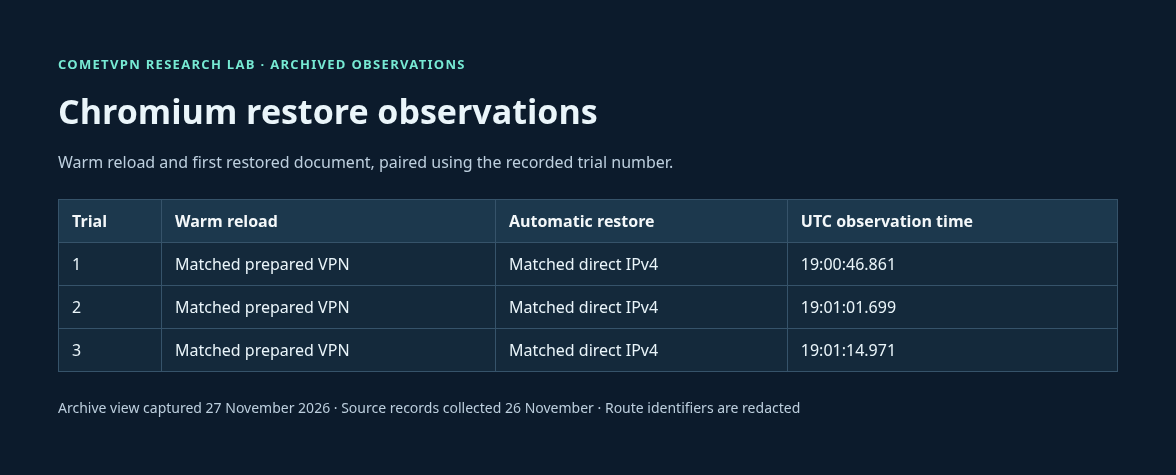
Each preparation row in the JSON records both the VPN check and the warm reload. Pair it with the restore-observed row sharing its trial number. The two flags in each restore row record whether the returned address matched the direct reference and whether it matched the prepared VPN reference.
The preparation-to-observation interval also contains shutdown, launch and the runner reading the restored page. Use the timestamps to order the checks. Estimating the browser’s first packet or the duration of the direct interval would require earlier network instrumentation.
| Судебный процесс | Preparation recorded | Restored document observed | Restored IPv4 |
|---|---|---|---|
| 1 | 19:00:44.491 | 19:00:46.861 | прямой |
| 2 | 19:00:56.439 | 19:01:01.699 | прямой |
| 3 | 19:01:12.647 | 19:01:14.971 | прямой |
Research lab screenshots
Часто задаваемые вопросы
Downloads, sources and citation
Suggested citation. FreePolicyTools. CometVPN Browser Restart Test: The First Restored Request. Original Research, November 26, 2026. Permanent article link.
FreePolicyTools may earn a commission if you purchase through this link.
Explore CometVPN plansRelated research
- CometVPN City Selection vs. IP Geolocation in Two Databases
- CometVPN WebRTC Leak Test: ICE Candidates and Data Channels
- CometVPN Firefox Per-Tab VPN Test: Three Tabs, Three Routes
- CometVPN WebRTC Protection On vs. Off: A Paired IP Leak Test
- CometVPN Firefox IP Rotation: 8 Trials, One Direct IP Result
- CometVPN Firefox Per-Tab VPN Test: Shared Workers Used One Exit