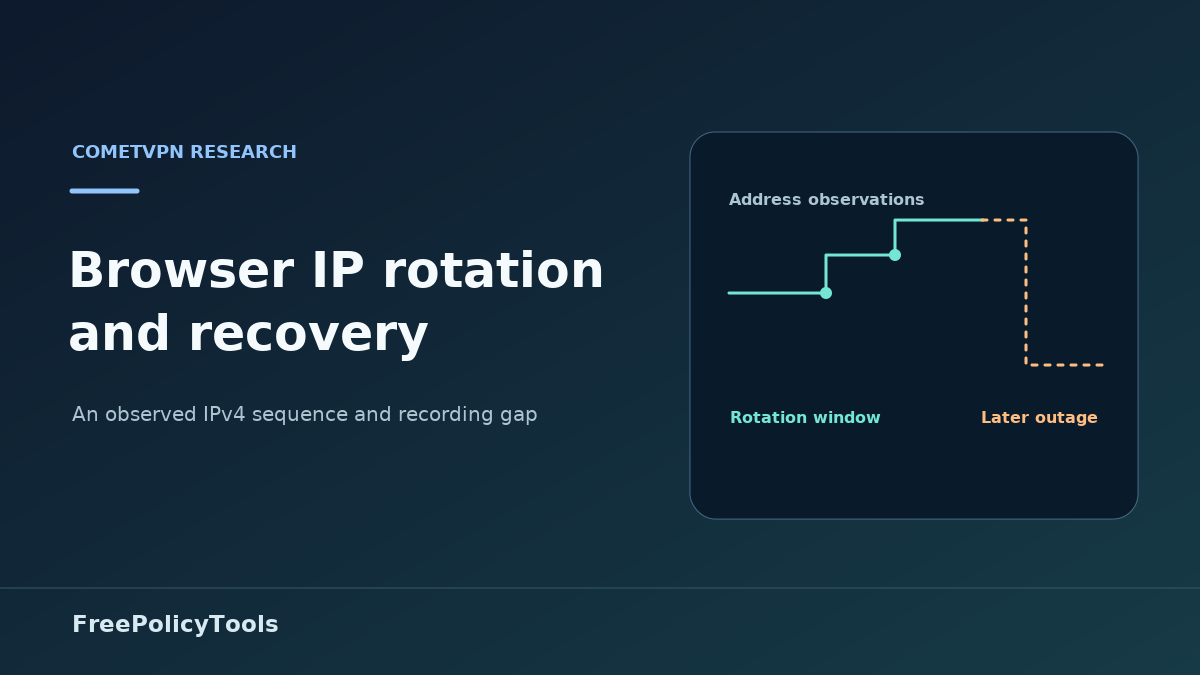
What does a website see when you rotate the address in a residential VPN browser extension? In our CometVPN test, an HTTPS endpoint saw an initial public IPv4 address, an intermediate address on three requests, and then a third address. The third address held across 514 successful probes over 32 minutes and 10 seconds before the recorder began returning errors.
We collected 1,076 browser probes across the original recording and a recovery follow-up. The operator performed one manual rotation in the original recording. A later internet interruption cut that recording short. Both logs are available below, with address labels in place of raw IPs.
- Original recording
- 740
- 576 probes returned a public IPv4.
- Original address changes
- 2
- 3 distinct IPv4 addresses observed.
- Recovery follow-up
- 336/336
- Successful probes on one observed address.
One browser extension, one Manhattan selection and one operator-reported rotation. The original recording had no verified direct IPv4 reference.
The results at a glance
Original probe outcomes
Elapsed time in the original recording
- Initial IPv4
- Intermediate IPv4
- Final observed IPv4
- Timeout
- Request failed
- No saved observations
| आउटकम | Elapsed range | Probes | Median probe time |
|---|---|---|---|
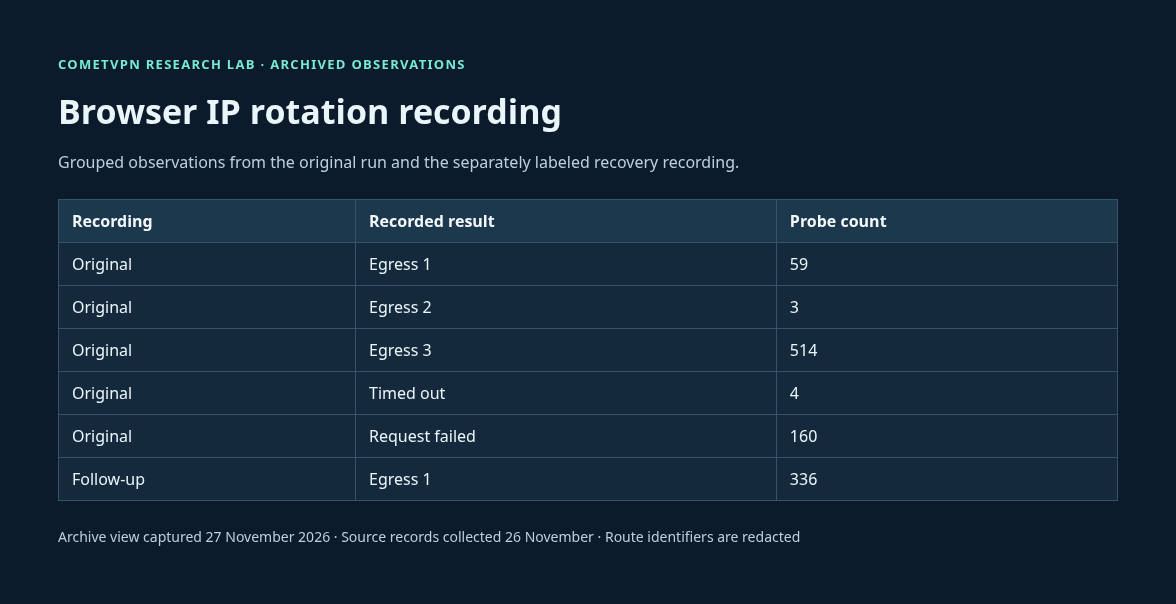
| Initial IPv4 | 0:00–0:59 | 59 | 480 ms |
| Intermediate IPv4 | 1:00–1:02 | 3 | 508 ms |
| Final observed IPv4 | 1:04–32:14 | 514 | 356 ms |
| Timeout | 32:19–32:34 | 4 | 2,500 ms |
| Request failed | 32:39–45:57 | 160 | 7 ms |
| No saved observations | After 45:57.5 to 60:00 | 0 | — |
The endpoint saw an intermediate IPv4 address
The first 59 probes returned the initial address. The first request that returned the intermediate address began 60.004 seconds after recording started. Three probes returned that address. The first request that returned the final address began at 64.001 seconds. Every recorded probe in that transition returned an address. In this session the endpoint saw two replacement addresses, even though the operator reported one press of the rotation control.
The recorder prompted the operator at 30.001 seconds. The operator acknowledged the rotation at 93.951 seconds, after the browser had already begun reporting the final address. The exact toolbar click time is missing. The two changed responses appeared about four seconds apart by request start time. The gap measures time between observations, so it cannot determine how long the extension took to act on the click or exactly when either address took over.
For a website, the public IP is one signal that can change while a browser session is open. We did not sign in to sites or measure whether an existing checkout, video stream, or login would survive. The separate WebRTC and browser routing study measured a different path and shows why an HTTPS IP check covers only one part of browser traffic.
The original run ended early. The follow-up stayed stable.
The last successful original probe started at 3:19:49 PM EAT. Four 2.5-second timeouts followed, starting at 3:19:54 PM. The recorder then logged 160 request failures, beginning at 3:20:14 PM and ending with its last saved probe at 3:33:32 PM. The operator reported an internet interruption between 3:25 and 3:35 PM EAT. The probe failures preceded that reported window. Since the collector only checked one endpoint and grouped network errors together, the cause remains unknown.
The browser reopened the recorder after the interruption and recovered its saved log. The first recording has 45 minutes and 58 seconds of probe coverage against a planned hour and no completion flag. The rest of that first hour has no saved observations. Those missing minutes do not enter the probe counts or get treated as failures.
To collect more data after service returned, we ran a separate 28-minute follow-up, from 3:36:38 to 4:04:38 PM EAT. No new intentional rotation was recorded. All 336 queries returned the same address within the new log, with a median response time of 401.5 milliseconds. We assign address labels afresh for each run, so recovery can be seen as a return of successful responses and within-run stability. The matching label “Egress 1” carries no information about whether the underlying address matched the first run.
The DNS path diary tracks resolver behavior separately. This test kept the measurement to an HTTPS endpoint and did not collect DNS resolver observations during the interruption.
How we measured browser traffic
- Test profile. We used the CometVPN extension in the ChatGPT in-app browser on Linux. The operator selected United States, Manhattan, New York, on the Native Residential plan. Manhattan is the location selected in the extension. No independent geolocation or network ownership lookup was performed.
- Measurement surface. A local browser page sent HTTPS requests to
api.ipify.org/?format=json. ipify returned the public IPv4 address it observed. The recorder used a Fetch request withcache: 'no-store', omitted credentials and referrers, and capped requests at 2.5 seconds. The browser could reuse connections. - Sampling. The original run attempted one probe per second in the first four minutes and one every five seconds afterward. The follow-up used five seconds throughout. The scheduler skipped a tick if a request was still pending. All intervals were nominal. The original logged 18 samples with the tab hidden at completion, so browser scheduling could also affect coverage.
- Scoring. Each valid address received a stable label within the recording. The log stored launch time, elapsed time, response duration, page visibility at completion, and an outcome label. An aborted request that reached the timeout was labeled separately from a generic failed request. Durations include the browser request and response parsing.
- Evidence. Both logs omit raw IP addresses. The grouped table uses consecutive observations in each log, including recorded failures. The preliminary disconnect cycles from November 25 used a direct IPv4 reference and are available as separate pilot notes.
What we learned from the pilot
On November 25, the operator deliberately switched the extension off and back on three times. The recorder matched the disconnected reference on 18, 8, and 25 probes respectively. This showed that the endpoint could observe the direct address when the extension was deliberately off. The pilot had no precise reconnect timestamps, and we did not carry that day’s address into the November 26 comparison.
How to read the recorded evidence
The original recording groups consecutive probe outcomes by address or error. The first noninitial IPv4 appeared for three request starts. The recording then moved to the final IPv4. Use the elapsed values in the log to see the gaps between those requests. A group’s first and last request describe the observed range, while the address could have changed between requests.
The independent Firefox rotation study used a verified direct control and eight marked clicks. It could classify its own observed direct result. This earlier browser-wide capture records ordinal address changes and a later failure streak. It has neither a verified direct reference for the main run nor an exact rotation click timestamp. Firefox per-tab rotation evidence.
यह परीक्षण क्या स्थापित कर सकता है
- Observed IPv4 changes: One browser, one selected location, one manual rotation, and one HTTPS destination. The test documents the order of observed public addresses. The result does not estimate how often a third address appears across rotations or locations.
- Direct exposure remains unknown: The main run had no verified VPN-off IPv4 reference. The pilot used deliberate off/on transitions and cannot supply a current control for the main run. No direct-IP exposure rate or kill switch finding can be inferred.
- Browser extension scope: These probes do not test a device-wide tunnel, other apps, IPv6, WebRTC, DNS, or long-lived connections. We did not use the vendor’s separately documented proxy configuration as a substitute for the extension.
- Outage attribution: The later errors show loss of successful probes to one endpoint. The test cannot distinguish a browser or extension error from a local network failure, a provider interruption, or an endpoint issue. The follow-up cannot establish the exact recovery time.
How to test your own browser
For a simple check, record the public IPv4 reported in your test profile before and after one rotation. Check a second endpoint you trust as well, especially if the first reports errors. Keep the region fixed and record the time you press the control. Our browser timezone and exit-country study shows why an exit change alone does not tell you what language or timezone the browser reports.
For a direct exposure test, capture a fresh VPN-off reference on the same browser and network before connecting, use a test profile without unrelated tabs, and record the disconnected, connected, and rotating states. Repeat the rotation across several independent sessions. A new exit observed after a button press tells you where sampled requests emerged. To test unexpected tunnel loss, use a controlled loss of connectivity and collect evidence from a separate control path.
सामान्य प्रश्न
Download the evidence
Both logs are redacted JSON. The collector is available as a standalone HTML file. Serve it on localhost, open it in the extension’s browser profile, and use the original or follow-up mode. The follow-up mode is selected with ?mode=follow-up.
Suggested citation. FreePolicyTools. CometVPN IP Rotation Test: What Changed in the Browser?. Original Research, November 26, 2026. Permanent article link.
Affiliate disclosure. FreePolicyTools may earn a commission if you purchase CometVPN through an affiliate link in this article. For more product context, see our CometVPN समीक्षा.
स्रोत
- CometVPN’s browser extension documentation describes the product surface.
- CometVPN’s Native Residential documentation describes the provider’s location and rotation options.
- ipify API documentation specifies the public IPv4 endpoint and JSON response.
- MDN’s Fetch request cache reference explains the no-store mode used by the recorder.