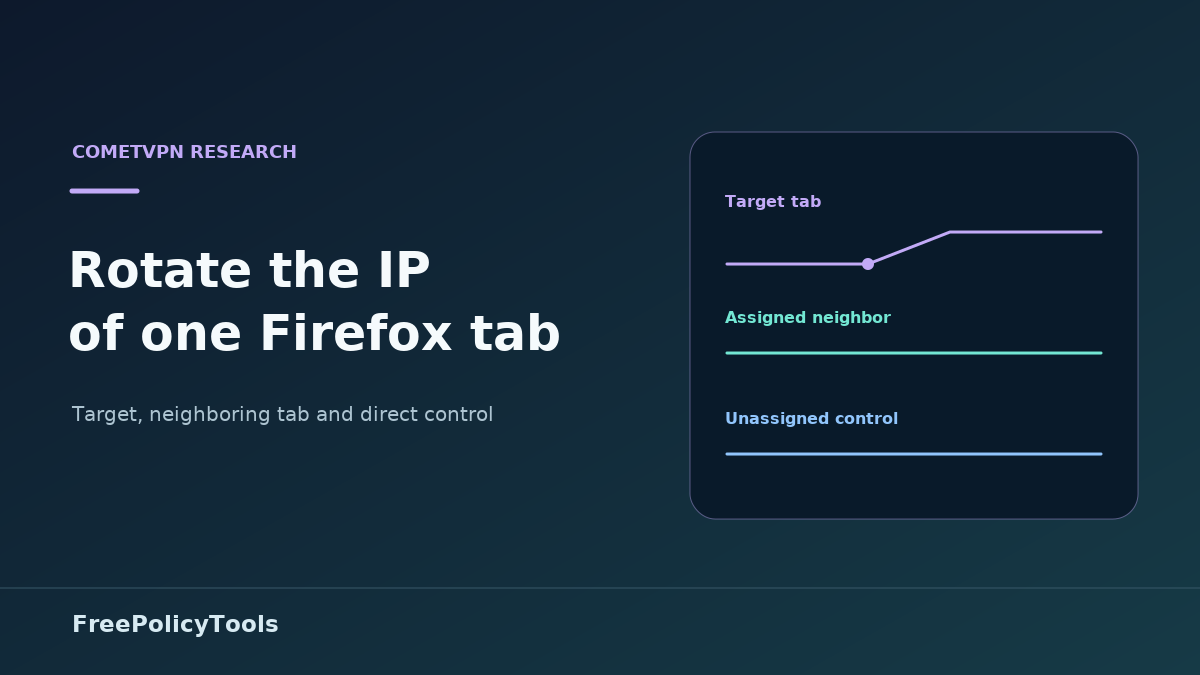
CometVPN’s Firefox rotation button changed the target tab’s public IPv4 in eight of eight trials. Seven rotations produced a different non-direct address. One was followed by two successful HTTPS requests using the workstation’s direct IPv4. An adjacent Manhattan-assigned tab and an unassigned direct tab kept their original routes throughout.
A per-tab IP rotation has two jobs. It should change the selected tab’s exit and preserve the routes already in use by other tabs. We measured both jobs with three tabs in one Firefox window and compared rotation with opening the extension without pressing its button.
- Target changes
- 8 / 8
- Address differed after the rotation command
- Direct IPv4 on target
- 1 / 8
- Two post-rotation requests matched the direct reference
- Changes on either comparison tab
- 0 / 8
- Each retained its pre-rotation address
Eight real rotations and four no-rotation controls, with three passes over the same three tabs in each block.
Results at a glance
Rotation outcomes with two post-command observations
| कार्रवाई | Target outcome | Manhattan neighbor | Unassigned direct tab |
|---|---|---|---|
| Rotate · 8 trials | 7 changed to another non-direct IPv4, 1 changed to direct | Unchanged in all 8 | Unchanged in all 8 |
| Open popup without rotating · 4 trials | Unchanged in all 4 | Unchanged in all 4 | Unchanged in all 4 |
| Direct outcome · Rotation in block 9 | Two consecutive post-action probes matched direct IPv4 | Retained its distinct Manhattan route | Confirmed the same direct reference |
Measurement design
- कार्रवाई
- Get a new IP on the target tab, compared with opening the popup without rotating
- नियंत्रण
- Distinct Manhattan route on a neighbor and independently verified direct route on the unassigned tab
- Sampling
- Before, first post-action and second post-action passes
- वसूली
- Reassignment after the observed direct outcome, with the next baseline verified
The command affected the target tab alone
The target and neighboring tab were assigned Manhattan through CometVPN’s Firefox per-tab mode. Before each action, the two showed different public IPv4 addresses, and neither matched the direct reference. The unassigned third tab matched the direct reference. Using the same location on the two assigned tabs held the city selection constant while giving each tab a distinct address to track.
After each rotation command, the target produced an address different from its own immediately preceding observation. All eight target results persisted through a second post-action pass. The neighboring tab returned the same distinct address in all 36 requests made in that tab across the experiment. The direct control matched the independently measured workstation IPv4 in all of its 36 requests.
Four interleaved no-rotation controls opened the same extension interface in the target tab and then resumed navigation. In each, all three addresses stayed the same. This helps distinguish the rotation command from the effects of opening the popup, navigating back to the IPv4 echo, or checking the tabs again.
One rotation returned the direct IPv4
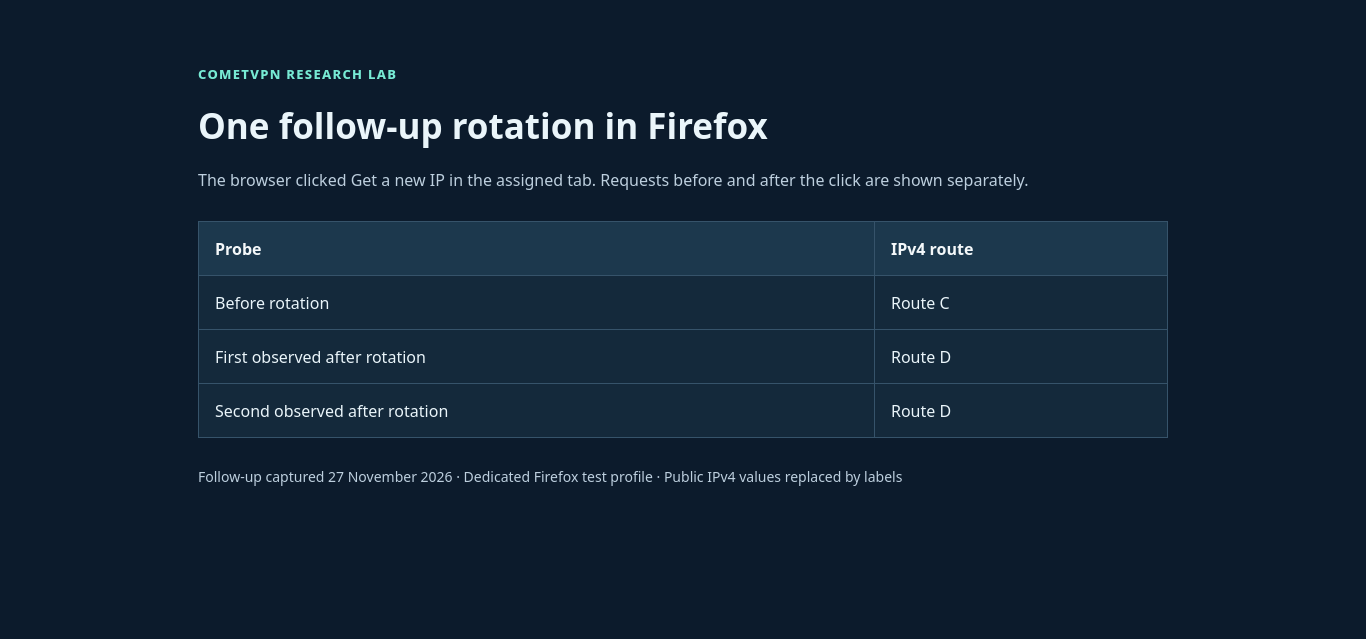
Block 9 began with separate verified VPN addresses in the target and neighboring tabs. After the rotation command, the target matched the unassigned control and the independent direct IPv4 in both follow-up passes. The neighboring tab stayed on its prepared route. The two matches were successful echo replies, so a failed network request did not account for the result.
The automation selected Manhattan again after detecting the direct outcome. The next block began with a non-direct target address and again showed no route change when the popup was opened without rotation. That verifies recovery by the next recorded baseline after reassignment. It leaves open whether the target would have recovered on its own.
The eight rotations tell two different stories. The action was isolated to the target in every measured round, and one round reached the direct network. The HTTPS samples were taken after a short settling period. They give no estimate of the transition duration, when the first direct request occurred, or the routing of requests between samples.
How we measured rotation and the no-rotation comparison
The test ran on 26 November 2026 using Firefox 153.8.0 ESR, CometVPN 1.3.0 and the Native Residential subscription. The signed extension ran in an isolated, linked Firefox profile. Both assigned tabs used the Manhattan selection. The independent direct IPv4 reference came from a workstation HTTPS request outside Firefox.
Before applying a trial action, we checked all three tabs with unique IPv4 echo URLs. The automation used the extension’s Get a new IP button in the target tab for rotation, or opened the interface and left the button alone for the comparison. It waited at least four seconds and, for rotation, checked the interface for visible transition text before collecting two more passes over the same tabs.
The order was rotation, no rotation, rotation, rotation, no rotation, rotation, no rotation, rotation, rotation, no rotation, rotation, rotation. The twelve complete blocks produced 108 browser observations. The first and last completed block timestamps were about four minutes and seventeen seconds apart. We stopped after the fixed action count because the comparison required repetition of the command, with controls, rather than arbitrary hours of steady-state browsing.
Each public response was classified by exact address equality. The published data uses anonymous route labels and direct-match flags. Equal labels identify repeats within this study only. Each row preserves the tab order, the pre-action pass, and both post-action passes so readers can reproduce all counts in the results.
What this comparison leaves open
These results apply to the observed HTTPS egress from one Linux workstation, one browser profile and one selected city. The study did not independently check whether each of the seven new non-direct addresses was located in Manhattan. It tested the effect of the button on routing equality, with the chosen location held fixed.
The direct result was one observed event in a sequential run. It cannot establish a population failure rate or the vendor-side cause. This procedure also leaves out transient traffic before the first post-action pass, IPv6, DNS, WebRTC, active WebSockets and operating-system VPN clients. Replication across distinct accounts, networks and exit locations would be needed to compare frequencies.
How to read the recorded evidence
The before, after and later arrays use the same tab order. Compare the target’s first position inside each block, then use the remaining positions to test collateral route changes. The direct exception is identified by an exact echo match in two passes; its duration cannot be inferred from those two readings.
The next block checks that the target had regained a VPN route after reassignment. It cannot distinguish whether the extension would have recovered without that intervention. The no-rotation comparisons help distinguish ordinary popup access from the Get a new IP action.
| ब्लॉक | कार्रवाई | Target before → after → later | Comparison routes |
|---|---|---|---|
| 9 | रोटेट | Non-direct → direct → direct | Both unchanged |
| 10 | Open popup only after reassignment | Non-direct → same → same | Both unchanged |
Research lab screenshots
अक्सर पूछे जाने वाले प्रश्न
Downloads, sources and citation
Suggested citation. FreePolicyTools. CometVPN Firefox IP Rotation: 8 Trials, One Direct IP Result. Original Research, November 26, 2026. Permanent article link.
FreePolicyTools may earn a commission if you purchase through this link.
Explore CometVPN plansRelated research
- CometVPN Browser Restart Test: The First Restored Request
- CometVPN City Switch Test: What Happened to an Open WebSocket?
- CometVPN City Selection vs. IP Geolocation in Two Databases
- CometVPN WebRTC Leak Test: ICE Candidates and Data Channels
- CometVPN Firefox Per-Tab VPN Test: Three Tabs, Three Routes
- CometVPN WebRTC Protection On vs. Off: A Paired IP Leak Test
- CometVPN Firefox Per-Tab VPN Test: Shared Workers Used One Exit