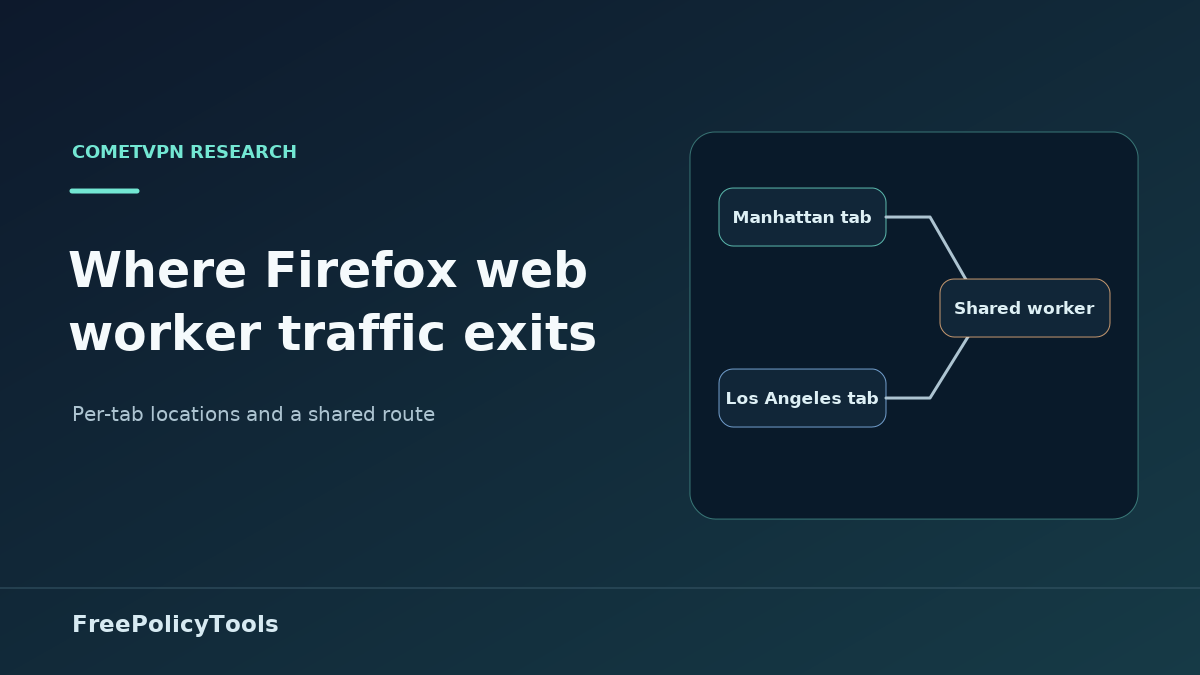
Two Firefox tabs assigned to different CometVPN locations kept separate public IPv4 addresses for document, iframe and dedicated-worker requests. The shared worker and service worker used one common VPN address across all three measured tabs. That convergence occurred in all 108 successful shared and service worker probes, including after a browser relaunch and reversal of the city assignment order.
A website can fetch data directly from a tab or ask a background worker to make the request. A per-tab VPN check that only opens an IP echo page measures one of those paths. We ran the same HTTPS echo from five execution contexts to see when the tab’s address remained a reliable predictor of what the destination would observe.
- Primary probes
- 270
- 266 usable IPv4 echoes and four recorded timeouts
- Assigned tab-bound requests
- 106 / 106
- Successful document, iframe and dedicated-worker requests matched their tab’s reference
- Worker convergence
- 108 / 108
- Shared and service worker requests matched the first assigned address in each browser run
Three blocks of six rounds over two starts of the same Firefox profile. The worker comparison used a loopback origin.
Results at a glance
Successful requests matching the initiating assigned tab’s own IPv4 reference
| Context | Usable of attempted, all tabs | Matched own reference, assigned tabs | Matched direct reference, unassigned tab |
|---|---|---|---|
| Document fetch | 54 of 54 | 36 of 36 | 6 of 18 |
| Same-origin iframe fetch | 52 of 54 | 35 of 35 | 6 of 17 |
| Specifieke werknemer | 52 of 54 | 35 of 35 | 6 of 17 |
| Shared worker | 54 of 54 | 12 of 36 | 0 of 18 |
| Dienstbediende | 54 of 54 | 12 of 36 | 0 of 18 |
Measurement design
- Matrix
- Three phases × six rounds × three tabs × five HTTPS execution contexts
- Worker control
- Named shared worker with observable instance ID, fresh dedicated workers, and service worker with no fetch handler
- Assignment reversal
- Los Angeles configured first after relaunch, with Manhattan sending the first worker probes
- Cross-check
- Pre-assignment loopback direct reference and closing document fetch from a public HTTPS origin
Which web requests followed the tab’s VPN route?
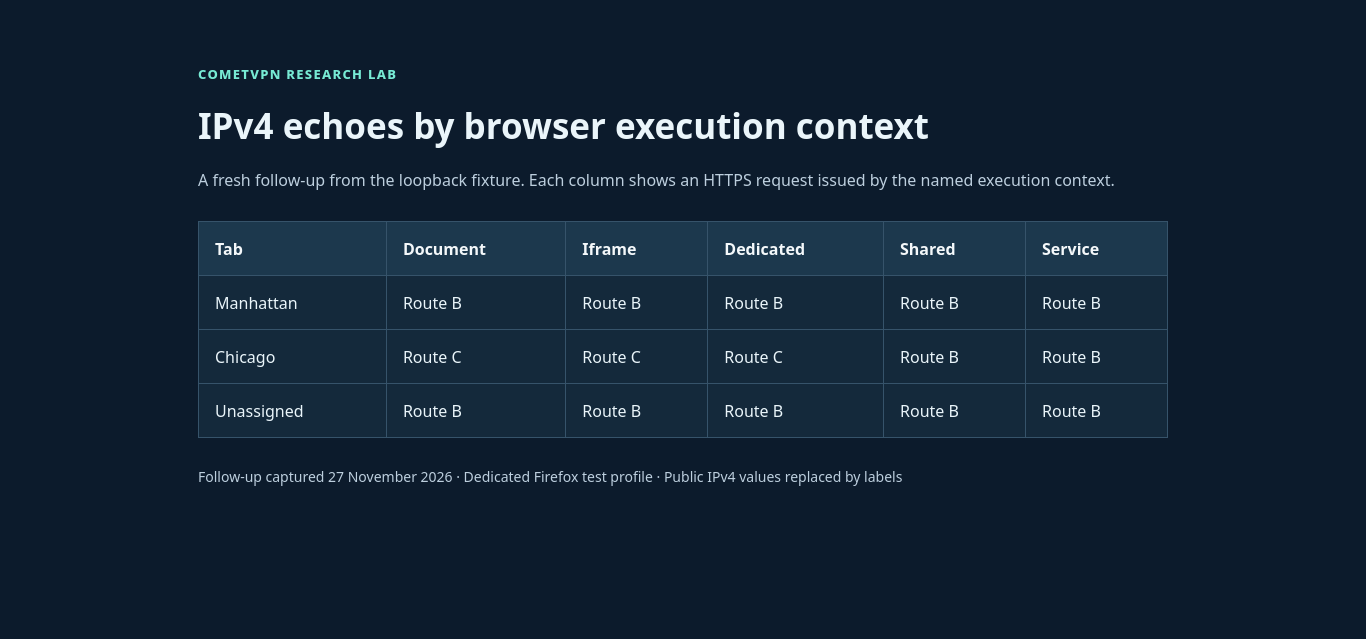
All 106 successful tab-bound requests from the two assigned tabs matched the corresponding reference address. That held for ordinary window fetches, requests made inside a same-origin iframe and requests made by a fresh dedicated worker. Each of those three surfaces could therefore still distinguish the two tab assignments in this experiment.
A shared worker runs outside the document and can serve more than one page from the same origin. We used a single named shared worker and verified that all three tabs saw the same worker instance within each phase. The service worker was registered on the fixture origin and received messages from the tabs. It performed the fetch itself. The fixture had no service-worker fetch handler, so the service worker did not intercept the document or iframe requests used as controls.
Each shared-worker request and each service-worker request returned the same address across all three tabs within each phase. The service worker sometimes restarted, as shown by a new in-memory instance label. Those instance changes did not change the observed route within a browser run. A result on the assigned tab that already matched the common worker address looked normal in isolation, which is why we included the other assigned tab and an unassigned tab.
Reversing the assignment order moved the common worker address
In the first phase, the setup connected Manhattan before Los Angeles. The shared worker and service worker used the first Manhattan address throughout the phase. In the second phase, fresh tabs were assigned to the same cities in the same order and received two new addresses. The document, iframe and dedicated-worker calls tracked those new addresses. The shared worker and service worker kept using the Manhattan address from the first phase, even with newly created worker instances.
We then closed Firefox and reopened the same linked research profile for a third phase. This time we assigned Los Angeles first and Manhattan second. The first worker probes were deliberately sent from the Manhattan tab. Shared-worker and service-worker requests nevertheless matched the Los Angeles reference across all three tabs. The replication supports a relationship with browser-run setup order under these conditions. The experiment cannot identify the internal proxy rule, connection state or storage responsible for it.
The unassigned comparison started each phase with a top-level echo that matched the independent direct IPv4. Its closing navigation used the first assigned exit in phases 1 and 3 and the direct address in phase 2. That pattern also appeared in its document, iframe and dedicated-worker fetches. The baseline identifies it as initially direct. Its later requests show why assigning a permanent direct label to that tab would have hidden an observation.
How to reproduce the address comparison
We used Firefox 153.8.0 ESR on one Linux workstation, the signed CometVPN extension version 1.3.0 and Native Residential VPN. The replication verified that the extension’s per-tab setting was on. For each phase, the two assigned tabs had to return distinct IPv4s on fresh top-level echo requests. Those addresses also had to differ from the off-browser direct reference. Location names describe the extension selection.
The loopback fixture issued unique HTTPS requests to the same IPv4 echo endpoint with cache reuse disabled, no credentials and no referrer. Each of the three phases contained six rounds. Every round sampled three tabs and five execution contexts, giving 90 scheduled probes per phase. Both tab order and the order of the five surfaces varied during collection. The fixture made dedicated workers afresh and kept the named shared worker ports open across rounds.
A pre-assignment check on a separate loopback origin recovered the direct IPv4 on all five surfaces. The external direct IPv4 remained unchanged across the start and end of each browser run. The final phase also repeated the document fetch from an owned public HTTPS origin. Its three results matched the closing navigations, including the VPN address in the previously direct unassigned tab. The worker experiment itself used the loopback fixture.
The dataset records each attempt, the comparison address label, worker instance label where available and any error. Four attempts yielded no usable IPv4, two inside iframes and two inside dedicated workers. Two affected an assigned tab and two affected the unassigned tab. Denominators in the matching columns use successful replies only. The probe totals include every scheduled attempt. Route identifiers are scoped to each browser run.
To repeat the experiment, run the supplied Python fixture on loopback and open it in an unassigned tab and two tabs with verified distinct assignments. The page exposes runProbe to run the five contexts from the browser console with a fresh nonce. Establish the three references before sampling, keep the shared worker clients open and repeat with the opposite assignment order after restarting the browser.
What this means for regional browser tests
A regional test can see the correct address in the page and still reach a backend from a different exit when a shared worker performs the network request. In this study the worker address stayed on a CometVPN route. The privacy result was a failure to preserve the per-tab exit distinction for the tested worker surfaces. The recorded worker responses after assignment did not expose the workstation’s direct IPv4.
The repeated observations come from one profile, one Firefox release, one workstation, two assigned cities and one measurement endpoint. They can describe repeatability and the outcome of the reverse-order comparison in that setup. They cannot establish a rate across installations or determine how other extensions handle these APIs. The study did not measure IPv6, DNS, cross-origin iframes, push events or payloads issued by service workers after every client tab closes.
For an independent follow-up, compare the initiating tab with the context that actually sends the request, then repeat with a separate browser profile or endpoint. Include the first verified address for each assignment and preserve a record of browser restarts. In this study replacement tabs acquired new addresses while shared workers kept the older one, so comparing only current city labels would have missed that carryover.
How to read the recorded evidence
The phase references identify each tab’s opening-navigation result and the route used by both worker types. In phase 2, the common worker route matched neither current assigned address. A simple city label would miss that fact, because the old and new Manhattan addresses differ even though their extension selection is the same.
Use the observations array for scoring individual surfaces, then examine the instance field to check whether a service-worker restart coincided with a route change. Keep the four missing responses in the collection count. The data supports a route observation within a browser run; route IDs from different runs cannot be compared for IP equality.
| Browser phase | Location order | Assigned addresses | Common worker address |
|---|---|---|---|
| Run 1 · phase 1 | Manhattan → Los Angeles | route-2, route-3 | route-2 |
| Run 1 · phase 2 | Manhattan → Los Angeles | route-4, route-5 | route-2 from phase 1 |
| Run 2 · phase 3 | Los Angeles → Manhattan | route-2, route-3 | route-2 from phase 3 |
Research lab screenshots
Veelgestelde vragen
Downloads, sources and citation
Suggested citation. FreePolicyTools. CometVPN Firefox Per-Tab VPN Test: Shared Workers Used One Exit. Original Research, November 26, 2026. Permanent article link.
FreePolicyTools may earn a commission if you purchase through this link.
Explore CometVPN plansRelated research
- CometVPN Browser Restart Test: The First Restored Request
- CometVPN City Switch Test: What Happened to an Open WebSocket?
- CometVPN City Selection vs. IP Geolocation in Two Databases
- CometVPN WebRTC Leak Test: ICE Candidates and Data Channels
- CometVPN Firefox IP Rotation: 8 Trials, One Direct IP Result
- CometVPN browser IP rotation and recovery