Our own public STUN server recovered the direct IPv4 address in six browser controls. With CometVPN connected to Chicago, three repeated ICE gathers produced zero candidates. A separate cross-network test then established a working direct control through a private TURN relay. The protected browser received its peer’s answer but gathered zero relay candidates and exchanged no data.
WebRTC exposes several distinct outcomes. A page can gather candidate addresses, communicate with a signaling service and still fail to move application data to another peer. We measured those stages separately to distinguish an address-exposure result from a connection result.
- Public STUN controls
- 6 / 6
- Direct IPv4 recovered
- Chicago gathers with candidates
- 0 / 3
- All three protected gathers returned zero candidates
- Cross-network relay pair
- 1 + 1
- Direct exchange passed; protected exchange had no candidate
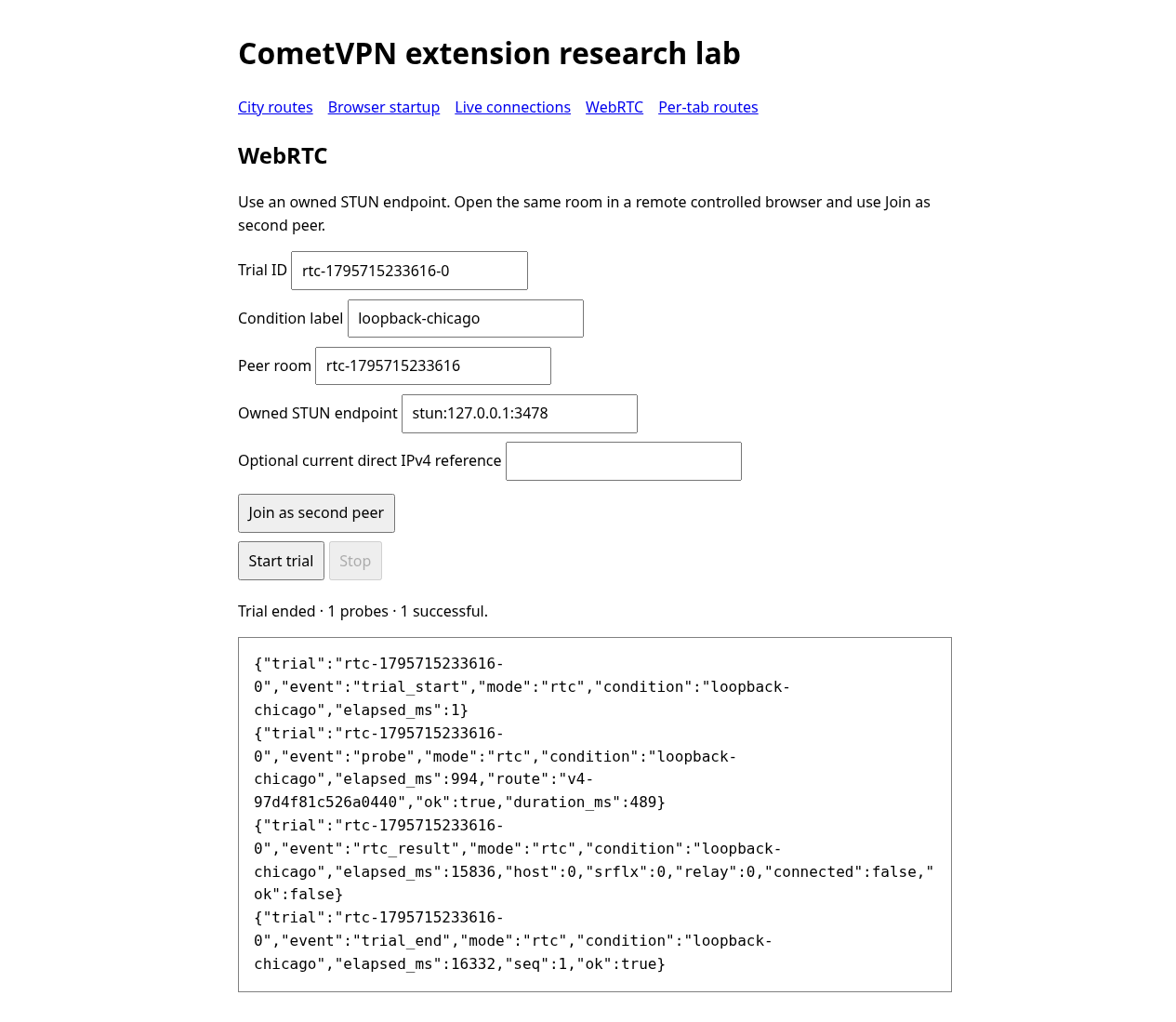
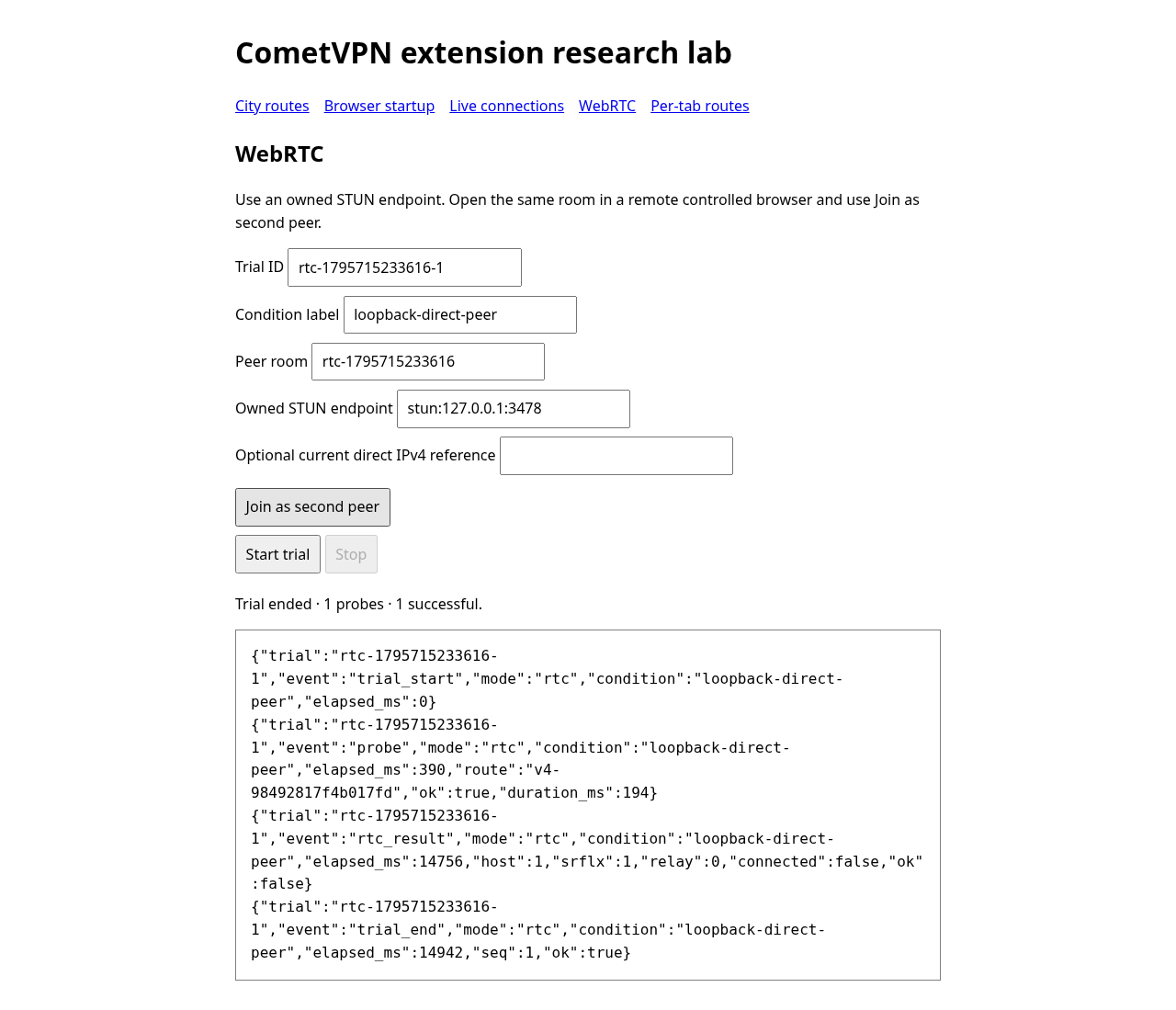
Nine public STUN gathers and one usable cross-network TURN comparison. The lab screenshots show earlier loopback checks.
Results at a glance
Public STUN gathers exposing the direct IPv4
| Voorwaarde | Observations | Candidate or channel result |
|---|---|---|
| Direct with public STUN | 6 gathers | Direct IPv4 appeared in all six |
| CometVPN Chicago with public STUN | 3 gathers | Zero candidates in each gather |
| Direct browser with TCP TURN | 1 scored trial | Two local relay candidates; probe and acknowledgment passed |
| CometVPN Chicago with TCP TURN | 1 scored trial | Peer answer arrived; zero local relay candidates and no acknowledgment |
Measurement design
- Public-address treatment
- Chromium 151 with public STUN, first disconnected and then connected to Chicago
- Connectivity treatment
- One scored direct and connected comparison using the same isolated TCP TURN arrangement
- Address outcome
- Candidate types and exact match against the direct public IPv4
- Delivery outcome
- Receipt of a data-channel acknowledgment from the remote peer
What an ICE candidate can expose
ICE is the process WebRTC peers use to find a working path. A browser can present local candidates, an address learned from a STUN server, or an address allocated by a TURN relay. A STUN-derived server-reflexive candidate is particularly useful in a privacy test because it can reveal an address learned from the network, independently of the IP used for an ordinary browser fetch.
For our direct control, the browser gathered one host candidate and one server-reflexive candidate on every observation. The host candidate used a local multicast name, while the server-reflexive address matched the direct public IPv4 reference obtained in the same Chromium profile. The comparison was made in memory and only the matching flag and counts were saved.
When we connected the extension to Chicago, a separate HTTPS echo verified that the browser’s public IPv4 had changed. We then started three fresh peer connections from the same HTTPS origin. Each reported completed gathering with zero host, server-reflexive, peer-reflexive or relay candidates in the public STUN phase.
The cross-network data-channel check
The browser ran on our workstation and its WebRTC peer ran in an independently reached Coolify container. The same authenticated HTTPS collector relayed the offer and answer. It held the descriptions temporarily in memory. We did not include SDP or candidate addresses in the evidence package.
The successful control used an owned, short-lived TURN relay. Both sides obtained allocations on the relay’s isolated network, and the browser used a relay-only ICE policy to test that specific route. The direct browser gathered two relay candidates, received an answer with one relay candidate, sent an application probe and received the expected acknowledgment. This established an actual data exchange across the two environments.
With CometVPN connected, the browser still received a remote answer containing one relay candidate over HTTPS. It gathered zero local relay candidates, and the data channel never acknowledged the probe. The two media runs used the same relay type and the same remote peer code. The browser’s ability to receive the answer isolated the observed failure beyond the signaling phase.
Failed controls and what we counted
We tested the capture logic first with two same-machine direct peers. They exchanged data with the loopback setup. The Chicago loopback run exposed zero candidates on the VPN side and the exchange failed. These checks helped validate the instrumentation but could not establish public data-path behavior by themselves.
The first cross-network setup signaled successfully, but the direct browser could not establish an unrelayed data channel across those networks. The first TURN attempt also failed its direct control. A later relay setup issued candidates but failed to deliver data. We retained those attempts as unscored controls and drew the data-channel comparison from the final setup that exchanged a message and acknowledgment with the extension disconnected.
The public STUN controls cover two collection starts. One of those starts ended before its protected series could run because the extension could not select the target exit at that time. The second start yielded three matched direct controls and the three Chicago observations. This is why the evidence contains six valid direct gathers and three valid protected gathers.
Privacy and connectivity implications
The test combines two practical observations for this Chromium 151 and CometVPN 1.3.0 setup. A neutral web page failed to obtain the direct IPv4 through candidate gathering when the extension was connected, and a relay-backed data channel that passed on the direct connection failed under the connected condition. Readers who rely on calls or peer-to-peer browser features should measure connectivity alongside address exposure.
The comparison covers one workstation, one selected VPN location, the installed extension’s default WebRTC setting, an IPv4 reference and one controlled TURN arrangement. It leaves IPv6 exposure, other browser builds, alternative extension settings, media capture and production conference applications for separate tests. A short data-channel message exercises connection establishment and delivery, while service-specific audio and video behavior can differ.
How to read the recorded evidence
Start with public_stun_gathers for the candidate-address result. Use scored_relay_rooms to select the final direct and protected entries in relay_attempts for the data-delivery comparison. The earlier rooms demonstrate why candidate collection or signaling by itself could not qualify a delivery control.
The two loopback screenshots below are diagnostic artifacts. They show that the measured browser and its local peer reported different candidate counts in that specific loopback run. The public STUN and final TURN results are documented separately in the dataset.
| Room | Answer received | Browser relay candidates | Peer acknowledged probe |
|---|---|---|---|
| relay-local-direct | Ja. | 2 | Ja. |
| relay-local-vpn | Ja. | 0 | Nee |
Research lab screenshots

Veelgestelde vragen
Downloads, sources and citation
Suggested citation. FreePolicyTools. CometVPN WebRTC Leak Test: ICE Candidates and Data Channels. Original Research, November 26, 2026. Permanent article link.
FreePolicyTools may earn a commission if you purchase through this link.
Explore CometVPN plansRelated research
- CometVPN Browser Restart Test: The First Restored Request
- CometVPN City Selection vs. IP Geolocation in Two Databases
- CometVPN Firefox Per-Tab VPN Test: Three Tabs, Three Routes
- CometVPN Firefox Tab Test: Do Duplicated and Reopened Tabs Keep the VPN?
- CometVPN Firefox IP Rotation: 8 Trials, One Direct IP Result
- CometVPN Firefox Per-Tab VPN Test: Shared Workers Used One Exit
- CometVPN browser IP rotation and recovery