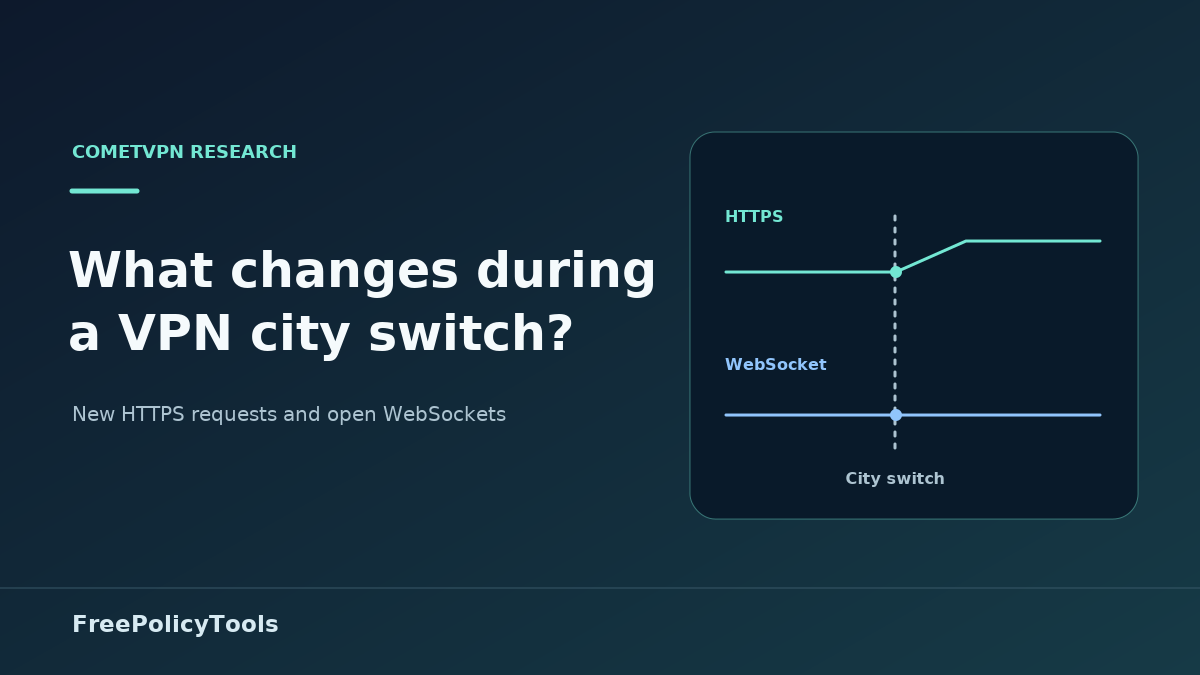
In the completed Manhattan-to-Chicago switch, new HTTPS requests moved to the new route. The WebSocket that was already open continued to use the original route. It delivered 117 recorded heartbeat acknowledgments without a reconnect before the trial ended.
A public-IP check opens an exchange whose egress can differ from a connection established earlier. Long-running collaboration, live updates and browser consoles often use an open WebSocket. This experiment tracked the two surfaces in the same browser, against the same owned staging origin, during a switch in the CometVPN extension.
- Completed switch
- 1
- Manhattan to Chicago
- First new HTTPS route
- 56.65 s
- Elapsed from the collector start
- Original WebSocket
- 117
- Heartbeat acknowledgments on its original route
One completed Manhattan-to-Chicago switch, one no-switch control and separate partial attempts. Both measured surfaces used the same owned origin.
Results at a glance
Sequence of recorded events in the completed switch
- 1.81 s WebSocket opens on the original route
- 50.00 s Chicago switch requested
- 52.60–56.65 s Last old HTTPS observation to first new one
- 120.36 s Last heartbeat on the original socket
| अवलोकन | Elapsed time | Recorded outcome |
|---|---|---|
| Original WebSocket opened | 1.81 s | Original route |
| Switch requested | 50.00 s | Independent operator marker |
| Last HTTPS observation on original route | 52.60 s | Original route still observed |
| Chicago connection confirmed | 56.30 s | Extension showed connected |
| First HTTPS observation on new route | 56.65 s | New route |
| Last recorded WebSocket heartbeat | 120.36 s | Original route, same socket |
Measurement design
- Pairing
- Fresh HTTPS echoes and sequential heartbeat acknowledgments on one pre-opened WebSocket
- Observable address
- The collector labels the peer of each HTTP request or WebSocket upgrade
- Independent timing
- Extension switch request and connected confirmation marked outside the browser probe loop
- तुलना
- A Manhattan trial with a midpoint marker and no extension switch
What moved during the switch
The automation started the trial with Manhattan connected. It opened a WebSocket and requested HTTPS echo responses from the collector throughout the roughly two-minute window. At 50 seconds, it requested Chicago through the actual extension popup. The browser reported the new connection at 56.30 seconds, and the first new HTTPS route was observed shortly afterward, at 56.65 seconds.
The last original-route HTTPS observation arrived at 52.60 seconds. That gives an observation bracket for the HTTP change. Requests were sampled, and responses can arrive after the network action that prompted them. The first new response time therefore gives a useful measured upper bound for seeing the new route in this setup, with uncertainty between the two observations.
The HTTPS echo endpoint received 28 observations on the original route and 40 on the new route before the server recorded the trial end. The browser logged one failed probe and a successful probe that finished after its ending marker. The server-side request count and the browser-side outcome count describe different parts of the sampling process. Treating those counts as identical would hide the in-flight request at the boundary.
How we kept the WebSocket evidence separate
The server recorded the route label when the WebSocket upgrade opened the connection. Its echo loop then replied to numbered messages on that same socket. The 117 recorded acknowledgments all belonged to the original connection. The server logged one socket open and no browser close before the end marker. A later connection would have received its own opening record and label.
A WebSocket handshake starts an application channel carried by an existing network connection. During this experiment, Chrome continued sending and receiving frames on that connection after the extension changed the route for fresh HTTPS exchanges. The route label is an observation from our HTTPS and WebSocket ingress. It describes the public address seen by the collector, without any access to the provider’s infrastructure.
We also ran a two-minute Manhattan control with a midpoint marker and no switch. In that control, 115 successful HTTPS probes and 117 WebSocket heartbeats were recorded before the trial ended. Both surfaces stayed on the Manhattan reference. The control verifies that the fixture could observe simultaneous HTTPS and socket traffic in the ordinary connected state.
Browser, timing and failed attempts
The test used a dedicated Chromium 151 profile, CometVPN extension 1.3.0, and an owned HTTPS origin with a WebSocket upgrade route. The collector kept a keyed label for the ingress IPv4 instead of writing raw IPs. We had already recorded distinct direct and VPN references. HTTPS requests used cache-bypassing fetches, and the socket sent application-level heartbeat messages.
The final switch markers were written over the workstation’s separate control path. This was important because earlier switch attempts timed out or interrupted the browser’s ability to send markers to the collector. In the completed trial we recorded both the request to change cities and the extension’s connection confirmation. Those two events let a reader distinguish the browser action from the observed network response.
Two earlier timed attempts ended without a successful measured transition or a normal ending record. An additional setup retry could not connect to the selected starting city. We kept the earlier timed logs and scored the single completed switch separately. The two-minute no-switch control and the uncompleted attempts contribute context, while the Chicago result describes one successful transition.
What an open connection means for the result
Changing the location shown in a browser extension can affect newly established traffic and an existing connection at different times. A browser tool that reports only the current HTTP address could correctly show the new location while a live application still has an open session on the previous route. For a reproduction, keep a socket open and record a second, fresh HTTPS observation in parallel before and after a marked switch.
The successful switch retained the original VPN route on the socket. This trial does not establish a route pattern for every server, VPN change, browser version or transport. It does not show whether an already open socket would persist during a disconnect, a browser restart or a tunnel interruption. It also does not independently establish the physical city of either IP.
How to read the recorded evidence
Use the completed switch ID when filtering observations. The opening record supplies the socket’s route label. Numbered heartbeats describe that connection until the end marker. The HTTPS entries can be grouped independently by their route labels and timestamps.
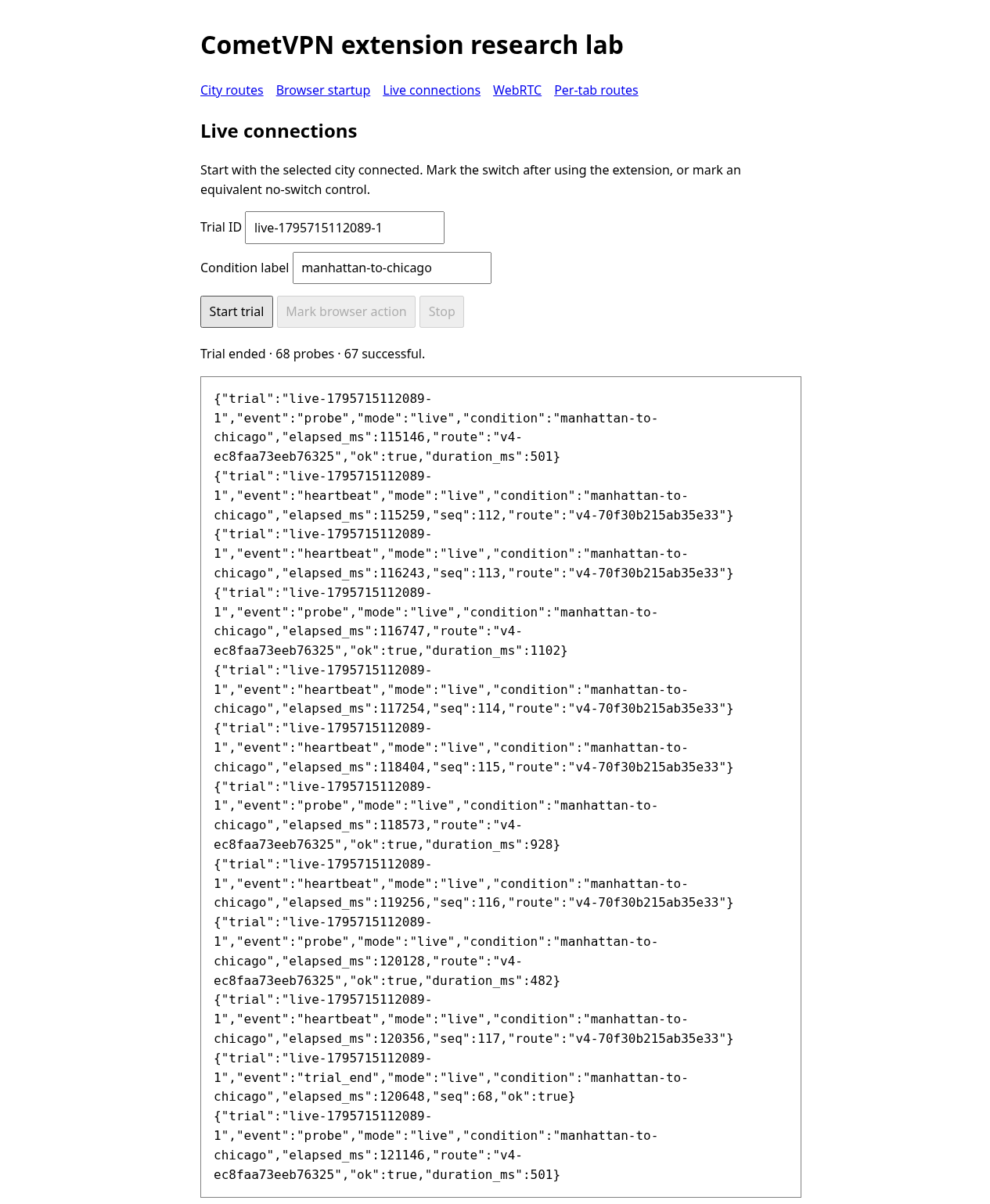
The recorder and collector use different viewpoints. The screenshot shows the browser-side probe count and the final heartbeat sequence. On the server, a request can be received before the cutoff even if its browser response event is recorded afterward. Keep the two counts tied to their respective clocks.
| रन | HTTPS observations | WebSocket heartbeat acknowledgments | Socket route |
|---|---|---|---|
| Manhattan → Chicago | 28 original + 40 new at the server | 117 | Original at upgrade |
| Manhattan control | 115 successful browser probes | 117 | Manhattan at upgrade |
Research lab screenshots

अक्सर पूछे जाने वाले प्रश्न
Downloads, sources and citation
Suggested citation. FreePolicyTools. CometVPN City Switch Test: What Happened to an Open WebSocket?. Original Research, November 26, 2026. Permanent article link.
FreePolicyTools may earn a commission if you purchase through this link.
Explore CometVPN plansRelated research
- CometVPN City Selection vs. IP Geolocation in Two Databases
- CometVPN WebRTC Leak Test: ICE Candidates and Data Channels
- CometVPN Firefox Per-Tab VPN Test: Three Tabs, Three Routes
- CometVPN WebRTC Protection On vs. Off: A Paired IP Leak Test
- CometVPN Firefox Tab Test: Do Duplicated and Reopened Tabs Keep the VPN?
- CometVPN Firefox IP Rotation: 8 Trials, One Direct IP Result
- CometVPN Firefox Per-Tab VPN Test: Shared Workers Used One Exit