With CometVPN connected to Manhattan, Chromium’s WebRTC API returned the workstation’s direct public IPv4 in all six checks with WebRTC leak protection off. It returned zero ICE candidates in all six checks with protection on. All 24 HTTPS requests bracketing the WebRTC probes returned the same Manhattan VPN egress.
A browser can report a VPN IP to a webpage over HTTPS while WebRTC is gathering possible routes for peer-to-peer media. That makes a public IP checker an incomplete test of what a page can learn. We changed one extension setting, kept the VPN location fixed, and checked both surfaces in each pair.
- Protection off
- 6 / 6
- Direct public IPv4 appeared in a WebRTC candidate
- Protection on
- 0 / 6
- Direct public IPv4 appeared in no WebRTC candidate
- HTTPS checks
- 24 / 24
- Same Manhattan VPN IPv4 before and after candidate gathering
Six within-session pairs, three direct controls and 24 HTTPS reference checks on one Manhattan exit.
Results at a glance
Gathers that exposed the direct public IPv4
| शर्त | Gathers | Direct public IPv4 recovered | ICE candidates | HTTPS route checks |
|---|---|---|---|---|
| Disconnected direct control | 3 | 3 of 3 | 3 host, 3 server-reflexive | Direct reference established |
| Manhattan, protection off | 6 | 6 of 6 | 6 host, 6 server-reflexive | 12 of 12 matched VPN reference |
| Manhattan, protection on | 6 | 0 of 6 | 0 | 12 of 12 matched VPN reference |
Measurement design
- Intervention
- Reverse the WebRTC protection switch order on alternating pairs
- Held constant
- Verified Manhattan IPv4, test page, STUN server and browser profile
- Per-condition timing
- 850 ms setting wait, one fresh gather, HTTPS checks before and after
- Scoring
- Exact direct-IP match and separate counts for each ICE candidate class
Why HTTPS and WebRTC gave different answers
The HTTPS check asks a remote server which address it saw on a browser request. The WebRTC check asks the browser to negotiate an offer and enumerate candidates that could be used to establish a peer connection. It can gather a server-reflexive candidate by contacting a STUN server. The address associated with that candidate can reflect a different network path from the one used to load the webpage.
In this setup the difference was observable from page script. With protection off, the one server-reflexive candidate in each trial matched the public IPv4 measured with a separate direct HTTPS request before the VPN was connected. Comparing the actual address in memory made this stronger than an inference from a candidate type, an internet provider or a city label.
With protection on, candidate gathering still reached its completed state in all six trials. The API returned zero host, server-reflexive, peer-reflexive or relay candidates for this configuration. The page’s HTTPS samples continued to use the same measured VPN egress. Together those controls separate the effect of the protection toggle from the effects of disconnecting or changing exit IP.
How we ran the paired test
We used one dedicated Chromium 151 profile with CometVPN extension 1.3.0 and Native Residential VPN. We tested on 26 November 2026. The initial Chicago connection attempt failed, so the full paired comparison used Manhattan, New York. The selected city comes from the extension confirmation. We did not use a separate geolocation database to identify the exit for this study.
Before the VPN connection, we confirmed the direct IPv4 through ipify and ran three gathers from an owned HTTPS page against an owned public UDP STUN responder. Each gather recovered that exact IPv4. The study proceeded with a responsive fixture. It was scoped to the workstation route and did not require requesting camera or microphone permissions.
Each pair used one protection-off observation and one protection-on observation. We reversed the order on every other pair, giving three off-first and three on-first pairs. The automation checked the switch’s visible accessibility state, waited 850 milliseconds, recorded an HTTPS echo, reloaded the test page, and created a new RTCPeerConnection with a data channel to initiate ICE. It recorded a second HTTPS echo after the peer was closed. Each gather had an 8.5-second observation limit, and all gathers completed within that limit.
The first direct gather and last paired gather were about 85 seconds apart. We stopped after six complete pairs from the same exit. The repeats show what happened each time the switch was changed in this session. They measure neither independent subscriber experiences nor variation over a full hour.
What the candidate and error counts mean
The primary outcome was whether the page received a candidate whose address exactly matched the direct IPv4 reference. We recorded candidate type counts as a second outcome. All nine direct or unprotected gathers also exposed one host candidate with a local multicast DNS name. The host candidate was counted separately from the server-reflexive candidate carrying the public IPv4.
Each direct and protection-off gather emitted a candidate error with code 701 alongside a successful server-reflexive observation. The error remained in the evidence. The matching candidate establishes that a usable result reached the page during the same gather. The observations do not identify which local interface produced the error.
We never wrote the direct IP, VPN IP, candidate strings or local hostnames to the public evidence. The shared dataset contains the UTC timestamps, counts and equality flags needed to check every result in the table. Both HTTPS equality flags are visible for each setting observation.
यह परीक्षण क्या स्थापित कर सकता है
For this browser version, extension version, route and fixture, turning WebRTC protection off exposed the direct public IPv4 through the candidate API even while the separate HTTPS requests reported a stable VPN address. Turning protection on removed observable ICE candidates in the same setup. The result concerns an address made available to page JavaScript. It does not establish whether a particular third-party site collected it.
We did not measure call quality, use of TURN relays, an established call during a toggle, IPv6 visibility, other Chromium releases, or a desktop VPN tunnel. The related CometVPN WebRTC study separately examines data-channel behavior. To reproduce this specific result, first demonstrate a working direct STUN control and then require the two HTTPS samples around each gather to match the same VPN reference.
How to read the recorded evidence
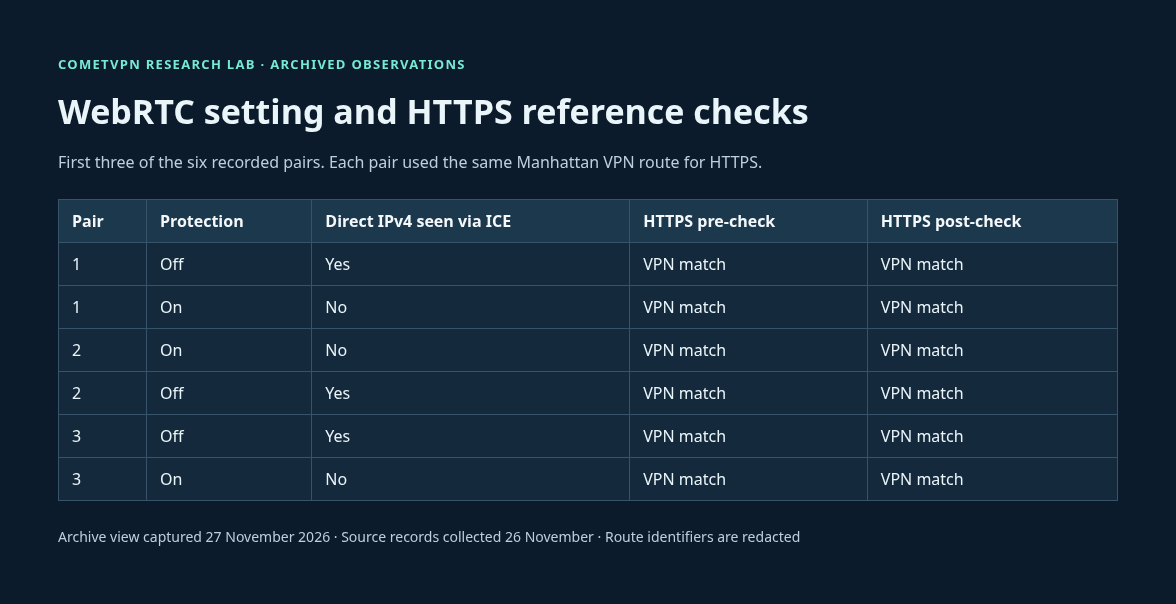
Group the evidence by pair, then compare the checked flag with directMatch. There should be exactly one row of each setting per pair. The two VPN flags make it possible to spot a setting trial whose browser HTTPS route changed as well.
The successful server-reflexive candidate in a direct or protection-off gather and its accompanying error both belong in the record. A completed gather with one successful address and one error differs from a gather with zero observed candidates. The study retained both rather than scoring from the error alone.
| Within-pair condition | Direct IPv4 seen via ICE | Gather complete | Same VPN before and after |
|---|---|---|---|
| Protection off | 6 of 6 | 6 of 6 | 6 of 6 |
| Protection on | 0 of 6 | 6 of 6 | 6 of 6 |
Research lab screenshots
अक्सर पूछे जाने वाले प्रश्न
Downloads, sources and citation
Suggested citation. FreePolicyTools. CometVPN WebRTC Protection On vs. Off: A Paired IP Leak Test. Original Research, November 26, 2026. Permanent article link.
FreePolicyTools may earn a commission if you purchase through this link.
Explore CometVPN plansRelated research
- CometVPN Browser Restart Test: The First Restored Request
- CometVPN City Switch Test: What Happened to an Open WebSocket?
- CometVPN City Selection vs. IP Geolocation in Two Databases
- CometVPN Firefox Per-Tab VPN Test: Three Tabs, Three Routes
- CometVPN Firefox Tab Test: Do Duplicated and Reopened Tabs Keep the VPN?
- CometVPN Firefox IP Rotation: 8 Trials, One Direct IP Result
- CometVPN browser IP rotation and recovery